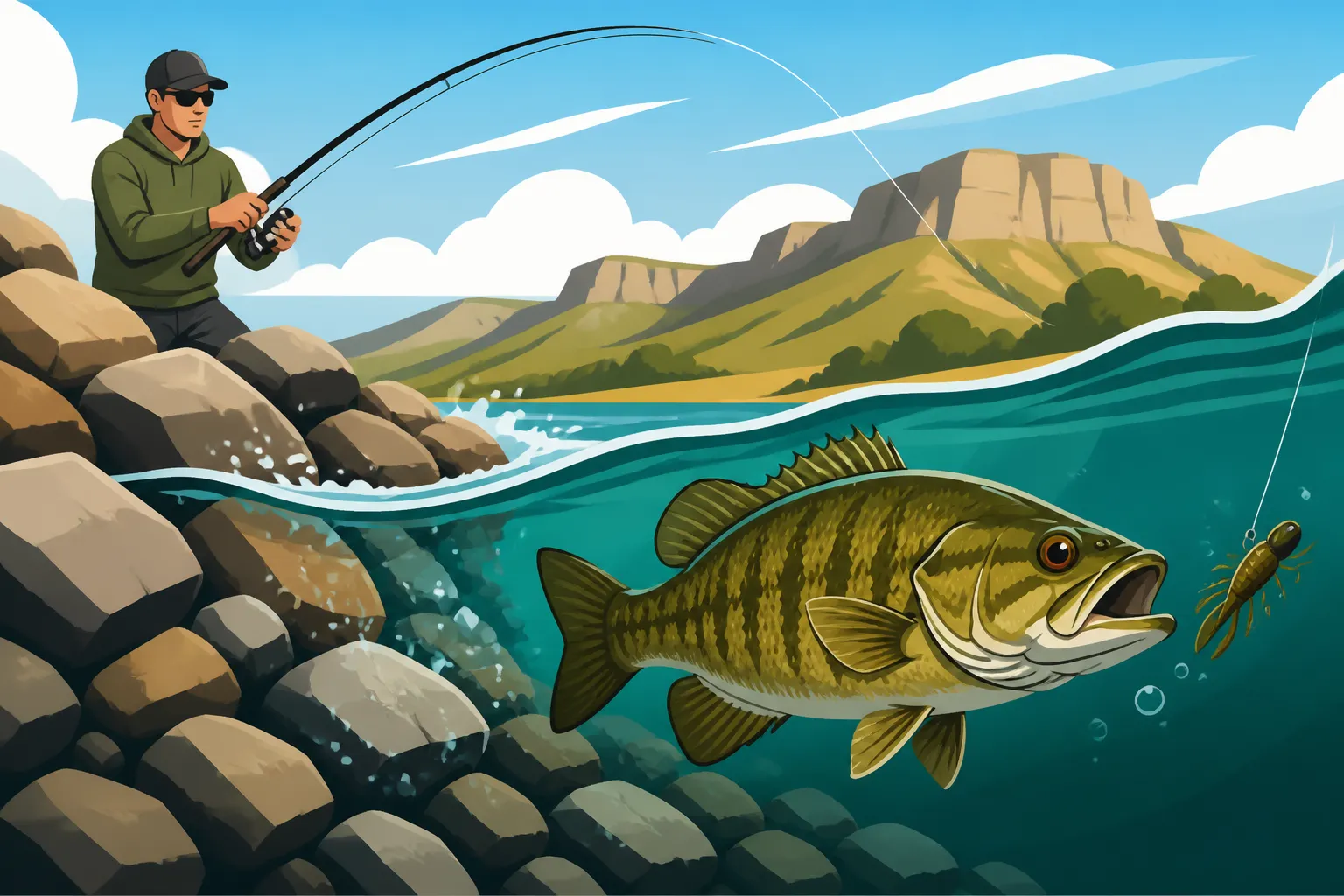
How to Fish Rock Piles for Smallmouth Bass
Many anglers get frustrated trying to pinpoint smallmouth bass, especially in vast South Dakota waters. They're often seen as elusive, disappearing just as you think you've found them, leading to a lot of wasted casts and head-scratching moments. But here's a secret that can dramatically change your luck: these bronze fighters absolutely adore rock piles, and once you understand why they gravitate to them and how to fish these structures effectively, your success rate will absolutely skyrocket. This comprehensive guide will dive deep into cracking the code of South Dakota's rock-dwelling smallmouth bass, helping you locate, target, and land these aggressive fish with confidence.
Why Smallmouth Bass Love South Dakota Rock Piles (And Why You Should Too!)
It's not just a coincidence that smallmouth bass seem to appear out of nowhere when you hit a rocky spot. There's a very good reason for it, and understanding their preferences is the first step to consistently catching them.
Understanding the Smallmouth's Habitat Preferences
Rock piles aren't just random clusters of submerged boulders; they are miniature ecosystems that offer everything a smallmouth bass could possibly want. Think of them as the perfect combination of a five-star restaurant, a fortified castle, and a comfortable temperature-controlled hotel all rolled into one. Smallmouth are incredibly visual predators, and these rocky havens provide countless ambush points where they can hide, dart out to grab an unsuspecting meal, and then quickly retreat to cover. These areas are teeming with prey items like crawfish, minnows, and various insect larvae that make for easy pickings, ensuring a steady food supply.
Beyond just food and safety, rocky structures play a crucial role in moderating water temperature. Rocks absorb and retain heat better than softer bottoms, which means they warm up faster in the spring and hold onto that warmth longer into the fall. This makes them thermal refuges, attracting smallmouth when they're looking for comfortable conditions. In deeper, clearer reservoirs, these features also create important current breaks and eddies, allowing fish to conserve energy while still being in a prime location to ambush prey drifting by. When you're dealing with vast, often uniform lakebeds found in some of South Dakota's larger reservoirs, a distinct rock pile sticking up can act like a giant magnet, concentrating fish in a relatively small and highly productive area.
Learning to identify these distinct features, whether through detailed bathymetric maps or your boat's sophisticated electronics, is truly half the battle. A good understanding of how water flows and interacts with submerged structure can also give you a significant edge. Imagine casting your line near a cluster of boulders that creates a gentle eddy; it's a textbook smallmouth hangout. The clearer the water, the more critical these visual breaks become for the bass, offering them security from predators from above while they hunt below.
Seasonal Movements Around Rocky Structures
Smallmouth bass aren't stagnant; they don't just hang out on any rock pile at any given time. Their behavior is incredibly seasonal, much like our own desire for comfort and good food changes throughout the year. Knowing these seasonal patterns will save you endless hours of casting into barren water and help you dial in your approach.
In the pre-spawn period, which typically spans from late April to early June depending heavily on water temperatures and specific lake conditions, smallmouth undertake a significant migration. They move from deeper wintering holes to shallower rock piles, often located adjacent to traditional spawning flats. These rock piles serve as critical staging areas where the bass feed heavily, gathering strength and energy before the arduous spawning process begins. They're like hungry athletes carbo-loading before a big race, incredibly aggressive and eager to strike.
During and immediately after the spawn, usually from late May through July, some fish will remain on these shallow rock piles, guarding nests or simply recovering from the rigors of reproduction. However, as summer fully kicks in and water temperatures rise significantly, many smallmouth will retreat to deeper rock piles or the deeper, cooler edges of shallower structures. They seek out thermoclines and more oxygenated water, trying to escape the warmer surface temperatures. This is when your ability to read depth and pinpoint submerged structure becomes absolutely paramount. As the days shorten and fall approaches, the smallmouth once again stage on rock piles, often deeper ones, gorging themselves on available forage in preparation for the long winter ahead. This is a fantastic time for aggressive presentations, as the fish are trying to pack on as much weight as possible. Understanding these cyclical movements is key to maximizing your time on the water, whether you're fishing in spring or fall, and is crucial to understanding South Dakota Fishing Seasons Explained.
Essential Gear for Targeting Smallmouth on Rocks
Fishing rock piles isn't just about finding the fish; it's about having the right tools to present your lures effectively and extract those powerful smallmouth once they bite. This kind of fishing can be tough on gear, so reliability and durability are paramount. For a comprehensive overview, you might also want to consult a South Dakota Fishing Gear Checklist.
Rod, Reel, and Line Setup for Rocky Terrain
When you're consistently bumping lures against jagged rocks, feeling for subtle bites, and battling strong fish that want to dive back into cover, your gear needs to be absolutely up to the task. It's a demanding environment, and a good setup makes all the difference. For moving baits like crankbaits and spinnerbaits, a medium-heavy action casting rod, typically between 6'6" and 7'0" in length, is often the sweet spot. This length provides excellent casting distance, which is often needed to reach distant rock piles, and crucially, enough backbone to muscle powerful fish away from snags without tearing the hook out. The medium-heavy action also offers a bit of forgiveness when a fish surges unexpectedly or you tick off a rock, helping prevent lost lures and broken lines. Pair this rod with a reliable baitcasting reel that has a decent gear ratio, somewhere in the 6.4:1 to 7.1:1 range. This allows for quick retrieves, which are essential for keeping crankbaits in the strike zone, and provides powerful torque for battling bigger smallmouth.
For more finessed presentations like jigs, tubes, and the popular Ned rig, which require a much more sensitive touch, a medium-light to medium power spinning rod, generally 6'9" to 7'3", with a fast or extra-fast action tip, will be your best friend. This setup allows you to feel even the most subtle bites and differentiate between a light tap from a fish and the texture of the bottom. Yet, it still has enough power in the butt section to drive a hook home effectively. A good quality spinning reel in the 2000-3000 size range is perfect for these applications. Spool it with 10-20 lb braided line, which offers incredible sensitivity and strength, and then tie on a 6-10 lb fluorocarbon leader. The braid transmits every bump and bite directly to your hands, while the fluorocarbon leader is virtually invisible underwater and, critically, provides excellent abrasion resistance against those unforgiving rocky edges. This combination allows you to confidently fish tricky structures without constantly worrying about your line failing. Many fantastic rod, reel, and line options can be found and compared on sites like Amazon, making it easy to find what fits your budget and fishing style.
Must-Have Lures for Cranking and Jigging Rocks
Your tackle box for targeting smallmouth on rock piles should be well-stocked with a versatile arsenal, capable of probing various depths and eliciting strikes from different moods of fish. The goal is to have lures that can either mimic the natural forage or provoke a reaction strike when bounced off the structure.
Deep-diving crankbaits are absolutely fantastic for covering water quickly and ticking the tops of submerged rock piles. The aggressive deflection off the rocks often triggers an impulsive reaction strike from opportunistic smallmouth. Look for crankbait models with durable bills that can withstand repeated collisions with rocks without breaking, and consider colors that mimic local forage like crawfish, perch, or shad, which are always a good bet in South Dakota waters. Brands like Strike King or Rapala offer excellent choices for this type of fishing.
Jigs, especially football jigs or skirted jigs paired with crawfish imitations, are incredibly deadly when slowly bounced and dragged along the bottom of rock piles. The unique shape of a football jig helps it to rock and wobble, enticing strikes, and its wide head helps it navigate over and around rocks with fewer snags than a traditional round head jig. The weed guard on skirted jigs is also a huge advantage in this snag-prone environment. Tube jigs are another smallmouth staple; they imitate crawfish or injured baitfish as they spiral down through the water column. A heavy jig head inserted inside the tube ensures it gets down to the structure quickly and accurately. Don't overlook the popular Ned rig – a small, buoyant worm rigged on a mushroom-shaped jig head. This finesse presentation can be absolutely irresistible to finicky smallmouth, especially when slowly dragged, hopped, or dead-sticked across the top of a rock pile. It's often the bait that gets a bite when nothing else will. For more insights on specific lure choices, a guide like Best Lures for South Dakota Walleye can offer some crossover ideas, as both species often respond to similar presentations on rocky bottoms. You'll find a wide selection of these effective lures on Amazon, making it convenient to fill your tackle box.
Mastering Techniques for Product productive Rock Pile Fishing
Finding the rock pile is one thing; fishing it effectively is another. It requires a combination of observation, technological assistance, and skillful lure presentation to consistently put smallmouth in the boat.
Reading the Water and Locating Key Rock Piles
Successfully locating productive rock piles is truly a blend of diligent research and on-the-water expertise. Start your planning by meticulously studying detailed lake maps or contour charts, either paper copies or digital versions on your favorite mapping app. Look for tell-tale signs: areas where the depth changes rapidly, where points extend out into deeper water, or where submerged humps and saddles are indicated. These topographical features are prime candidates for holding significant rocky structure. Remember, a contour line that shows a tight grouping indicates a steep drop-off or rise, often associated with rock.
Once you're actually on the water, your boat's electronics become your absolute best friend. A good quality fish finder or sonar unit can help you distinguish between a hard, rocky bottom and a softer, muddy or silty one. Advanced units with side imaging or down imaging can even render incredibly detailed images of distinct rock formations, individual boulders, and the transition zones where rock meets other bottom compositions. Look specifically for irregular shapes, sudden depth changes that suggest vertical structure, and, crucially, baitfish schools or prominent fish arches congregated directly around these structures. Mark any productive spots on your GPS with a waypoint so you can return to them with precision later, especially if you're fishing expansive waters like Lake Oahe or Lake Sharpe. Knowing how to interpret what you see on your screen is a skill that improves with practice, and guides like How to Read a Fish Finder for Walleye offer valuable insights that are highly applicable to bass fishing.
Don't just scan the middle of a massive rock pile; pay meticulous attention to the subtle nuances. Smallmouth often hold on the edges, breaks, and transition zones where rock meets mud, gravel, or sand. These less obvious spots are frequently where smallmouth prefer to stage or ambush prey, especially if there's a slight current. Sometimes, particularly in the clearer waters of the Black Hills lakes, you might even be able to spot visible rock piles, boulder fields, or rip-rap near the shoreline. Always remember that smallmouth bass, especially the larger, more experienced ones, tend to prefer specific parts of these structures depending on factors like sunlight penetration, current intensity, and the immediate presence of their preferred prey.
Presentation Strategies for Different Lure Types
Once you've located a promising rock pile, the next step is presenting your lure in a way that triggers a strike. Different lures demand different techniques, and mastering these nuances can be the difference between a slow day and a banner one. When you're throwing deep-diving crankbaits, the key is to make consistent contact with the rock pile itself. Let the lure dive until you feel it "tick" or "deflect" off a rock, then immediately pause your retrieve for a split second. This sudden, erratic action often mimics a fleeing or injured baitfish, which is incredibly effective at triggering violent reaction strikes from smallmouth. Vary your retrieve speed: sometimes a steady, grinding retrieve works best, other times a stop-and-go or even a rapid "burn-and-kill" tactic will be more effective. Experimentation is crucial, as the fish's mood can change throughout the day.
For jigs and tube baits, a slower, more methodical approach is usually the most productive. Cast your lure beyond the rock pile, allowing it ample time to sink all the way to the bottom. Once it's down, use short, subtle hops, slow drags, or gentle shakes of your rod tip to imitate a crawfish scuttling across the rocks or a baitfish struggling near the bottom. The key here is to maintain constant bottom contact while still allowing the lure to move naturally and enticingly. With a finesse presentation like the Ned rig, a subtle drag-and-pause motion often works wonders, letting the buoyant worm stand upright on the bottom, mimicking a feeding crawfish or a small, irresistible morsel. It's about coaxing a bite, not forcing it, and sometimes less action is more.
Remember, these precise presentation techniques are often discussed in comprehensive resources like the South Dakota Smallmouth Bass Fishing Guide, which offers even more detailed insights into various situations you might encounter. Pay very close attention to how the fish are biting; sometimes they'll hammer the lure with an unmistakable strike, while other times it might be just a subtle "thump," a feeling of unexpected weight on your line, or even just your line going slack as a fish picks it up while swimming towards you. Learning to differentiate these subtle cues is a skill that takes time but pays off immensely.
Handling Snags and Protecting Your Gear
Let's be realistic: fishing rock piles means you're going to get snagged. It's an inevitable fact of life when you're targeting fish in their favorite, snag-laden environments. The frustration of losing a favorite lure or breaking off a fish because of a snag is something every angler knows well. However, there are proactive ways to minimize that frustration and protect your valuable tackle. First, try to "read" your lure as it moves through the structure. If you feel it grinding deeply into a rock, or if its action abruptly stops, pause your retrieve immediately and give your line a little slack. Sometimes, a slight slack in the line will allow the lure to float up and over the obstruction, freeing itself. If it's truly stuck, try a few different maneuvers: slowly pull from various angles, give a sharp "bow-and-arrow" flick of your rod (pulling the rod back and releasing the line with your finger), or if you're in a boat, try to slowly move your boat to the opposite side of the snag, changing the angle of your pull.
Using braided line with a fluorocarbon leader, as discussed earlier, helps immensely in these situations. The incredible strength and lack of stretch in braided line can often help you free a lure that monofilament would simply snap off. Moreover, fluorocarbon, while more prone to abrasion than braid, is still quite durable and provides that crucial stealth factor near the lure. Investing in a good lure retriever can also save you a significant amount of money over time, paying for itself after just a few retrieved lures. These handy devices can often dislodge even deeply buried crankbaits or jigs. Finally, and this is critical, always, always check your line for frays or nicks after freeing a snag. Rocky edges are incredibly abrasive and can quickly weaken your line, turning a successful lure retrieval into a heartbreaking lost fish on the next bite. Many of these protective strategies are universally valuable, even detailed in articles like Best Fishing Rods and Reels for Walleye, as snagging is a common challenge across various species.
Top South Dakota Waters for Rocky Smallmouth Action
South Dakota might be famous for its walleye, but it also holds some truly phenomenal smallmouth bass fishing, especially if you know where to look for those coveted rock piles.
Missouri River System Reservoirs
South Dakota's magnificent stretch of the Missouri River, which includes the expansive Lakes Oahe, Sharpe, Francis Case, and Lewis and Clark Lake, is truly a smallmouth haven, and its abundant rock piles are a huge reason why. These massive impoundments, formed by a series of dams, feature countless rocky points, submerged islands, rip-rap shorelines, and extensive underwater rubble fields. All of these offer diverse and attractive rocky structures that are absolutely loaded with smallmouth bass. Each reservoir has its unique character, but the common thread is the prevalence of excellent rocky habitat.
Lake Sharpe, in particular, stands out for its relatively clear waters and abundant forage base, which contribute to its reputation for fantastic smallmouth fishing. You'll find incredible opportunities around its many rocky shorelines, prominent points, and submerged humps, especially in areas like those near Big Bend Dam. Many anglers find consistent success here by working jigs and crankbaits along these structures. Lake Francis Case is another prime example, renowned for its strong smallmouth population. The numerous rocky bluffs, underwater rubble fields, and former creek channels now filled with rock throughout this reservoir provide endless opportunities for anglers seeking bronzebacks. You'll encounter different rock compositions, ranging from massive boulders to smaller gravel, and understanding which types hold fish at different times of the year is part of the exciting challenge and the ultimate reward. For specific hotspots and techniques in these waters, you might want to delve into resources like Lake Francis Case Smallmouth Bass Fishing or Lake Sharpe Smallmouth Bass Near Big Bend Dam. The Missouri River system truly offers a vast playground for the rock-pile enthusiast.
Black Hills Lakes
While the picturesque Black Hills region of South Dakota is often primarily synonymous with phenomenal trout fishing in its pristine streams, some of its larger, deeper lakes also offer truly excellent smallmouth bass opportunities. This is particularly true in waters where rocky bottoms and clear conditions prevail, providing the ideal habitat for these aggressive fish.
Pactola Reservoir, for instance, known for its deep, exceptionally clear waters and stunning scenery, boasts numerous rocky points, submerged humps, and intricate underwater structures that consistently hold strong populations of smallmouth. The visibility in Pactola often necessitates more subtle presentations, but the rewards can be substantial. Similarly, Sheridan Lake, another gem nestled in the Black Hills, offers very good smallmouth fishing around its rocky shores, deep ledges, and other structural elements. These clear, often cooler lakes, with their healthy forage bases, allow smallmouth to thrive and grow to impressive sizes. The fundamental techniques for fishing rock piles here are largely the same as on the expansive Missouri River system, though the terrain might be steeper, the water even clearer, or the cover more sparse. Always, always consult local regulations and understand specific water body rules, as Smallmouth Bass Daily Limits can vary, and it's absolutely essential to stay compliant with all state and local guidelines. Whether you're a local angler seeking new challenges or an out-of-state visitor looking to experience the diverse fishing South Dakota offers, exploring these Black Hills lakes for smallmouth is a rewarding and beautiful experience. Also remember that the Best Time of Year to Fish in South Dakota can influence smallmouth activity even in these cooler, higher-elevation lakes.
| Lure Type | Ideal Depth | Key Presentation | Pros | Cons |
|---|---|---|---|---|
| Deep-Diving Crankbait | Mid-Deep (8-20 ft) | Aggressive retrieve, deflect off rocks | Covers water quickly, triggers reaction strikes | Prone to snagging, less finesse |
| Football Jig | Bottom (all depths) | Drag, hop, shake | Mimics crawfish, excellent bottom feel | Can snag in very heavy cover, slower retrieve |
| Tube Jig | Bottom (all depths) | Hop, drag, spiral fall | Versatile, imitates baitfish/crawfish | Can be chewed up quickly by aggressive fish |
| Ned Rig | Bottom (all depths) | Drag, pause, subtle shakes | Finesse presentation, high hook-up ratio | Very subtle, requires patience and slow retrieve |
| Spinnerbait | Shallow-Mid (0-15 ft) | Steady retrieve, stop-and-go | Good for cover, flashes and vibrates effectively | Less effective in very deep water or precise bottom contact |
| Swimbait | Mid-Column | Steady retrieve, slow roll | Realistic baitfish imitation, versatile | Can be expensive, less snag-resistant |
Disclaimer
This article is for general informational purposes only and does not constitute professional advice. Laws, prices and regulations vary by location and change over time. Consult a qualified professional for guidance on your specific situation.