South Dakota State Record Chinook Salmon Weight
Every angler who's ever cast a line into the deep, cold waters of Lake Oahe has probably dreamt of it: the line screaming, the rod bending double, and the eventual surfacing of a truly monstrous fish. For those chasing Chinook salmon in South Dakota, that dream often revolves around not just a big catch, but a record-breaking one. This guide isn't just about a number; it's about the legend, the pursuit, and what it truly means to hold the title of the heaviest Chinook salmon ever caught in our great state.
The Allure of a State Record Chinook Salmon
There's something deeply primal about the pursuit of a record fish. It's not just about bragging rights, although those are certainly a part of it! It's about pitting your skill, your patience, and your gear against nature's finest, hoping to connect with a fish that stands out among millions. For Chinook salmon, especially in South Dakota, that pursuit takes on an almost mythical quality. These powerful, ocean-going fish, thriving in the vast, deep waters of Lake Oahe, represent the pinnacle of freshwater sportfishing for many.
Think about it: decades of fishing, countless hours on the water, enduring all kinds of weather, all for that one bite, that one fight, that one fish that could etch your name into the state's angling history books. It’s an inspiring thought, isn't it? It pushes anglers to refine their techniques, invest in top-tier equipment (many find great deals on specialized gear like downriggers and heavy-duty rods on Amazon), and truly understand the nuances of the water they fish. The state record isn't just a weight; it's a testament to dedication and, let's be honest, a little bit of pure, unadulterated luck. It sets a benchmark, inspiring both seasoned veterans and eager newcomers to chase greatness on the water.
Understanding Chinook Salmon in South Dakota
Before we dive into the specifics of a record, it's essential to understand the journey of Chinook salmon in South Dakota. These aren't native fish to our prairie state; they are an incredible success story of careful management and stocking efforts by the South Dakota Game, Fish and Parks (GFP). Originally introduced to provide a unique, large game fish opportunity, particularly in the deep, cold waters of Lake Oahe, they've become a cherished part of our state's diverse fishery.
The success of the Chinook salmon program hinges on several factors, including the availability of forage fish like smelt, which provide the rich diet these salmon need to grow to impressive sizes. Without a robust smelt population, the salmon simply wouldn't thrive, let alone reach record-breaking dimensions. The colder, deeper sections of Lake Oahe offer the ideal habitat for these cold-water giants, mimicking some of the conditions they'd find in their native Pacific Northwest. Anglers often spend considerable time learning the intricacies of South Dakota Chinook Salmon Stocking History to better understand where and when to target these magnificent fish.
The Life Cycle and Growth of Oahe Salmon
Chinook salmon, often called "Kings" by anglers, have a fascinating life cycle. Stocked as fingerlings, they spend several years in Lake Oahe, growing rapidly on the abundant forage. Unlike many other species, they are anadromous in nature, meaning they typically migrate from freshwater to saltwater to mature, then return to freshwater to spawn and die. In landlocked environments like Lake Oahe, they still exhibit this spawning run behavior, making their way up tributaries or to specific areas in the lake during the fall. This is why areas like Whitlock Bay become famous during the Chinook Salmon Spawning Time on Lake Oahe, offering unique opportunities for anglers.
Their growth rate can be astonishing. A young salmon, once released, will spend its life gorging on smelt, packing on pounds rapidly. The combination of plentiful food, deep cold water, and excellent genetics from the stocking program allows some individuals to achieve truly colossal sizes. It's these particular fish, the ones that manage to evade predators, survive the angler's hook for years, and find the best feeding grounds, that have the potential to challenge state records. They're like the elite athletes of the fish world, constantly pushing their limits.
Prime Habitat and Key Locations
When you're dreaming of a record Chinook, you're almost certainly thinking of Lake Oahe. This massive reservoir, stretching over 230 miles along the Missouri River, offers the deep, cold water and ample forage necessary for these fish to thrive. While Chinook can be found throughout the lake, certain areas are renowned for producing larger specimens and higher concentrations of fish. The upper reaches of Lake Oahe, particularly near the Cheyenne River arm and around Whitlock Bay, are often talked about in hushed tones among salmon enthusiasts.
These areas combine deeper water access with contours and structures that hold baitfish, creating perfect ambush points for hungry salmon. During the fall spawning runs, the salmon congregate, becoming more accessible to anglers, both those trolling offshore and those casting from shore. Knowing the lake's topography, understanding baitfish movements, and keeping an eye on water temperature are all critical for finding these elusive giants. For detailed information on finding these fish, anglers often consult guides like Lake Oahe Chinook Salmon Fishing at Whitlock Bay.
The Moment of Truth: Landing a Potential Record
Catching any big fish is thrilling, but reeling in a potential state record Chinook salmon is an experience that transcends mere excitement. It's a grueling battle that tests both angler and gear to their absolute limits. These fish are renowned for their powerful runs, deep dives, and head shakes that can easily throw a hook or snap a line. You need more than just good luck; you need preparation, skill, and a touch of grit.
Techniques and Gear for Trophy Salmon
Targeting trophy Chinook salmon in Lake Oahe primarily involves trolling. This method allows anglers to cover vast expanses of water and present lures at precise depths where salmon are feeding. Specialized equipment is a must. You'll need heavy-duty trolling rods, capable of handling the immense strain of a fighting salmon and the drag of lead core lines or downriggers. These setups allow you to get your baits down to where the salmon are, often hundreds of feet deep in Lake Oahe's thermocline.
Popular lures include large spoons, plugs, and flasher/fly combinations, often in vibrant colors that mimic baitfish. Many anglers experiment with different brands and styles, stocking up on their favorites from retailers like Amazon. Line choice is also critical; strong monofilament or braided line with a fluorocarbon leader is common. The whole setup is designed for brute strength and durability because when a massive King salmon hits, it hits hard. If you're looking to refine your approach, a deeper dive into South Dakota Chinook Salmon Trolling Techniques can be incredibly helpful.
The Fight: A Test of Endurance
When a Chinook hits, there's no mistaking it. The rod doubles over, and the reel screams as hundreds of feet of line peel off in seconds. These fish are incredible athletes, capable of sustained, powerful runs. The fight can last anywhere from 15 minutes to well over an hour, depending on the size of the fish and the angler's skill. You have to maintain constant pressure, pump the rod to gain line, and be prepared for sudden changes in direction. Losing focus for even a second can mean losing the fish.
Many a record-contender has been lost boatside because the angler wasn't prepared for that final surge of energy. Having a large, sturdy net ready, operated by a calm and experienced fishing buddy, is absolutely crucial. A good net can mean the difference between landing a fish of a lifetime and telling a heartbreaking "one that got away" story.
The Official Process for Reporting a Record Fish
So, you've landed a fish that looks like it could be a contender. What now? The process for officially reporting a state record is rigorous, and for good reason. It ensures the integrity of the record book.
Here's a general overview of the steps involved:
- Weighing: The fish must be weighed on a certified scale. This usually means a scale found at a post office, grocery store, or other commercial establishment that is regularly inspected and certified for accuracy. Your digital scale from Amazon, however accurate it feels, won't cut it for official purposes.
- Witnesses: Ideally, you'll have witnesses present during the weighing process.
- Measurement: Accurate length and girth measurements are typically required.
- Species Identification: A qualified biologist or Game, Fish and Parks official must confirm the species. This is particularly important for species that might be mistaken for others.
- Documentation: Photos are vital – clear shots of the fish, the angler, and the scale reading.
- Application: You'll need to fill out an official record application with the South Dakota Game, Fish and Parks.
Failing to follow any of these steps precisely can lead to disqualification, no matter how large your fish is. It's a detail-oriented process that respects the significance of a state record. Knowing these requirements beforehand is paramount, so reviewing resources like the South Dakota GFP Fishing Handbook Guide is always a good idea.
The South Dakota State Record Chinook Salmon
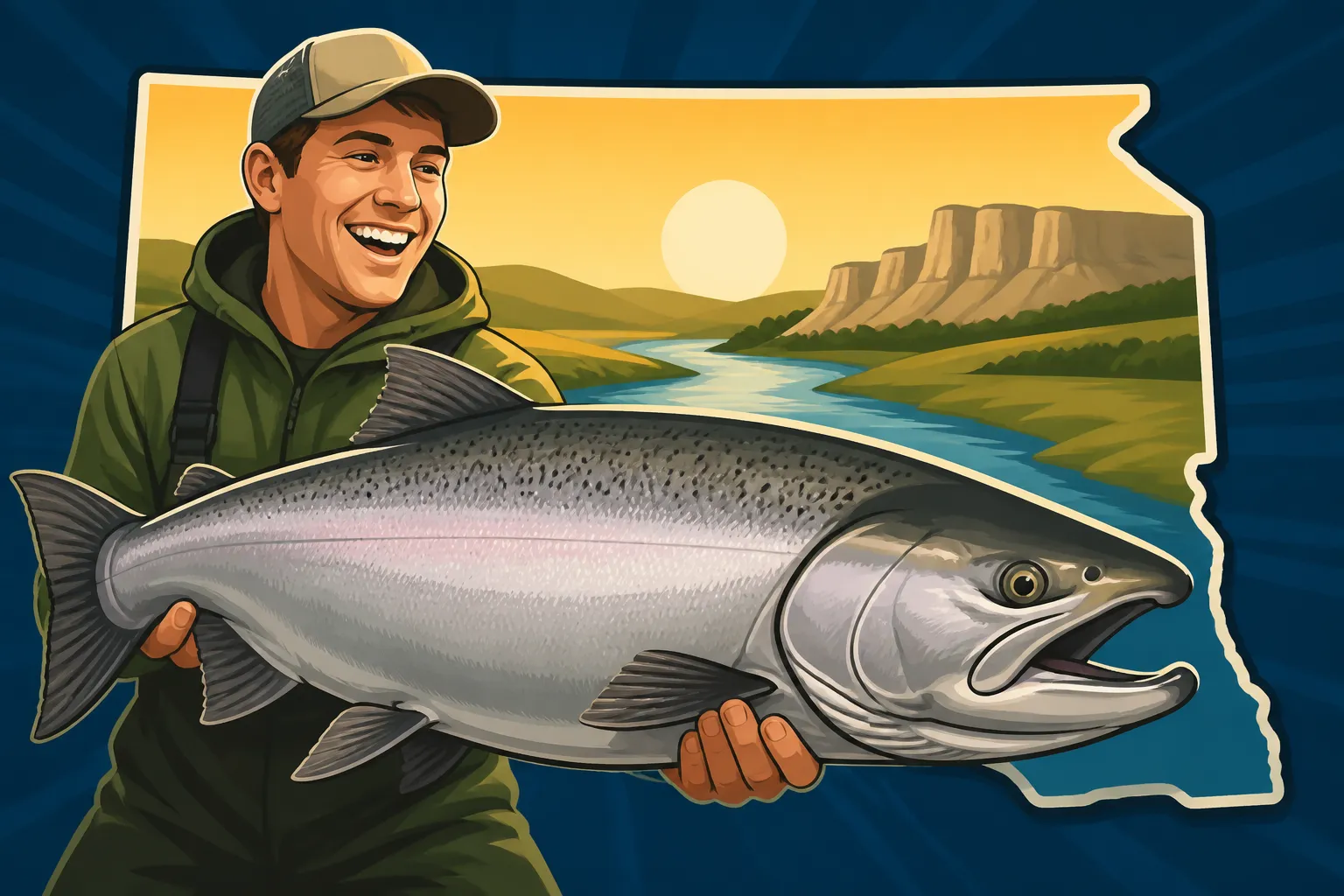
Now, for the moment you've been waiting for! The current South Dakota state record for Chinook salmon is an absolute monster of a fish, a true testament to the fantastic fishery we have in Lake Oahe. This incredible specimen weighed in at 35 pounds, 13 ounces.
Just imagine that! Nearly 36 pounds of pure, fighting power. When you're out on the water, whether you're fly fishing in the Black Hills or jigging for walleye on Lake Sharpe, a fish of this magnitude is the kind of legend that drives you. It wasn't just a big fish; it was an exceptional one, a culmination of years of growth in the deep, cold waters of Lake Oahe and an incredible angling achievement. This record-setting Chinook was caught on Lake Oahe, solidifying its reputation as the premier destination for these magnificent fish in South Dakota.
The Legacy of the Record
A record like this isn't just about a single fish or a single angler. It has a ripple effect throughout the entire South Dakota fishing community. It fuels dreams, encourages new anglers to try their hand at salmon fishing, and reaffirms the incredible quality of the state's natural resources and fish management programs. It puts South Dakota on the map as a serious destination for those chasing large, powerful freshwater salmon.
This record fish also serves as a benchmark for the health of the Lake Oahe ecosystem. For a salmon to reach such a monumental size, it requires a healthy food chain, pristine water quality, and successful stocking efforts over many years. It tells us that the lake is doing its job, providing the perfect environment for these powerful fish to thrive. It’s a point of pride for everyone involved in South Dakota fishing, from the biologists to the local bait shop owners.
The Challenge of Breaking the Record
Breaking the existing state record for Chinook salmon is no easy feat. That 35-pound, 13-ounce mark is a high bar, one that requires a combination of perfect conditions, exceptional skill, and a healthy dose of pure luck. Anglers who set their sights on this challenge are typically very experienced, dedicating countless hours to understanding salmon behavior, migration patterns, and preferred feeding depths. They often invest heavily in specialized electronics and sophisticated trolling setups, sometimes even upgrading their entire boat to handle the vastness of Lake Oahe and the power of these fish.
The pursuit often involves meticulously tracking reports, studying past successes, and adapting techniques to ever-changing lake conditions. It's a long game, a true angling marathon, where perseverance is just as important as skill. Every year, anglers head out with the hope that this will be the season they encounter that one in a million fish, the King of Kings, that could rewrite the record books. It's a constant reminder that nature always holds a few surprises, and the next record-breaker is always out there, swimming in the depths of Lake Oahe.
Here's a quick look at what it takes to get on the record books:
| Step | Description | Key Requirement |
|---|---|---|
| Catching the Fish | Landing an exceptionally large Chinook salmon that appears to exceed the current record. | Skill, patience, appropriate gear (e.g., strong trolling rods, reliable reels), and luck. |
| Initial Assessment | Quickly determining if the fish is a potential record based on its size and your knowledge of the current record. | Awareness of current state records, visual estimation. |
| Proper Handling & Preservation | Keeping the fish in the best possible condition (e.g., in a cooler with ice) to maintain its weight and integrity until official measurement. | Large cooler, plenty of ice, careful handling. |
| Locating a Certified Scale | Finding a legally certified scale (e.g., post office, grocery store, certified butcher shop) that is regularly calibrated and inspected. Personal scales are not accepted. | Research certified scale locations beforehand. |
| Official Weighing & Measuring | Weighing the fish on the certified scale with witnesses, obtaining accurate length and girth measurements. | Certified scale, witnesses, tape measure. |
| Species Verification | Having the fish identified by a South Dakota Game, Fish and Parks biologist or official to confirm it is indeed a Chinook salmon. This is crucial to avoid misidentification. | Contact GFP immediately, clear photos for initial assessment. |
| Photo Documentation | Taking clear, well-lit photographs of the fish, especially with the angler, on the scale (showing the weight), and close-ups for identification. | High-resolution camera or smartphone. |
| Submitting Application | Completing and submitting the official state record application form to the South Dakota Game, Fish and Parks. | Access to application form, accurate completion of details. |
This entire process, from the first strike to the final approval, is a journey in itself, and it adds another layer to the legendary status of a state record fish. The pursuit of South Dakota Walleye World Record or South Dakota Northern Pike Record Sizes involves similar steps, proving that dedication is key across all species.
Beyond the Record: The Joy of Chinook Fishing
While chasing the state record is an exhilarating goal, it's important to remember that the true joy of Chinook salmon fishing in South Dakota extends far beyond any number on a scale. It's about the entire experience: the vast beauty of Lake Oahe, the camaraderie with fishing partners, the thrill of the strike, and the sheer power of these magnificent fish.
Whether you're trolling with downriggers or trying your hand at Casting for Salmon From Shore during the spawn, every Chinook you hook is a memorable battle. The beautiful silver flanks, the sheer size, and the powerful fight make them a premier sportfish. Even if you never land a record, the experience of battling a 10, 15, or even 20-pound King salmon is something you'll cherish for a lifetime. It's about getting out on the water, enjoying nature, and creating lasting memories. And for many, simply knowing that a record-setting leviathan swims in those same waters is inspiration enough to keep coming back, season after season.
Respecting the Resource
As anglers, we have a responsibility to protect the very resource that brings us so much joy. Responsible fishing practices, adhering to South Dakota Fishing Regulations Explained and South Dakota Fish Limits and Size Restrictions, and practicing proper catch-and-release when appropriate, are crucial. This ensures that future generations of anglers will also have the opportunity to chase their own dream fish, whether it's a state record Chinook or simply a delicious walleye for the dinner table.
The South Dakota GFP works tirelessly to manage these fisheries, from stocking programs to habitat protection, and our participation in these efforts is vital. Knowing how to correctly handle a fish, especially a large one you intend to release, minimizes stress and increases its chances of survival. Using appropriate gear, like a large net to land a big salmon, helps prevent injury to the fish before release. It's all part of being a good steward of the incredible fishing opportunities we're so fortunate to have in South Dakota.
Disclaimer
This article is for general informational purposes only and does not constitute professional advice. Laws, prices and regulations vary by location and change over time. Consult a qualified professional for guidance on your specific situation.