How to Tell a Largemouth Bass From a Smallmouth Bass
For many folks who love casting a line in South Dakota, there’s a common moment of confusion that happens right when you reel in a beautiful bass: "Is this a largemouth or a smallmouth?" It can be genuinely tricky to tell them apart, especially when you're caught up in the excitement of a catch. This guide is here to walk you through the distinct features and habits of both species, ensuring you can confidently identify your bass and understand their world better.
The Tale of Two Bass: Why It Matters to Anglers
South Dakota's waters are home to both the robust Largemouth Bass and the spirited Smallmouth Bass, and while they share the "bass" moniker, they are truly different creatures. Knowing how to distinguish them isn't just about bragging rights; it's fundamental to understanding where to find them, what tackle to use, and even what regulations apply to your catch. Their preferred habitats, diets, and fighting styles are as distinct as their appearances.
Beyond Just a Name: Different Habits, Different Tactics
Imagine heading out to Lake Sharpe or Lake Oahe with a specific game plan for bass. If you're targeting largemouths, you'll be looking for dense weed beds, submerged timber, or shady docks. You'll likely be flipping jigs or casting spinnerbaits into thick cover. But if smallmouths are your quarry, your focus shifts dramatically to rocky points, gravel bars, and areas with current, where tube jigs, crankbaits, or Ned rigs might be more effective.
This difference in strategy isn't just preference; it's a necessity. A bait perfectly suited for a largemouth hiding in lily pads would be largely ineffective for a smallmouth cruising rocky ledges in cooler, clearer water. The entire approach, from your lure selection to your casting technique, is dictated by which bass species you're pursuing. It’s why understanding their habits is crucial for any angler hoping for consistent success on the water.
Beyond the actual fishing, knowing the species can sometimes impact your legal responsibilities. While many regulations are universal, specific bodies of water or special management zones might have differing length or daily limits for one species over the other. Always check the South Dakota Fishing Regulations Explained or the current South Dakota GFP Fishing Handbook Guide to ensure you're in compliance. This knowledge safeguards you from accidental violations and helps support sustainable fishing practices.
South Dakota's Bass Landscape: Where Each Species Thrives
In South Dakota, these two bass species generally occupy different niches, though there can be some overlap, particularly in the vast Missouri River reservoirs. Largemouth Bass tend to prefer the warmer, shallower, and often murkier waters, rich with aquatic vegetation and submerged wood. Think of the back bays of Lewis and Clark Lake or slower stretches of smaller impoundments in eastern South Dakota. They are ambush predators, perfectly designed to hide in cover and explode on unsuspecting prey.
On the other hand, Smallmouth Bass are creatures of clearer, cooler, and rockier environments. The mainstem Missouri River reservoirs like Lake Oahe, Lake Sharpe, and Lake Francis Case, with their abundant riprap, rocky points, and current, are prime smallmouth territory. You'll often find them chasing baitfish in open water or hiding amongst boulders. The Black Hills region, with its pristine lakes and streams, can also host impressive smallmouth populations in certain areas, drawn to the colder water and rocky structures.
Understanding these general preferences allows you to "read" the water and predict which species you're more likely to encounter. If you're fishing a deep, clear main lake point on Lake Sharpe, you're probably going to be setting up for a smallmouth. Conversely, if you're working a shallow, weedy bay on a smaller glacial lake, you're definitely thinking largemouth. This mental map is invaluable for saving time and increasing your chances of a bite.
Key Identification Markers: What to Look For
When that fish is finally in your hands, take a moment to observe its distinct characteristics. While some features can be subtle, there are a few tell-tale signs that will quickly reveal whether you've got a largemouth or a smallmouth. Getting to know these specific markers will make you a much more informed angler, even if you're just enjoying a day of South Dakota Smallmouth Bass Fishing Guide or targeting their larger-mouthed cousins.
The Mouth: A Definitive Feature
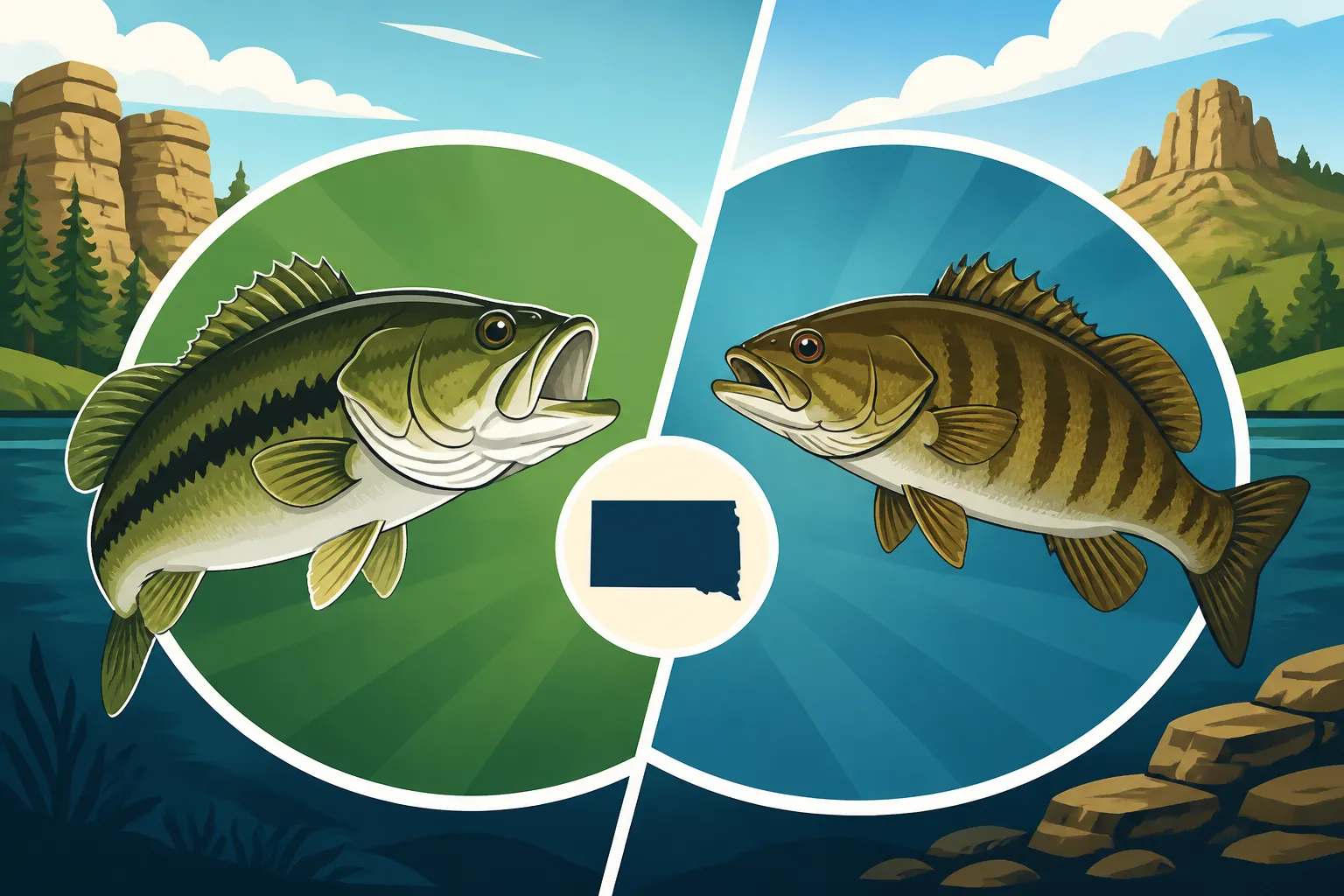
Without a doubt, the easiest and most reliable way to tell these two bass apart is by examining their mouth. The clue is right there in their names! For a Largemouth Bass, if you close its mouth, the hinge of its jaw (the maxillary bone) will extend significantly past the back of its eye. It's almost comically large, giving it that characteristic "bucketmouth" appearance. This large mouth is perfectly adapted for swallowing bigger prey whole, making them formidable predators in their habitat.
Now, for the Smallmouth Bass, it’s a different story. When its mouth is closed, the hinge of the jaw will only extend to about the middle of its eye, or at most, directly underneath it. It won't go past the back edge of the eye. This more compact mouth is still incredibly efficient for hunting, but it's a clear visual distinction from its largemouth cousin. If you're ever in doubt, just grab the fish gently by its lower jaw, hold it horizontally, and check that jawline against the eye. This one trick alone will resolve most of your bass identification questions.
Practically speaking, this difference in mouth size also influences how they strike baits. Largemouths can engulf larger lures and plastics, while smallmouths, with their smaller mouths, tend to prefer more compact baits or will often "suck in" a bait rather than fully engulfing it. This can mean a more subtle bite for smallmouths, often feeling like a light tap or a sudden increase in weight on your line, whereas a largemouth strike can be more aggressive and unmistakable.
Body Shape and Coloration: More Than Skin Deep
Beyond the mouth, their overall body shape and coloration offer strong clues. Largemouth Bass typically have a more elongated, somewhat cylindrical body, often described as football-shaped, especially when they're well-fed. Their coloring tends to be a darker green, transitioning to a lighter belly, and they often feature a prominent, irregular horizontal stripe or blotchy pattern running along their side. This lateral line can sometimes appear as a series of distinct dark splotches rather than a continuous stripe, and it might be more pronounced or faded depending on the water clarity and background of their habitat.
Smallmouth Bass, on the other hand, boast a more compact, muscular, and "bronze" appearance. Their coloration is usually a golden-brown or bronze, sometimes with vertical dark bars or stripes on their sides, rather than a horizontal one. These bars are often more distinct in clear water or when the fish is excited. Their eyes also tend to be a reddish-orange color, adding to their distinctive look. They feel dense and powerful for their size, a testament to their life in currents and rocky environments.
Consider the environment these fish live in. The mottled green of a largemouth helps it blend into the weedy, shady cover it prefers, allowing it to ambush prey. The bronze, barred pattern of a smallmouth, however, provides excellent camouflage against rocky bottoms and gravel, where light conditions can vary significantly with depth. These evolutionary adaptations are not just aesthetic; they are critical for their survival as predators in their respective domains. Many anglers even find that the fight of a smallmouth feels more intense, with more jumps and headshakes, reflecting their powerful, compact build.
Dorsal Fins: The Spiny and Soft Story
Another key identifier lies in their dorsal fins – the fin on their back. The dorsal fin on both bass species is actually two fins connected, a spiny front section and a soft-rayed rear section. For a Largemouth Bass, there is a very deep, almost complete, separation between the spiny front dorsal fin and the soft-rayed rear dorsal fin. If you were to press on it, you'd feel a clear notch, making it look almost like two distinct fins connected by a thin membrane.
The Smallmouth Bass, conversely, has a more continuous dorsal fin. While there is still a division between the spiny and soft-rayed sections, it’s much less pronounced. The notch is shallower, creating a more uniform appearance across the top of its back. This difference is subtle but consistent and can be a definitive clue, especially if you're having trouble with the mouth identification or the fish's coloration is unclear due to water conditions or stress.
Examining the dorsal fin is a great secondary check. Gently extending the fin will make this characteristic notch more apparent. This detail, combined with the mouth and coloration, gives you three reliable methods to confidently identify your catch. Knowing these anatomical differences helps you appreciate the biodiversity in South Dakota's waters and respects the unique biology of each species.
Habitat and Behavior Clues: Where to Find Them
Understanding where these bass prefer to live and how they behave is just as important as knowing their physical features. After all, if you can predict which bass species will be in a particular area, you've already won half the battle. This knowledge guides your fishing choices, from choosing a Best Rod Length for Trolling Walleye to knowing what kind of structure to target specifically for bass.
Largemouth: Masters of the Weeds and Structure
Largemouth Bass are classic ambush predators, and their preferred habitats reflect this strategy perfectly. You'll find them lurking in thick cover – think dense beds of cattails, lily pads, submerged hydrilla, coontail, or milfoil. They love wood, too, whether it's fallen trees, stump fields, or old dock pilings. Any kind of shade or structure that offers a place to hide and wait for unsuspecting prey is prime largemouth territory. These areas provide both camouflage and a buffet of smaller fish, frogs, and insects.
When fishing for largemouths, focus your efforts on these types of areas. Pitching a weedless jig into the thickest cover, slowly working a plastic worm along a submerged log, or casting a topwater frog over lily pads are all quintessential largemouth tactics. They aren't usually found in strong currents or over vast open flats, preferring the security and hunting opportunities presented by complex structures and vegetation. If you're exploring a new lake or reservoir in South Dakota, scanning for these obvious covers will lead you directly to where the largemouths are likely hiding.
Their behavior is also dictated by this preference for cover. Largemouths often strike aggressively from hiding, making for exciting, powerful takes. They'll use their broad bodies and the structure around them to fight, often trying to bury themselves back into the weeds or wrap your line around timber. This makes for a challenging but rewarding fight, requiring stout tackle and quick reactions to pull them out of the thick stuff. You might even find yourself buying extra heavy-duty jigs or Texas rigs on Amazon to handle these powerful fish.
Smallmouth: Rock Lovers and Current Dwellers
Smallmouth Bass, the "bronze backs" of South Dakota, are built for a different kind of fight and a different kind of home. Their strong, compact bodies and keen eyesight make them perfectly suited for life in clearer, cooler waters with rocky bottoms and current. Think of the expansive riprap along the Missouri River reservoirs, rocky points that drop off into deeper water, gravel bars, and current seams below dams. These areas are rich in crayfish and baitfish, which are staples of the smallmouth diet.
When you're targeting smallmouths, you'll want to focus on these hard-bottom areas. Drop-shot rigs, Ned rigs, tube jigs, and crankbaits that mimic crayfish or small baitfish are often highly effective. Smallmouths are less about ambush from dense cover and more about actively cruising and hunting. They will often school up, especially during feeding frenzies, making it possible to catch several from one productive rocky point. Check out articles like Smallmouth Bass Fishing Techniques for Rocky Shorelines for more in-depth strategies.
Their fighting style is legendary – they are known for their acrobatic jumps and powerful runs, especially in current. Unlike largemouths, who often try to dive into cover, smallmouths tend to fight in open water, using their strength and the water resistance to their advantage. This makes for a thrilling battle, often involving multiple aerial displays. They are truly one of the most exciting fish to catch in South Dakota, and understanding their preferred habitat is the first step to finding them.
Differences in Diet and Aggression
The distinct habitats of largemouth and smallmouth bass naturally lead to differences in their diet. Largemouth Bass, residing in vegetated and woody cover, have a broader diet that includes not only baitfish like shad and minnows but also frogs, snakes, ducklings, and even small mammals that fall into the water. Their large mouth allows them to consume a wide variety of prey, making them opportunistic feeders. This adaptability makes them susceptible to a vast array of lures that imitate various prey items. You'll find many specialty lures for these types of prey available on Amazon.
Smallmouth Bass, on the other hand, have a more specific diet largely centered around crustaceans and baitfish found in their rocky, clear-water environments. Crayfish are a huge part of a smallmouth's diet, and lures designed to imitate these bottom-dwelling creatures are often incredibly effective. Shiners, various minnows, and insect larvae also make up a significant portion of their meals. Their smaller, more precise mouths are well-suited for picking off these smaller prey items from rocky crevices or chasing down schools of baitfish in open water. This diet influences what baits you should present to them. For specific information, you can always consult a detailed guide on South Dakota Fish Species Diet by Season.
In terms of aggression, both species are formidable predators, but their typical "mood" can differ. Largemouths, especially when guarding a nest or ambushing from cover, can strike with explosive, almost reckless abandon. They often hit a lure with incredible force, taking it directly into their large mouth. Smallmouths, while certainly aggressive, often exhibit a more calculated chase. They might follow a bait for a distance before committing, and their strike can feel like a solid thud or simply a heavy weight on the line, rather than the violent lunge of a largemouth. However, once hooked, smallmouths are known for their unrelenting fight, often jumping and pulling hard until the very end.
Practical Tips for On-the-Water Identification
Being able to quickly and accurately identify your bass while out on the water in South Dakota can save you time, ensure you're following regulations, and even help you refine your fishing strategy for the day. It’s a skill that comes with practice, but with these tips, you'll be a pro in no time.
The Quick Check: Mouth, Color, and Fin
When you land a bass, run through this mental checklist for a rapid identification:
- Mouth Test: The absolute first thing to check. Gently close the fish's mouth. Does the hinge of the jaw extend past the back of the eye (Largemouth) or stop at or before the middle of the eye (Smallmouth)? This is almost always the most reliable indicator.
- Color and Pattern: Look at the body coloration. Is it a darker, olive green with a prominent horizontal stripe or series of blotches (Largemouth)? Or is it a bronze to golden-brown with vertical bars or stripes (Smallmouth)? Also, note the eye color – reddish eyes are often a smallmouth trait.
- Dorsal Fin: While often more subtle, check the dorsal fin. Is there a deep, distinct notch between the spiny and soft-rayed sections (Largemouth)? Or is the notch shallower, making the fin appear more continuous (Smallmouth)?
By quickly running through these three points, you can make a confident identification within seconds. It becomes second nature after a while, and you'll often be able to tell just from the fish's initial appearance and how it fights. This quick check is especially useful when fishing in areas where both species are present, like parts of the Missouri River reservoirs.
What If It's a Hybrid? (Rare, but worth noting)
While rare, it is possible to encounter a hybrid bass, which can make identification confusing. These hybrids typically occur when Largemouth Bass and Smallmouth Bass interbreed. They might display characteristics of both species, such as a mouth that extends just slightly past the eye (not as much as a true largemouth, but more than a smallmouth) or a blend of coloration patterns.
If you believe you’ve caught a hybrid, the best approach is to treat it as you would the more regulated of the two species if there are different limits. However, in most South Dakota waters, hybrids are uncommon, and you'll likely be dealing with a purebred largemouth or smallmouth. If you're truly stumped, it's always best to practice catch and release, or consult a local fisheries expert or the South Dakota GFP Contact Information for License Questions. For the vast majority of your fishing experiences, the main identifying characteristics will be clear.
The Importance of Knowing for Regulations
Finally, knowing how to tell these two bass apart is crucial for adhering to South Dakota's fishing regulations. While both are highly prized game fish, specific waters might have different length limits, daily creel limits, or even slot limits for one species over the other. For instance, a particular lake might have a more stringent limit on largemouth bass to protect its population, while smallmouths might have a more generous allowance.
| Feature | Largemouth Bass | Smallmouth Bass |
|---|---|---|
| Mouth Hinge | Extends past the back of the eye | Ends at or before the middle of the eye |
| Body Shape | Elongated, somewhat "football-shaped" | More compact, muscular, robust |
| Coloration | Dark green, lighter belly, prominent horizontal stripe or blotches | Golden-brown to bronze, vertical bars or stripes |
| Dorsal Fin | Deep, distinct notch between spiny and soft rays | Shallower notch, more continuous appearance |
| Habitat | Weedy, woody cover, shallow, warmer waters | Rocky bottoms, current, clear, cooler waters |
| Fight Style | Powerful dives into cover, strong pulls | Acrobatic jumps, strong runs, open water fight |
| Typical Diet | Baitfish, frogs, snakes, insects, small mammals | Crayfish, baitfish, insect larvae |
Always double-check the current South Dakota Fish Limits and Size Restrictions for the specific body of water you're fishing. Being able to correctly identify your catch means you can measure it accurately against the rules, ensuring you're fishing responsibly and helping to maintain healthy fish populations for everyone to enjoy. It’s part of being a good steward of South Dakota's fantastic fishing resources.
Disclaimer
This article is for general informational purposes only and does not constitute professional advice. Laws, prices and regulations vary by location and change over time. Consult a qualified professional for guidance on your specific situation.