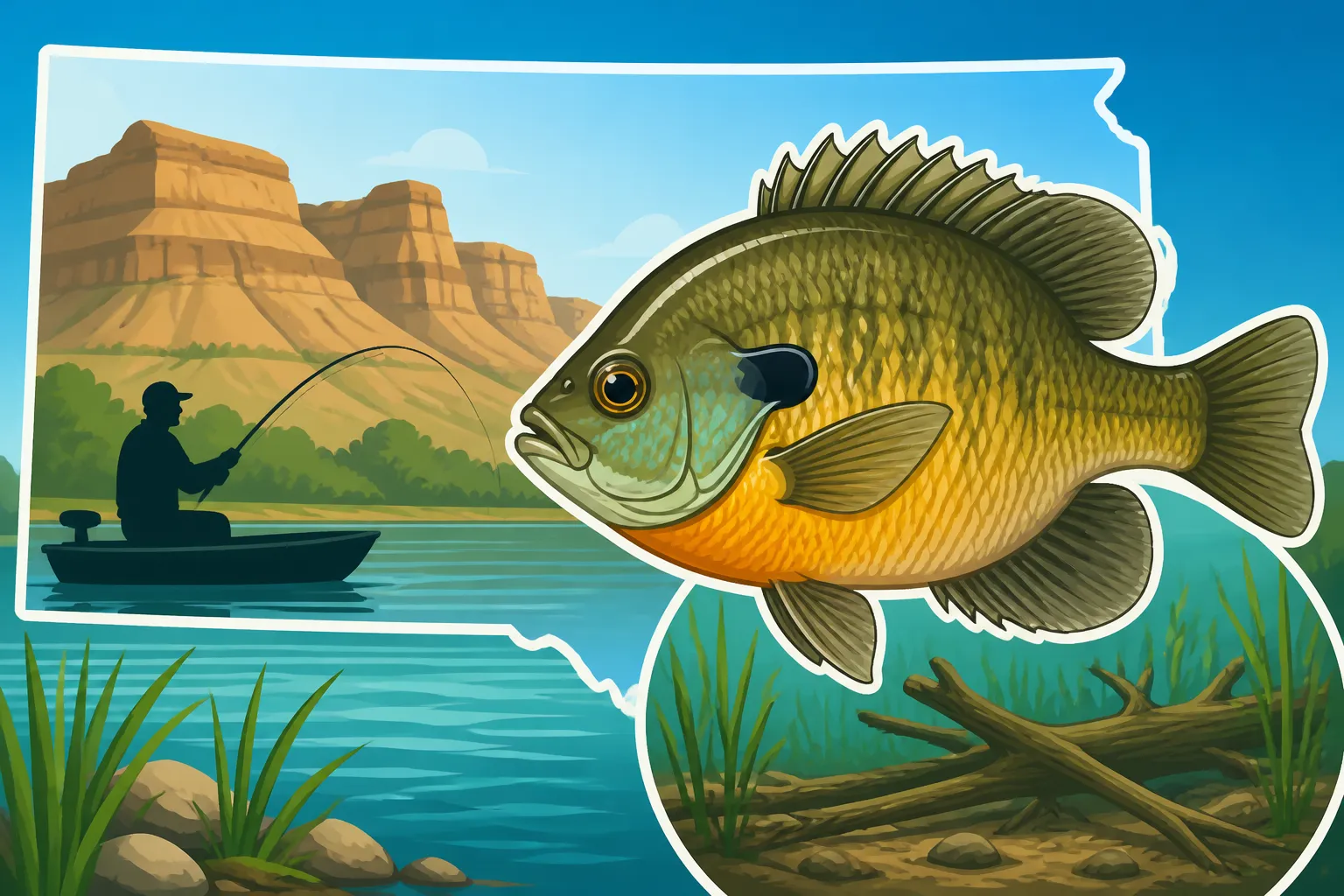
Bluegill Identification and Habitat
Oh, the humble bluegill! If you've ever spent a sunny afternoon by a South Dakota lake or pond, chances are you've tangled with these spirited little fighters. They're often the first fish to greet a beginner's line, but knowing the difference between a bluegill and its panfish cousins can sometimes be a head-scratcher. This comprehensive guide will walk you through exactly how to identify bluegill, reveal their favorite hangouts in South Dakota's diverse waters, and celebrate why these fantastic fish are such a crucial part of our state's angling legacy.
The Distinctive Features of a South Dakota Bluegill
Bluegill are often grouped under the general "sunfish" umbrella, and while they share similarities with their relatives, they possess several key characteristics that make them stand out. Learning these visual cues can make all the difference when you're trying to figure out what you've just reeled in.
Visual Cues for Positive Identification
When you pull a bluegill from the water, the first thing you'll notice is its body shape. These fish are distinctly deep and compressed, almost like a disc or a dinner plate turned on its side. Their bodies are relatively thin from side to side but tall from back to belly, which gives them that classic "panfish" profile.
Their coloration can vary quite a bit depending on the water clarity, depth, and even the fish's mood, but generally, you'll see an olive-green to dark blue or purplish hue on their back, fading to lighter, often silvery sides. Many bluegill, especially those from clearer waters, will display several faint vertical bars along their sides. The belly is usually where they show some real flair, often a vibrant yellow or orange, particularly on spawning males during the spring. But the absolute giveaway, the "aha!" moment for bluegill identification, is the dark spot on their operculum, or gill cover. This spot, often called the "ear flap," is solid black, without any kind of colorful margin or edging around it. This solid black ear flap is the bluegill's signature look and a great way to tell them apart from other sunfish species. Additionally, take a peek at their mouth – it's quite small, and typically, it won't extend past the front edge of their eye. Their pectoral fins, the pair just behind their gill covers, are also notably long and pointed, which is another helpful identifier.
Average Size and Lifespan in South Dakota Waters
While bluegill might not be the giants of the fishing world, they certainly hold their own in terms of average size, especially in productive South Dakota waters. Most anglers will encounter bluegill in the 6 to 10-inch range, which is perfect "pan-sized" for a delicious meal. However, don't be surprised to hook into some true lunkers that push past the 10-inch mark, occasionally even reaching up to 12 inches or more under ideal conditions. A bluegill hitting or exceeding a pound in weight is considered a trophy in many circles, and South Dakota certainly has waters capable of producing such specimens.
Their lifespan generally ranges from 5 to 8 years, though some individuals in very stable, nutrient-rich environments with low fishing pressure might live a bit longer. The growth rate of bluegill, like any fish, is heavily influenced by factors such as the availability of food, the water quality, the amount of cover, and of course, how many other fish are competing for resources in their habitat. A lake with a healthy forage base and good structure can yield faster-growing, fatter bluegill, making for a more rewarding catch.
Understanding Bluegill Habitat in South Dakota
To catch bluegill, you first need to know where they like to hang out. These fish aren't picky about just any water; they have specific preferences that guide their movements and congregation throughout the year. Understanding these habitat choices is key to consistently finding them.
Preferred Aquatic Environments
Bluegill thrive in a variety of aquatic environments across South Dakota, making them accessible to many anglers. You'll find them in abundance in many of our state's lakes, ponds, slower-moving rivers, and various impoundments. They absolutely adore warmer, shallower waters, which is why they're often a staple of smaller lakes and farm ponds. They are not typically found in fast-moving rivers or deep, cold mountain lakes where trout might dominate.
Their absolute favorite haunts are areas with extensive submerged vegetation, often referred to as "weed beds." These dense underwater gardens provide essential cover from predators, a rich foraging ground for insects and invertebrates, and crucial shade during hot summer days. Beyond weeds, bluegill are strongly attracted to other forms of submerged structure like fallen timber, brush piles, old dock pilings, and even artificial fish structures placed by wildlife agencies. These features offer security, ambush points, and places to rest. Good examples of places to find healthy bluegill populations include many of the glacial lakes in eastern South Dakota, such as Lake Kampeska, and certainly the numerous South Dakota State Park Fishing Ponds designed for public access and family fishing. If you're looking for bluegill, start by targeting these types of areas.
Seasonal Movements and Structure Preferences
Bluegill aren't static residents; their movements are largely dictated by the changing seasons and their biological needs, especially spawning and foraging. Understanding these patterns will significantly increase your chances of a successful outing.
In spring, as water temperatures begin to climb, bluegill move into the shallow, warmer areas of lakes and ponds to begin their spawning rituals. Males create circular depressions, known as "nests," on the bottom in shallow areas, often near protective cover. These nests are typically found in congregations, creating what's often called a "bluegill bed." This is prime time for shore anglers, as the fish are very accessible and aggressive, guarding their nests. As summer progresses and the water heats up, many bluegill will seek out slightly deeper, cooler water, especially during the hottest parts of the day. However, they'll still make frequent forays into the shallows during dawn and dusk to feed. During this time, they remain closely associated with submerged structures like weed lines, rock piles, brush, and docks, using these features for both cover and feeding opportunities.
Come fall, as water temperatures begin to cool again, bluegill often become very active and can be found in shallower areas, feeding aggressively to build up fat reserves for the coming winter. They tend to school up more tightly during this period. Finally, in winter, when the lakes and ponds freeze over, bluegill typically suspend in deeper water or position themselves near major structural elements like deep weed edges, humps, or submerged timber. They often form large schools under the ice, and once you find one, you've likely found a whole mess of them! South Dakota Ice Fishing Guide provides more detail on how to pursue these and other species during the cold months. Knowing these seasonal shifts will help you pinpoint their location no matter the time of year.
The Bluegill's Role in South Dakota's Ecosystem and Angling Culture
Beyond being a fun catch, bluegill play a vital role in the aquatic ecosystems of South Dakota and hold a special place in the hearts of anglers, both seasoned and novice.
Ecological Importance and Food Chain Dynamics
Bluegill are much more than just a target for fishing; they are a cornerstone of many freshwater food webs in South Dakota. Their sheer abundance makes them a critical forage fish for a wide array of larger, predatory species. Think about it: our prized walleye, aggressive northern pike, and feisty largemouth and smallmouth bass all rely heavily on bluegill as a primary food source. Without a healthy population of bluegill, these larger game fish would struggle to find enough sustenance, potentially impacting their growth rates and overall numbers. Understanding their role helps us appreciate the intricate balance of the underwater world. For instance, knowing What Preys on Small Walleye in South Dakota Lakes gives you a glimpse into the constant give-and-take in our waters, where bluegill are frequently on the menu.
Furthermore, bluegill are voracious eaters of insects, insect larvae, zooplankton, and other small aquatic invertebrates. By consuming these organisms, they help control insect populations and contribute to the overall health and balance of their aquatic environment. They essentially act as tiny, underwater gardeners, keeping the ecosystem in check. Their presence is often an indicator of a healthy, productive fishery.
Why Bluegill are a Favorite for Anglers
It's hard to find an angler in South Dakota who doesn't have a soft spot for bluegill. There's a reason they're often the first fish a child catches, sparking a lifelong love affair with fishing. Their abundance is a huge factor; in many waters, you can catch them consistently, providing continuous action that keeps spirits high. This makes them perfect for introducing beginners, especially kids, to the joys of fishing. A simple cane pole, a bobber, a small hook, and a worm are often all you need to get into a school of bluegill, and the excitement of a bobber disappearing under the water is simply unmatched for a budding angler. You can often find great starter kits for these panfish on Amazon, making it easy for families to get equipped.
Beyond the thrill of the bite, bluegill are universally praised for their superb qualities as table fare. They are famously delicious, with mild, flaky white meat, making them truly deserving of the "panfish" moniker. Many families cherish the tradition of a fresh bluegill fry, a perfect culmination to a day spent outdoors. The relatively easy nature of catching them, combined with their excellent taste, firmly cements bluegill as a beloved species in South Dakota's angling culture. They are a staple of family fishing trips and casual outings, providing enjoyable recreation and delicious meals alike. For more species that offer similar enjoyment, check out our South Dakota Panfish Fishing Guide.
Distinguishing Bluegill from Other Panfish Species
South Dakota waters are home to a variety of panfish, and while bluegill are distinct, they often get confused with their close relatives, especially crappie and other sunfish. Knowing the subtle differences can help you identify your catch accurately and understand the unique characteristics of each species.
Bluegill vs. Crappie
This is perhaps the most common identification conundrum for many panfish anglers. Both bluegill and crappie are popular, widespread, and often found in similar habitats, but they have some clear distinctions once you know what to look for.
The most noticeable difference lies in their body shape and mouth size. Bluegill have a distinctly rounder, deeper, and more compressed, disc-like body. Imagine a perfectly round pancake, but thicker. Crappie, on the other hand, are also deep and compressed, but their body tends to be more elongated and taller, giving them a somewhat stretched-out appearance compared to the bluegill's almost circular profile. When it comes to the mouth, bluegill have a much smaller mouth that typically does not extend past the front of their eye. Crappie have a noticeably larger mouth that extends well past the middle of their eye, indicating their more predatory feeding style. Another key difference is in their dorsal fin, the fin on their back. Bluegill usually have 5 to 6 hard spines in their dorsal fin, while crappie typically have 6 to 8. Lastly, crappie often display a mottled, speckled pattern of dark spots and bars over a silvery body, while bluegill tend to have more uniform coloration with those fainter vertical bars and, of course, the solid black "ear flap." For a more in-depth look, consult Difference Between a Crappie and a Sunfish.
Bluegill vs. Other Sunfish (Green Sunfish, Pumpkinseed)
The broader sunfish family includes several species that can be mistaken for bluegill. The green sunfish and pumpkinseed are two of the most common "look-alikes" in South Dakota.
Green Sunfish are often encountered in similar environments. The primary identifier for a green sunfish is its larger mouth, which, like the crappie, extends past the middle of the eye. Their body is generally more robust and stout than a bluegill's, though still compressed. While they can be bluish-green, the black spot on their gill cover usually has a distinct, lighter margin, often orange or yellow, unlike the bluegill's solid black spot. They might also have iridescent blue spots or streaks on their cheeks and gill covers.
Pumpkinseeds are perhaps the most colorful of the sunfish clan and are less likely to be confused once you've seen one. They are also deep-bodied and compressed, but their coloration is much more vibrant and ornate. They typically have an olive back with numerous orange spots and wavy blue lines on their head and gill covers. Their most distinguishing feature is a bright red or orange spot on the rear edge of their black "ear flap." This vivid splash of color is an immediate indicator that you're holding a pumpkinseed, not a bluegill.
Here’s a quick comparison table to help differentiate these common panfish:
| Feature | Bluegill | Black Crappie | Green Sunfish | Pumpkinseed |
|---|---|---|---|---|
| Body Shape | Deep, compressed, round/disc-like | Deep, compressed, more elongated | Robust, stout, slightly less compressed | Deep, compressed, oval |
| Mouth Size | Small, doesn't extend past eye | Large, extends past middle of eye | Large, extends past middle of eye | Small |
| Dorsal Spines | 5-6 | 7-8 | 10 (spiny dorsal & soft dorsal continuous) | 10-11 (spiny dorsal & soft dorsal continuous) |
| Ear Flap | Solid black, no colorful margin | Black, no distinct spot | Black, distinct orange/yellow margin | Black, vivid red/orange spot |
| Coloration | Olive/blue/purple back, yellow/orange belly, faint vertical bars | Silvery, mottled with irregular dark spots/bars | Bluish-green back, yellow/white belly, iridescent blue spots | Olive back, orange spots, wavy blue lines on head, orange belly |
| Pectoral Fin | Long and pointed | Shorter, rounded | Shorter, rounded | Shorter, rounded |
If you're still struggling, a good waterproof fish identification guide, which you can easily find on Amazon, is a great tool to keep in your tackle box. It can be invaluable for quickly identifying your catch right there on the water.
Practical Tips for Identifying and Catching Bluegill
Now that you know what to look for, let's talk about putting that knowledge into practice on the water and making the most of your bluegill fishing adventures in South Dakota.
Best Practices for Field Identification
When you've just reeled in a lively panfish, taking a moment for proper identification can enhance your understanding of the fishery and ensure you're following regulations. Always remember that a bluegill's identifying features are best observed in combination. Don't just look for one thing; check the body shape, the mouth size, the pectoral fin, and most importantly, that iconic solid black "ear flap." The presence of faint vertical bars and a yellow or orange belly are also strong indicators.
If you plan to release the fish, handle it gently and quickly. Wet your hands before touching the fish to protect its protective slime coat, and avoid squeezing it, especially around the gills. Hold it horizontally and support its body weight. A quick photo can also help for later reference if you're unsure. For true beginners, dedicating some time to learn Fish Identification for Beginners can make all the difference. Practice makes perfect, and the more bluegill (and other panfish) you see, the quicker you'll become at recognizing them.
Basic Angling Strategies for Bluegill
Catching bluegill is a fantastic entry point into fishing, but even experienced anglers appreciate their consistent willingness to bite. The key to successful bluegill fishing lies in using light tackle and presenting small baits or lures effectively.
An ultralight spinning rod and reel combo, spooled with light monofilament line (2-4 pound test), is absolutely ideal. This setup allows you to feel even the lightest nibbles and provides a fun fight from these surprisingly strong fish. For bait, small live offerings are hard to beat: tiny pieces of nightcrawler or earthworm, maggots (often called "spikes" or "waxies"), and even kernels of corn can be incredibly effective. Small artificial jigs, sometimes tipped with a wax worm or a small soft plastic grub, also work wonders. Tiny spinners or micro-spoons can entice larger bluegill looking for a chase. For specific recommendations, understanding What Size Hook to Use for Panfish is crucial – typically, small hooks like size 8 or 10 are perfect for their small mouths.
The most common and effective technique for bluegill is bobber fishing. Suspend your bait a foot or two below a small bobber and cast it near cover like weed edges, lily pads, fallen trees, or docks. Watch for that bobber to twitch, dip, or suddenly disappear! Sight fishing in clear, shallow water, especially during the spring spawn when bluegill are on their nests, can also be incredibly productive and visually exciting. During winter, ice fishing for bluegill often involves tiny jigs or spoons tipped with bait, presented directly over schools suspended near structure. Remember to explore different depths and structures, but generally, bluegill will be where the food and cover are. You might even find some useful beginner ice fishing gear on Amazon if you're looking to extend your bluegill season.
Conservation and Sustainable Bluegill Fishing
While bluegill are abundant, it's our responsibility as anglers to ensure their populations remain healthy for future generations. Practicing conservation and adhering to regulations are paramount to sustainable fishing.
Importance of Following South Dakota Regulations
Every angler in South Dakota has a role to play in maintaining healthy fish populations. The South Dakota Game, Fish and Parks (GFP) sets specific regulations, including daily limits and possession limits, for bluegill and other panfish. These limits are not arbitrary; they are carefully determined by fisheries biologists to ensure that enough fish remain in the population to reproduce and sustain the ecosystem. It's crucial to know and adhere to these limits, not just for bluegill but for all species you target. For instance, knowing the Crappie and Panfish Possession Limits is just as important as knowing how to catch them.
Beyond simply following the numbers, practicing selective harvest is a thoughtful approach. This means not just keeping every fish you catch, but perhaps releasing the largest, most robust bluegill (often referred to as "brood stock") to ensure they can continue to reproduce and pass on strong genetics. Keeping a meal's worth of medium-sized fish is often a better management strategy for a healthy bluegill population. It's also wise to be aware of any specific local regulations that might apply to certain water bodies, as rules can sometimes vary by lake or river.
Protecting Bluegill Habitats
Healthy bluegill populations depend on healthy habitats. As anglers, we can contribute significantly to habitat protection through conscious actions both on and off the water. A major concern in South Dakota, as in many states, is the spread of aquatic invasive species (AIS). These unwanted plants and animals can outcompete native species, destroy habitats, and disrupt the food chain, negatively impacting bluegill and other fish. Always remember to clean, drain, and dry your boat, trailer, and all fishing gear thoroughly between outings, especially when moving from one body of water to another.
Respecting shorelines and preserving natural vegetation are also critical. Healthy aquatic plants provide shelter, food, and spawning grounds for bluegill. Avoid disturbing these areas unnecessarily. Participating in local conservation efforts, whether it's a lake clean-up day or supporting organizations dedicated to habitat restoration, can have a lasting positive impact. By being responsible stewards of our waters, we ensure that the joy of catching bluegill, and the health of the entire aquatic ecosystem, continues for many years to come.
Disclaimer
This article is for general informational purposes only and does not constitute professional advice. Laws, prices and regulations vary by location and change over time. Consult a qualified professional for guidance on your specific situation.