Downrigger Fishing Techniques for Salmon
You've experienced that moment, haven't you? Out on the expansive waters of Lake Oahe, knowing there are monstrous Chinook salmon lurking somewhere in the depths, but feeling utterly helpless to reach them. You try your usual casting and shallow trolling tactics, only to come up empty-handed while hearing whispers of others pulling in big ones. That frustration is real, and it stems from a simple truth: these salmon often hold deep, far below where traditional methods can reach. This comprehensive guide will demystify downrigger fishing, giving you the precise techniques, gear knowledge, and strategic insights to confidently target and catch South Dakota's elusive and powerful Chinook salmon, no matter how deep they're hiding.
Understanding Chinook Salmon Behavior in South Dakota Waters
Before we even talk about gear, it's absolutely crucial to understand the fish you're targeting. Chinook salmon, often called "King Salmon," aren't native to South Dakota, but thanks to dedicated stocking programs, they've found a thriving home, primarily in the vast depths of Lake Oahe. Knowing their habits, from their preferred temperatures to their feeding frenzies, will give you a significant edge when it comes to downrigger fishing.
Chinook Salmon Life Cycle and Presence in Lake Oahe
The presence of Chinook salmon in South Dakota's Lake Oahe is a remarkable success story. These magnificent fish are not naturally occurring here; they are sustained by a diligent stocking program carried out by the South Dakota Game, Fish and Parks (GFP) department. Each year, thousands of juvenile salmon are released into the lake, transforming it into one of the premier landlocked salmon fisheries in the Midwest. This continuous effort ensures a healthy population for anglers to pursue. If you're curious about the history behind this, take a look at our article on the South Dakota Chinook Salmon Stocking History.
Once stocked, these salmon adapt to the freshwater environment, feeding voraciously on the abundant forage fish like rainbow smelt and cisco. They grow rapidly, often reaching impressive sizes, making them a highly prized sport fish. Unlike their ocean-dwelling cousins, Lake Oahe's Chinook don't migrate to the sea, completing their entire life cycle within the lake. However, their instinct to spawn remains, drawing them to specific areas of the lake during the fall, primarily around the Whitlock Bay area, although true reproduction is limited due to the specific conditions required for successful natural spawning.
The "trophy" appeal of Chinook salmon lies not just in their size but also in their incredible fighting spirit. They are renowned for their powerful runs, aerial acrobatics, and sheer stamina, providing an unparalleled challenge for anglers. Understanding that these fish are sustained by a delicate balance of stocking and a robust food chain within Lake Oahe reinforces the importance of ethical angling and conservation practices to ensure this unique fishery thrives for generations to come.
Seasonal Movements and Feeding Patterns
Chinook salmon are creatures of habit, largely dictated by water temperature and the availability of their preferred forage. Their movements throughout the year are quite predictable, and knowing these patterns is key to locating them.
In spring and early summer, as the ice recedes and surface temperatures begin to rise, Chinook salmon can often be found shallower, chasing baitfish that are also moving into warmer water. This is when they are actively putting on weight after the lean winter months. They might be found anywhere from 20 to 60 feet down, depending on the specific conditions. While downriggers can still be effective, sometimes other trolling methods or even casting can produce results during this time.
However, as mid-summer arrives and the sun bakes the surface, Lake Oahe begins to stratify, forming a distinct thermocline. This is when Chinook salmon really become downrigger targets. They seek out the cooler, oxygen-rich waters below the thermocline, often suspending over deep open water. Their primary focus shifts to intercepting schools of baitfish, which are also often congregating along this thermal break. This period, from July through September, is prime time for deep-water downrigger trolling, as the salmon become highly concentrated in these specific temperature zones.
As fall approaches, typically in late September and October, a dramatic shift occurs. The cooling surface waters start to break down the thermocline, and the salmon, driven by their powerful spawning instincts, begin to migrate towards traditional staging areas. Whitlock Bay is particularly famous for this, as the salmon congregate before their attempts to spawn. During this pre-spawn period, they become incredibly aggressive, striking at lures with immense force. While they might be found at varying depths during this migration, downriggers are still crucial for presenting lures consistently in their path as they move through the water column. You can learn more about this specific migration in our article on Chinook Salmon Spawning Time on Lake Oahe.
Preferred Depths and Water Temperatures
For Chinook salmon, temperature is everything. These fish are cold-blooded and thrive within a relatively narrow range of cool, oxygenated water. Their comfort zone typically falls between 45 and 58 degrees Fahrenheit, though they might tolerate slightly warmer or cooler temperatures for short periods. Finding this "sweet spot" is paramount to successful downrigger fishing.
In Lake Oahe, especially during the summer months, this ideal temperature range is usually found within or just below the thermocline. The thermocline is a distinct layer in the water column where the temperature changes rapidly with depth. Above it, the water is warmer; below it, it's significantly colder. Baitfish, like rainbow smelt and cisco, also prefer this cooler, oxygenated water and tend to congregate in dense schools along the thermocline. Since Chinook salmon are predatory, they follow their food source. If you can locate the bait and the right temperature, you're almost guaranteed to find the salmon.
To effectively target these fish, anglers need to use reliable sonar units with temperature gauges and, ideally, the ability to clearly mark the thermocline. Many modern fish finders can show you the thermocline as a distinct band on the screen. Once you've identified this critical depth, your downrigger allows you to present your lures precisely within that productive zone, rather than guessing or simply hoping your lure drifts through it. This precision is what makes downrigger fishing so incredibly effective for deep-holding salmon.
Essential Downrigger Gear and Setup for South Dakota Salmon
Successfully landing Chinook salmon with a downrigger requires more than just dropping a weight. It involves a carefully selected array of gear, all working in harmony to present your lure effectively in the strike zone. From the downrigger itself to the specific rods and reels, every component plays a vital role.
Choosing the Right Downrigger System
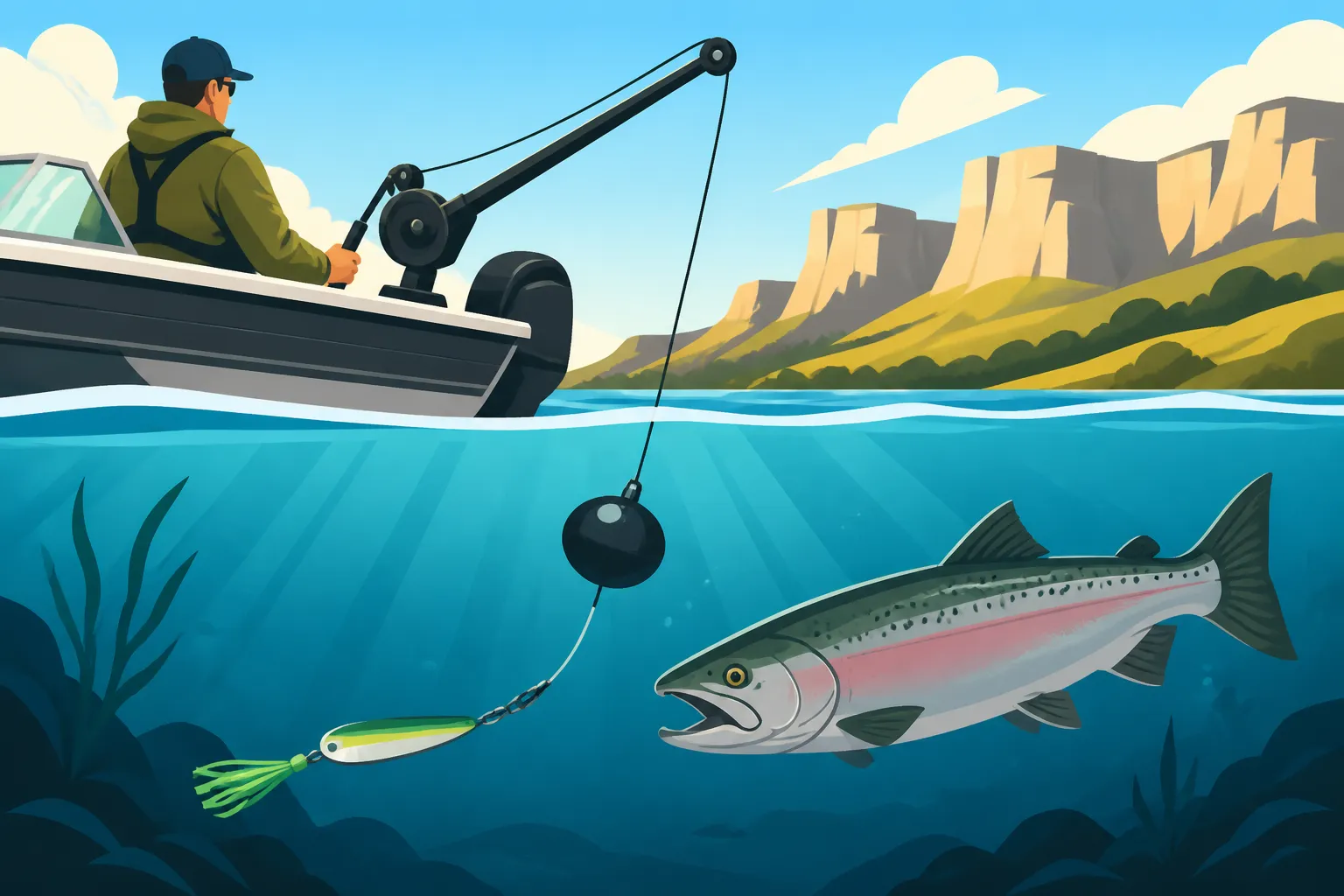
The downrigger is the heart of this fishing technique, allowing you to deploy your lure to precise depths and keep it there while trolling. You essentially have two main categories to consider: manual and electric.
Manual downriggers are typically more affordable and simpler in design. They require you to physically crank a handle to raise and lower the heavy downrigger weight. These are a great option for anglers who are new to downrigger fishing, only go out occasionally, or have a smaller boat where space and power are limited. While effective, repeatedly cranking up a 10-pound weight from 100 feet down, especially when you're frequently checking baits or moving spots, can quickly become tiring. For a basic setup, you can find reliable manual models on Amazon that will get you started without breaking the bank.
Electric downriggers, on the other hand, offer convenience and efficiency at a higher price point. With the press of a button, the electric motor does all the work, deploying and retrieving the weight effortlessly. This is a massive advantage when fishing deep water, running multiple downriggers, or when you need to make frequent depth adjustments to follow bait or structure. Many electric models come with advanced features like digital depth counters, auto-stop at the surface, and even positive ion control, which some anglers believe can attract fish. For serious salmon anglers on Lake Oahe, electric downriggers from brands like Cannon or Scotty are often the preferred choice due to their reliability and ease of use over long days on the water.
When selecting a downrigger, consider the boom length – longer booms keep your lines further away from the boat, reducing prop wash interference. Also, check the retrieval speed for electric models and the maximum weight capacity, as you'll typically be using 8-12 pound weights for salmon. Finally, think about mounting options: some downriggers can be mounted on rail clamps or universal bases, making them easy to remove, while others require more permanent flush-mount installations.
Rod, Reel, Line, and Leader Selection
Just like any specialized fishing, choosing the right rod, reel, line, and leader for downrigger salmon fishing is paramount. Each component works together to handle the unique stresses of this technique and deliver your lure effectively.
For rods, you'll want something specifically designed for downriggers. These rods are typically longer, often 8 to 10.5 feet, with a moderate action. This means they have a relatively soft, forgiving tip that allows the rod to load up smoothly when clipped into the downrigger release, absorbing the shock without snapping. However, they also possess a strong backbone in the mid-section and butt to handle the powerful runs of a Chinook salmon. Fiberglass or composite rods are popular choices due to their durability and flexibility. While our guide on Best Rod and Reel Setup for Walleye Trolling covers general trolling setups, remember salmon require a bit more beef and backbone due to their sheer power.
When it comes to reels, a level-wind baitcasting reel is almost universally preferred for downrigger fishing. Look for models with a high line capacity (enough to hold 200-300 yards of line), a smooth, reliable drag system, and a line counter. The line counter is absolutely essential for knowing how much line you have out, allowing you to accurately replicate successful depths and maintain a consistent spread. Brands like Daiwa and Shimano offer excellent options that can withstand the abuse of fighting big fish.
Line choice is also critical. Many anglers opt for 20-25 pound test monofilament as their main line. Monofilament offers a bit of stretch, which acts as a shock absorber during violent strikes and head shakes, helping to prevent hooks from pulling out. However, some prefer braided line for its zero-stretch sensitivity, especially when fishing very deep. If using braid, a monofilament or fluorocarbon leader is often used to provide some stretch and invisibility. For leaders, fluorocarbon is the preferred material for its near-invisibility underwater and its abrasion resistance. A 20-30 pound fluorocarbon leader, typically 6-10 feet long, is tied directly to your main line using a strong knot like a double uni or Alberto knot, and then to your lure. This setup ensures that the fish sees your lure, not your main line.
Terminal Tackle: Lures, Baits, and Flashers
The array of terminal tackle used for downrigger salmon fishing is vast, but it generally revolves around two key elements: attractors (flashers and dodgers) and lures/baits. The right combination can make all the difference in triggering a strike.
Flashers and dodgers are designed to create attraction, mimicking the flash and vibration of a school of baitfish, or simply drawing attention to your spread. Flashers typically rotate, creating a continuous flash and thump, while dodgers have a side-to-side rocking motion. Both are usually rigged 18-36 inches in front of your lure. They come in various sizes and colors, and experimenting is key. Popular colors often include chrome, chartreuse, blue, and green, especially when paired with a matching lure. You can find excellent multi-pack flashers and dodgers in different sizes and colors on Amazon, allowing you to adapt to changing light conditions and fish preferences.
When it comes to lures, spoons are perhaps the most popular choice for Lake Oahe Chinook. Brands like Northport Nailers, Little Cleos, Dardevles, and various custom painted spoons are highly effective. Spoon size and color are important; typically, spoons between 3.5 to 5 inches are a good starting point. Brighter colors and highly reflective patterns work well on cloudy days or in deeper, darker water, while more natural patterns might be better in clearer, shallower conditions. Another effective lure category is plugs, such as J-Plugs or Kwikfish. These lures have a unique wobbling and diving action that salmon find irresistible, especially when fished plain or with a scent. Our guide on Best Lures for Lake Oahe Salmon in October offers more detailed suggestions specific to the fall run, but many of those lures are effective throughout the season.
Finally, incorporating natural bait can be a game-changer. Cut bait, particularly herring or smelt fillets, fished behind a flasher or a dodger, is incredibly effective. The natural scent and subtle action of real bait can often entice strikes when artificial lures alone fall short. There are specialized bait heads or harnesses designed to rig these cut baits to impart a specific action. Always check local regulations regarding bait use, but generally, live or cut bait is permitted for salmon. The combination of a flashy attractor with a natural-looking and smelling bait is a powerful one for convincing a cautious Chinook to commit.
Mastering Downrigger Techniques for Optimal Salmon Bites
Operating downriggers isn't just about dropping a weight to a certain depth. It involves a nuanced understanding of spread, precision in depth control, and a readiness for the explosive strike. Mastering these techniques will significantly increase your success rate for South Dakota Chinook salmon.
Setting Up Your Downrigger Spread
The goal of setting up your downrigger spread is to cover a wide range of depths and present multiple lure options simultaneously, all while keeping your lines from tangling. This is especially important on large bodies of water like Lake Oahe, where salmon can be scattered.
If you're running a single downrigger, the setup is straightforward: attach your fishing line to the downrigger release clip, lower the weight to your desired depth, and then start trolling. However, most serious salmon anglers run multiple downriggers, typically two or four, to maximize their chances. With two downriggers, you'll generally place one on each side of the boat, usually with different depths or lure choices. For example, one might be at 60 feet and the other at 70 feet.
When running three or more downriggers, you can create a more complex spread. A common setup involves staggering the depths and distances from the boat. For instance, you might run one downrigger directly below the boat ("shotgun" position) deepest, another on one side slightly shallower, and the third on the other side even shallower. Some anglers also use "stacking" clips, which allow you to run two separate lines off a single downrigger weight, further increasing your coverage. This is especially useful for targeting suspended fish that might be spread vertically in the water column.
The type of release clip you use is also critical. Heavy-duty clips are necessary to hold the line securely while trolling, preventing premature releases, but they must release cleanly when a fish strikes. Experiment with different tensions; you want enough tension to keep the line secure through turns and waves, but not so much that a smaller fish can't pull it free. For more general guidance on how to organize your trolling, our South Dakota Chinook Salmon Trolling Techniques article provides additional insights that can be adapted for downrigger use. Proper spread and clip tension ensure that when a salmon does strike, your rod springs free, signaling the bite clearly.
Reading the Blowback and Depth Control
One of the most common misconceptions about downrigger fishing is that the depth counter on your unit always reflects the exact depth of your lure. This isn't entirely true, and understanding "blowback" is key to precise depth control. Blowback refers to the angle at which your downrigger cable trails behind the boat due to boat speed, current, and the drag of your downrigger weight and lure. The faster you troll or the stronger the current, the more your cable "blows back," meaning your weight and lure will actually be shallower than what the depth counter reads.
To accurately determine your lure's true depth, you need to account for blowback. Experienced anglers often use a "blowback chart" or simply learn through experience how much their specific setup pulls back at different speeds. Some advanced downriggers have features to help compensate for this. Generally, if you're trolling at 2.0-2.5 mph with a 10-pound weight, your lure might be 5-10 feet shallower than what the counter indicates, especially at deeper settings. Adjusting your trolling speed is a primary way to manage blowback and maintain your desired depth.
Consistent depth control is paramount because Chinook salmon often hold within a very specific temperature band or alongside a particular bait ball. Even a few feet off can make the difference between a hot bite and a dead zone. Use your boat's speed control and the downrigger's depth adjustment (especially on electric models) to keep your lure precisely where you want it. Monitoring your fish finder for bait schools and fish arches at specific depths will help you fine-tune your downrigger settings. Don't be afraid to experiment; if you mark fish at 75 feet, set your downrigger to 75 feet and then make small adjustments up or down, paying attention to blowback, until you find the strike zone. Sometimes, placing the lure slightly above the bait ball can trigger aggressive upward strikes.
Fighting and Landing Salmon on Downrigger Gear
The moment your downrigger rod snaps free from the clip is an adrenaline rush unlike any other! That sudden spring of the rod signals that a Chinook salmon has hit your lure and freed your line from the downrigger. What happens next is a critical sequence of actions to ensure you land your prize.
Immediately upon a strike, grab the rod quickly but smoothly. The first thing you need to do is reel up any slack line to get direct contact with the fish. As you're reeling, the tension from the fish will often cause the downrigger clip to completely release your line, but sometimes you might need to give a slight tug on the rod to ensure it's free. Once you're certain the line is clear of the downrigger cable and weight, you can begin to fight the fish. This process is often called "clearing the line."
Fighting a Chinook salmon is a test of strength and patience. These fish are known for their powerful, sustained runs, often stripping hundreds of feet of line off your reel. Keep constant pressure on the fish, letting the rod and reel's drag system do their job. Avoid "pumping" the rod excessively or trying to muscle the fish in too quickly; this can pull the hooks or break your line. Instead, focus on maintaining steady pressure, reeling when the fish pauses or swims towards you, and letting the drag sing when it makes another searing run. Be prepared for strong head shakes and sudden changes in direction, as these fish will fight until they're boatside.
As the salmon tires and approaches the boat, clear any other lines or obstacles to ensure a smooth landing. Communication with your fishing partners is vital – call out "Fish on!" so they can react and prepare the net. When the fish is boatside, guide it towards a waiting net, ideally held by a partner. It's best to lead the fish headfirst into the net, as trying to net it tail-first often results in a last-ditch escape attempt. Use a net with a wide hoop and deep bag, large enough to handle a potential 20-30 pound salmon. While our article on Best Net Size for Landing Walleye provides good general advice, remember that a Chinook might require an even larger, more robust net. Once netted, lift the fish smoothly into the boat, and secure it quickly. Congratulations, you've just landed a South Dakota King!
Reading the Water: Electronics and Environmental Factors
Successful downrigger fishing for salmon isn't just about the gear; it's heavily influenced by your ability to interpret what the water is telling you. Modern electronics and an understanding of environmental factors are your best allies in locating these deep-dwelling fish.
Utilizing Sonar and GPS for Salmon Hotspots
In the vast expanse of Lake Oahe, blind trolling is largely a waste of time. This is where modern sonar and GPS units become absolutely indispensable tools for the serious salmon angler.
Your fish finder (sonar) is your underwater eye. It allows you to see the bottom contour, identify underwater structure, and, most importantly, locate baitfish schools and individual salmon arches. When scanning the water, you're primarily looking for dense schools of rainbow smelt or cisco, which often appear as large, cloudy masses or distinct blobs on your screen. These bait balls are magnets for predatory Chinook salmon. When you see bait, look for larger, distinct arches either within the bait or just below or above it – these are your target salmon. Learning How to Read a Fish Finder for Walleye provides a strong foundation that can easily be applied to salmon, as the principles of identifying fish arches and bait balls remain similar.
GPS, often integrated into modern fish finders, is equally crucial. Once you've identified a promising area on your sonar – a productive bait ball, a temperature break, or a specific depth where you've had a strike – use your GPS to mark a waypoint. This allows you to return to that exact spot, troll a consistent path, or create a series of waypoints to follow a productive contour or break line. Effective use of GPS helps you analyze patterns: "We got strikes here at 65 feet on this waypoint during the morning bite." Having a dedicated unit or a robust fish finder combo from brands like Humminbird or Garmin will be a game changer, and many top models are readily available on Amazon. Furthermore, our article on the Best GPS Unit for Marking Fishing Spots offers more detailed advice on leveraging this technology for all your fishing adventures.
Interpreting Water Temperature and Thermoclines
As discussed earlier, water temperature is arguably the single most important factor for Chinook salmon. They are cold-water fish, and being able to accurately read and interpret the water's thermal layers is paramount to downrigger success.
Your fish finder, especially models with a built-in temperature gauge and display, can help you identify the thermocline. The thermocline typically appears as a distinct, often fuzzy or diffuse, band on your sonar screen where the density of the water changes rapidly due to temperature differences. Often, baitfish will concentrate heavily on or just below this layer, and salmon won't be far behind. Knowing the depth of the thermocline allows you to set your downriggers precisely in that productive zone.
It's not just about finding a thermocline, but often the optimal thermocline. Sometimes there can be multiple subtle temperature breaks. Chinook will generally gravitate to the coolest, most oxygenated water where bait is present, usually within their preferred temperature range of 45-58°F. Pay attention to how the thermocline might shift throughout the day or with changing weather patterns. On very hot, sunny days, fish might push deeper as the thermocline becomes more pronounced and the warmer water above it expands. Conversely, on cooler, overcast days, they might hold slightly shallower. For a deeper dive into the relationship between water temperature and salmon behavior, especially during critical periods, our article What Water Temperature Triggers the Salmon Spawn? can provide valuable context. Constantly monitoring your temperature gauge and adjusting your downrigger depths accordingly will keep your lures in the strike zone.
Weather and Wind's Impact on Downrigger Success
Weather and wind are forces of nature that significantly influence how fish behave and how you need to approach downrigger fishing. Ignoring them can lead to a frustrating day on the water.
Wind, in particular, has a dual effect. A light chop on the water's surface can be beneficial, breaking up the light penetration and creating a more "natural" environment for fish to feed. This broken surface can also mask your boat's presence, making the salmon less wary. However, too much wind can quickly turn into a detriment. Heavy winds create large waves that make boat control incredibly challenging, causing your downrigger weights to swing wildly and your lures to surge erratically, making it difficult to maintain a consistent depth and speed. It also creates safety concerns and makes it uncomfortable for anglers. On very windy days, try to fish areas that offer some protection, like leeward shorelines or large bays.
Cloud cover versus bright sun can also impact your success. Generally, salmon tend to be more active and willing to feed in lower light conditions, such as cloudy days, early mornings, late evenings, or during storms. On bright, sunny days, they might push deeper, become more lethargic, or prefer lures with less flash and more subtle colors. Adjusting your lure colors based on light penetration is a common tactic; brighter, more reflective lures on dark days or deep water, and more natural, subtle hues on bright days or shallower water.
Finally, barometric pressure changes associated with weather fronts can affect fish activity. Pre-front conditions (when a storm is approaching and pressure is dropping) often trigger a feeding frenzy, while post-front conditions (after a storm has passed and pressure is high and stable) can lead to a slower bite as fish become less active. Being aware of these atmospheric shifts and adjusting your presentation – perhaps slowing down your troll or changing up your lure choice – can help you adapt and find success even when conditions aren't ideal.
Safety and Best Practices for Downrigger Fishing
Downrigger fishing, especially on large, often windy lakes like Oahe, comes with its own set of safety considerations and ethical responsibilities. Ensuring you're prepared and adhering to best practices not only protects you and your crew but also helps preserve the fishery for the future.
Downrigger Maintenance and Troubleshooting
Your downriggers are hard-working pieces of equipment, constantly exposed to water, sun, and the stresses of heavy weights. Regular maintenance is crucial to prevent breakdowns and ensure they operate smoothly when you need them most.
After every trip, especially if you've been in rough water, give your downriggers a good rinse with fresh water to remove any lake water, dirt, or debris. Pay particular attention to the reels, pulleys, and any moving parts. Periodically, you should apply a marine-grade lubricant to the moving components, following the manufacturer's recommendations. Check the downrigger cable for any signs of fraying, kinks, or damage. A damaged cable can snap, leading to lost weights and potentially dangerous situations. Most manufacturers recommend replacing your cable annually or every few years, depending on use.
Troubleshooting common issues can save a trip. If your electric downrigger isn't operating, first check your battery connections and fuses. Ensure the battery is fully charged. If your clutch is slipping on a manual downrigger, it might need adjustment or cleaning. Keep a small toolkit on board with basic spares like extra fuses, replacement clips, and a few common tools for minor repairs. Knowing how to quickly address a minor issue can prevent it from escalating into a major problem, keeping you on the water and fishing productively.
Boating Safety While Trolling with Downriggers
Trolling with downriggers adds layers of complexity to standard boating safety. On a large reservoir like Lake Oahe, often shared with other boaters and subject to sudden weather changes, vigilance is key.
Always ensure your boat is equipped with all the necessary safety gear required by law. This includes correctly sized personal flotation devices (PFDs) for everyone on board, a sound-producing device (horn or whistle), navigation lights (if operating at dawn, dusk, or night), and a fire extinguisher. For a complete list, refer to the South Dakota Boat Safety Requirements. When trolling, it's easy to get absorbed in the fishing, but always remain aware of your surroundings. Keep an eye out for other boats, especially smaller craft or kayakers who might be less visible. Maintain a safe distance and be predictable in your course.
Operating multiple downriggers means you'll have several heavy weights and lines in the water. Always be mindful of their position, especially when turning or when another boat is passing close by. Keep hands and fingers clear of the downrigger cables, weights, and moving parts, as these can cause serious injury if caught. If you need to make a sharp turn, consider bringing up your deeper downriggers to prevent tangles. Also, always check the weather forecast before heading out and be prepared to cut your trip short if conditions deteriorate. Lake Oahe can get rough quickly, and being caught far from shore in strong winds is a dangerous situation.
Ethical Angling and Conservation for Chinook Salmon
As stewards of our natural resources, ethical angling and conservation practices are paramount, especially when targeting a stocked species like Chinook salmon that relies on human intervention to thrive.
First and foremost, always adhere to the current South Dakota fishing regulations. This includes understanding the specific daily limits and size restrictions for Chinook salmon. Our article South Dakota Chinook Salmon Daily Limit provides details, and a general overview of all rules can be found in South Dakota Fishing Regulations Explained. These regulations are in place to ensure a sustainable fishery for everyone. Ensure you have your valid South Dakota Fishing License Guide before casting a line.
If you plan to harvest your catch, know how to properly handle the fish. Bleeding a salmon immediately after landing it by cutting a gill arch can significantly improve its meat quality and flavor. If you are practicing catch and release, handle the fish as little as possible. Keep it in the water, remove the hook gently with pliers or a dehooking tool, and release it only when it shows strong signs of revival. Avoid dragging fish onto dry surfaces, as this can remove their protective slime layer and increase stress.
Beyond direct fish handling, practice Leave No Trace principles. Pack out everything you pack in, including any discarded fishing line, lure packaging, or food wrappers. Support conservation efforts by purchasing your fishing licenses and contributing to organizations that work to protect and enhance South Dakota's aquatic environments. By being responsible and ethical anglers, we help ensure that the magnificent Chinook salmon fishery in Lake Oahe remains a prized destination for years to come.
Downrigger System Comparison
Choosing the right downrigger can significantly impact your fishing experience. Here's a quick comparison to help you decide:
| Feature | Manual Downrigger | Electric Downrigger |
|---|---|---|
| Cost | Lower upfront investment, budget-friendly | Higher upfront cost, premium investment |
| Effort | Requires physical cranking to deploy/retrieve | Push-button operation, minimal effort, easy |
| Retrieval Speed | Slower, dependent on angler's cranking speed | Fast, consistent retrieval, often with variable speeds |
| Depth Control | Relies on line counter, can be less precise | Digital depth readout, highly precise, sometimes auto-stop |
| Features | Basic crank, clutch, possibly a basic counter | Auto-up, preset depths, cycle feature, positive ion control |
| Power Needs | None, fully mechanical | Requires 12V power source (boat battery) |
| Maintenance | Simpler mechanics, less to go wrong | More complex electronics, requires battery care |
| Best For | Occasional use, smaller boats, shallower depths, budget-conscious anglers | Frequent use, multiple downriggers, deep water, convenience, serious anglers |
Disclaimer
The information provided in this guide is for general informational purposes only and is subject to change. Always consult the official South Dakota Game, Fish and Parks regulations handbook for the most current and accurate rules and laws before engaging in any fishing activities. Fishing conditions, fish behavior, and regulations can vary, so stay informed and prioritize safety.