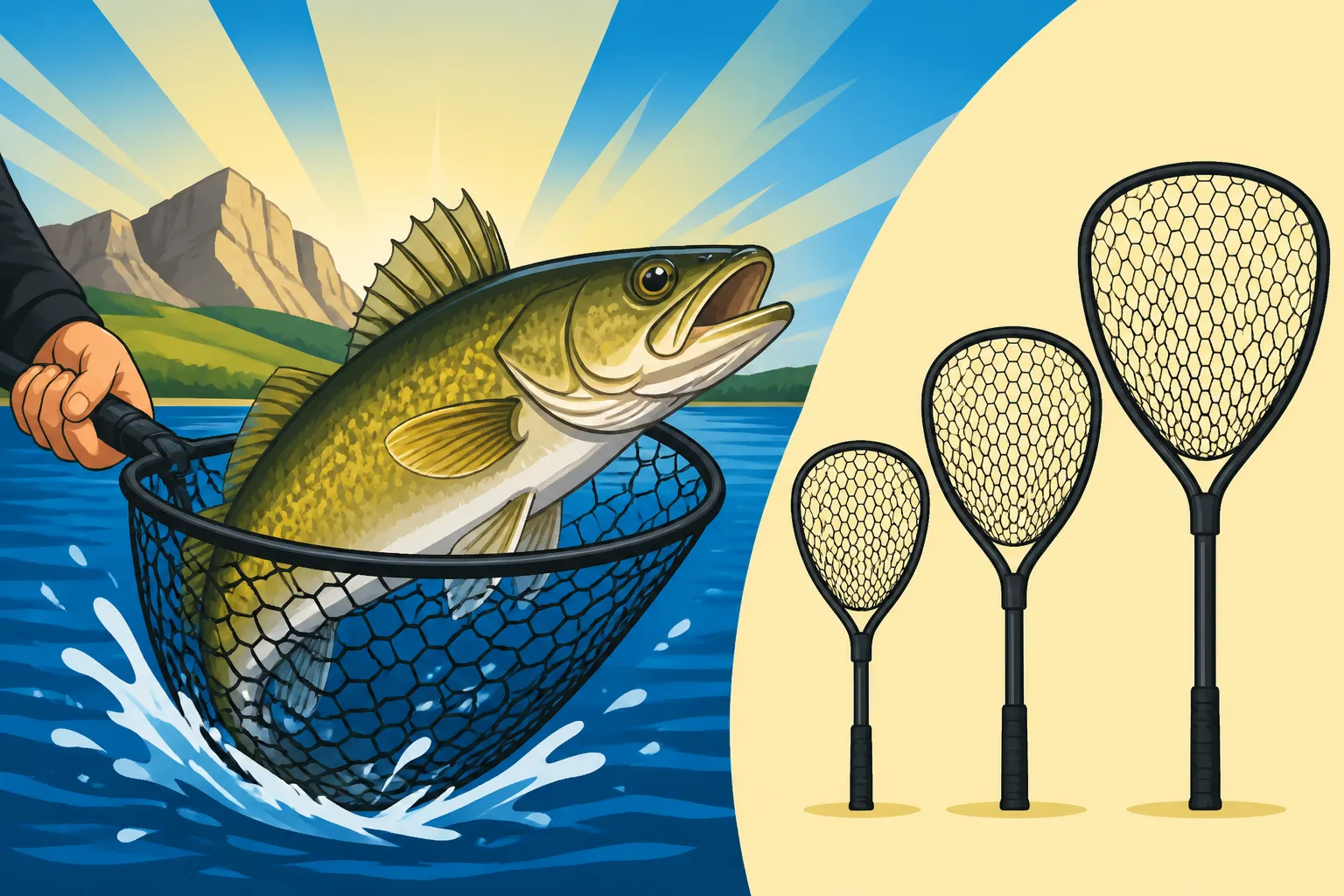
Best Net Size for Landing Walleye
There’s nothing quite like the rush of feeling that tell-tale tap, setting the hook, and battling a beautiful South Dakota walleye. You fight it to the boat or the shore, adrenaline pumping, only for it to make one last, desperate lunge and slip off the hook right at the crucial moment, leaving you with nothing but a splash and a sinking feeling. It’s a gut-wrenching experience we’ve all faced, and more often than not, a poorly chosen or inadequate landing net is to blame. This guide is here to help you navigate the often-overlooked world of fishing nets, specifically focusing on how to choose the best net size and type to confidently land those hard-fighting walleye and ensure they make it into your boat or to the bank, whether you’re keeping them for dinner or sending them back to grow bigger.
Why the Right Net Makes All the Difference for Walleye Anglers
It might seem like a minor detail, but your landing net is the final, critical link in your angling chain. For walleye especially, which are notorious for their thrashing, head shakes, and last-minute runs, a subpar net can turn a triumphant catch into a heartbreaking loss. We’ve all been there: a monster walleye surfaces, you reach for your net, and suddenly it feels too small, too shallow, or the mesh tangles disastrously. Understanding why a good net is so important will help you appreciate the features we’ll explore.
Preventing Lost Fish at the Boat or Shore
That moment when a walleye comes boatside or shore-side is often the most dangerous for losing the fish. They've used up a lot of energy, but they still have enough fight left for one last burst of energy. A net that's too small in diameter means you’re trying to thread a needle with a struggling, angry fish. You might graze its tail, spook it, and it'll bolt, often throwing the hook. A shallow net allows the fish to flop right over the rim as you lift it. I've seen countless beautiful walleye slip out of nets that were simply not deep enough, especially when the fish is still green and full of fight. This is particularly true for those bigger Missouri River walleye that can hit 25 inches or more – they have a lot of body to contain! A properly sized net gives you a larger target area and enough depth to cradle the fish securely once it’s in.
Imagine you're out on Lake Sharpe, the wind is picking up, and you've got a solid walleye on the line. You work it carefully, bringing it alongside your boat. Your buddy goes to net it, but his net is designed for panfish. The walleye barely fits the hoop, and with a violent head shake, it slaps the net rim and swims off with a frustrated splash. It's a tale as old as time, and one that can be easily avoided with the right gear. A bigger, deeper net just offers a wider margin for error, which is incredibly valuable in those high-stakes moments.
Prioritizing Fish Health and Conservation
Many South Dakota anglers, myself included, are passionate about catch and release, especially for the larger, reproductively valuable walleye. An improper net can do more harm than good. Fine, knotted mesh can strip away a fish's protective slime coat, which is vital for preventing disease. Hooks often get hopelessly tangled in thin mesh, prolonging the unhooking process and stressing the fish. When you’re trying to quickly unhook a thrashing walleye from a tangled net, you’re not only risking injury to yourself but also to the fish.
Rubberized, knotless mesh nets are a game-changer for fish health. The soft, coating material protects the fish's delicate scales and slime coat, and hooks rarely get snagged. This means a quicker, less stressful unhooking and release, significantly increasing the fish's survival chances. If you’re fishing the Black Hills streams for trout, you know how important gentle handling is, and it’s no different for walleye, especially those trophy-sized ones you hope to see again. Considering a more substantial net often goes hand-in-hand with making an ethical choice for the fish you cherish. For more on protecting our fisheries, you might find our guide on South Dakota Fishing Regulations Explained insightful.
Understanding Key Net Specifications for Walleye
When you start looking for a walleye net, you'll quickly realize there's more to it than just a hoop and a handle. There are specific features that truly make a difference in landing these popular fish. Knowing what these terms mean will help you choose wisely.
Hoop Size and Shape: The Walleye's Entry Point
The hoop is the frame that forms the opening of your net. For walleye, you generally want a hoop that is generously sized. A common mistake is going too small. A good starting point for walleye is a hoop with dimensions around 20-24 inches wide by 24-30 inches long, or a similar round or oval size. This provides ample space for an average South Dakota walleye, which often falls into the 15-20 inch range, but also gives you room for those surprise 25-inch-plus giants without having to jam them in.
Think about it: when that big walleye rolls on its side at the surface, you want to scoop it efficiently. A larger hoop allows you to make one decisive scoop rather than several attempts that might spook the fish. Many walleye nets come in a teardrop or oval shape, which can be advantageous as it allows for a wider entry point while still maintaining a manageable profile. While a big hoop might feel a little clunky at first, the confidence it provides when that trophy fish is at the boat is priceless. You can compare various models from retailers like Bass Pro Shops to get a real feel for different hoop sizes.
Net Depth and Mesh Type: Secure Containment and Fish Care
Once the walleye is in the hoop, the net's depth and mesh type become paramount. Walleye are notoriously squirmy, and a shallow net will let them bounce right out. Look for a net that has a depth of at least 24-36 inches. This deep pocket ensures that once the fish is scooped, it's securely contained, reducing the risk of it flopping back into the water, even if it makes a last vigorous attempt to escape.
The mesh material is equally, if not more, important. As mentioned, fine, knotted nylon mesh is a big no-no for walleye, especially if you plan to release them. It tangles hooks, scrapes off slime, and can damage fins. The best option is a rubberized or silicon-coated, knotless mesh. This material is gentle on the fish, prevents hooks from snagging (which is a huge time-saver and stress reducer), and is much easier to clean. It might cost a bit more upfront, but the benefits for both you and the fish are immense. When browsing for nets on Amazon, pay close attention to the mesh description – look for "rubberized," "silicon-coated," or "tangle-free" for the best results.
| Feature | Ideal for Walleye | Why It Matters |
|---|---|---|
| Hoop Size | 20-24" wide x 24-30" long (oval/teardrop often best) | Ample target for efficient scooping, accommodates average to trophy fish. |
| Net Depth | 24-36 inches minimum | Prevents fish from flopping out, securely contains active walleye. |
| Mesh Type | Rubberized/Silicon-coated, Knotless | Protects fish slime coat, prevents hook tangles, easier to clean. |
| Handle Length | 2-4 ft (boat), 4-8+ ft (shore/pier), Telescopic often | Matches fishing environment (boat, shore, wading), extends reach when needed. |
| Handle Material | Aluminum or reinforced composite | Durable, corrosion-resistant, lightweight, strong enough for heavy fish. |
Matching Your Net to Your South Dakota Fishing Style
Your fishing net isn't a one-size-fits-all tool. The best net for you will heavily depend on how and where you typically fish for walleye in South Dakota. Are you constantly on a boat, or do you prefer the solitude of shore fishing? Each scenario calls for a slightly different approach to net selection.
Boat Fishing: Length, Portability, and Durability
For most serious walleye anglers in South Dakota, boat fishing on the vast Missouri River reservoirs like Lake Oahe or Lake Francis Case is the primary method. Here, handle length is key. A shorter, rigid handle (around 2 to 4 feet) is often preferred for boat fishing, allowing you to quickly and efficiently net fish right alongside the boat. You don't want an overly long handle that becomes cumbersome in the confined space of a boat, getting in the way or tripping you up. Many boat nets also feature a telescopic handle, which can be a fantastic compromise, offering a compact storage solution while allowing for extended reach when needed, such as when netting a fish at the bow or stern of a larger vessel.
Durability is also paramount. Your boat net will likely be exposed to sun, water, and constant use. Look for robust construction, ideally an aluminum or reinforced composite handle that can withstand the elements and the strain of lifting a heavy walleye. The net head should also be securely attached and capable of withstanding abuse. Think about how many times that net will hit the deck or get tossed in a storage compartment. You want something that can take a beating and still perform when that 10-pound walleye comes calling. Investing in a quality net from a reputable brand found at places like Bass Pro Shops will pay off in the long run. If you're often fishing from a boat, our guide on Best Boats for South Dakota Reservoir Fishing might be a useful read.
Shore and Pier Fishing: Extended Reach is Crucial
If you enjoy the tranquility of casting from the bank of a glacial lake or a public pier, your net needs are very different. Here, reach is king. A short boat net is utterly useless when you're standing on an elevated pier or trying to land a fish from a sloped, rocky shoreline. For these situations, you'll want a net with a much longer handle, often 6 to 8 feet or even longer. Telescopic handles are particularly beneficial here, allowing you to compact the net for transport but extend it fully when you need to reach out over the water or down to a lower bank.
The challenge with long-handled nets is often the trade-off between reach and manageability. You want a handle that's strong enough not to buckle under the weight of a fish but also light enough to maneuver. Fiberglass or sturdy aluminum handles are good choices. Some dedicated pier nets have extremely long, rigid handles specifically designed for those elevated positions. Always consider the typical distance from the water you'll be fishing from. A net with insufficient reach is just as frustrating as one that's too small. You can find a wide range of handle lengths on online marketplaces like Amazon, often with user reviews that speak to their real-world usability from shore.
Kayak and Wading Fishing: Compact and Secure
For the adventurous angler who likes to kayak fish the calmer backwaters of Lake Sharpe or wade the shallow rivers for walleye, compactness and quick deployment are key. You have limited space in a kayak, and a bulky net can be a hindrance. Look for nets with shorter handles, often telescopic, that can be easily stowed but quickly extended. Some kayak-specific nets even feature a magnetic clip or bungee system for secure attachment to your PFD or kayak, making them instantly accessible.
When wading, a net attached to a lanyard or a clip on your vest is ideal. You want it out of the way until you need it, but ready for immediate action. The hoop size might be slightly smaller than a dedicated boat net, but still needs to be adequate for walleye. The rubberized mesh is even more crucial here, as you'll likely be handling the fish right in the water, and minimizing stress is paramount. Consider a net with a lanyard if you find yourself wading into the calmer stretches of the James River or similar waters.
Tips for Effective Walleye Netting and Net Care
Having the right net is only half the battle; knowing how to use it effectively and take care of it will ensure it serves you well for many seasons. Mastering the netting technique can save you from those last-second heartbreaks.
The Art of the Scoop: Timing and Technique
Netting a walleye isn't just about sticking the net in the water. Timing and technique are crucial. Wait until the fish is tired and close to the boat or shore. Try to guide the fish headfirst into the net. This is important because a fish going tail-first can often kick off the net, or its gill plates can get caught on the rim, leading to tangles and potential injury. Once the fish's head is past the hoop, make a decisive, upward scoop to bring it into the net. Don't jab or chase the fish with the net; this will only spook it and make it harder to land.
Work as a team if you have a fishing partner. The angler should keep the rod tip high, applying steady pressure and guiding the fish. The net person should wait patiently, net submerged slightly, ready for that perfect moment. A common mistake is lifting the net too early, creating a wake that spooks the fish. Once the fish is in the net, lift it swiftly and confidently out of the water, ensuring the net’s depth cradles the fish, preventing it from flopping out. Practice makes perfect, and with the right net, you'll soon be a walleye-netting pro! Our guide on How to Fish for Walleye in South Dakota covers more techniques for bringing them to the boat.
Cleaning and Maintenance for Longevity
Your landing net is an investment, and proper care will extend its life and ensure it's always ready for action. After each fishing trip, especially if you've landed fish, give your net a good rinse with fresh water. This removes fish slime, dirt, and any lake or river residue that can degrade the mesh and handle over time. Pay particular attention to the mesh, making sure no bait chunks or debris are left behind.
If you’ve used a rubberized mesh net, you’ll notice how much easier it is to clean compared to traditional nylon. For any stubborn odors or residue, a mild soap and water solution can be used, followed by a thorough rinse. Always let your net air dry completely before storing it. Storing a wet net can lead to mildew, unpleasant smells, and deterioration of the mesh and handle materials. For telescopic nets, occasionally clean and lubricate the extending sections to prevent sticking. Proper care means your net will be reliable for every fishing adventure, whether you're targeting South Dakota Walleye Limits or just enjoying a relaxing day on the water.
Disclaimer
This article is for general informational purposes only and does not constitute professional advice. Laws, prices and regulations vary by location and change over time. Consult a qualified professional for guidance on your specific situation.