Best Downriggers for Salmon Trolling
One of the most thrilling experiences in South Dakota fishing is chasing after Chinook salmon, especially on vast waters like Lake Oahe. But anyone who's tried knows the deep-water challenge: getting your lures consistently down to where these magnificent fish are lurking, often suspended in specific temperature bands. It's a real head-scratcher when you're watching fish on your sonar at 60 feet, but your bait just won't get there reliably. This guide is all about demystifying the downrigger, the essential tool that solves this depth dilemma and significantly increases your chances of hooking into those elusive salmon.
Understanding Downriggers: Why They're Essential for Salmon Trolling
Fishing for Chinook salmon in South Dakota's big reservoirs, primarily Lake Oahe, isn't like casting for panfish in a farm pond. These are pelagic fish, meaning they live in the open water column, often at considerable depths. If you want to consistently put a spoon or a flasher and fly right in front of their nose, you absolutely need precise depth control. That's where downriggers become not just helpful, but truly essential.
The Challenge of Deep Water Salmon on Lake Oahe
Imagine a massive body of water like Lake Oahe, stretching for miles and plunging to impressive depths. Chinook salmon, particularly in the warmer months, don't hang out in the shallow bays. They seek out cooler, oxygen-rich water, often congregating around the thermocline – that invisible boundary where water temperature changes rapidly. This thermocline can be anywhere from 40 to 80 feet down, or even deeper, depending on the season and specific conditions.
Trying to get your lures to these exact depths using just weight and line can be incredibly frustrating. Trolling speed, current, line diameter, and the type of lure all influence how deep your gear runs. One minute you think you're at 50 feet, the next you're at 30 or 70. This inconsistency means your lure might be above, below, or just plain missing the fish entirely, leading to long hours without a bite and a lot of head-scratching. We've all been there, watching the sonar light up with fish, only for our efforts to yield nothing but exercise. That's the pain point downriggers are designed to alleviate.
How Downriggers Solve the Depth Dilemma
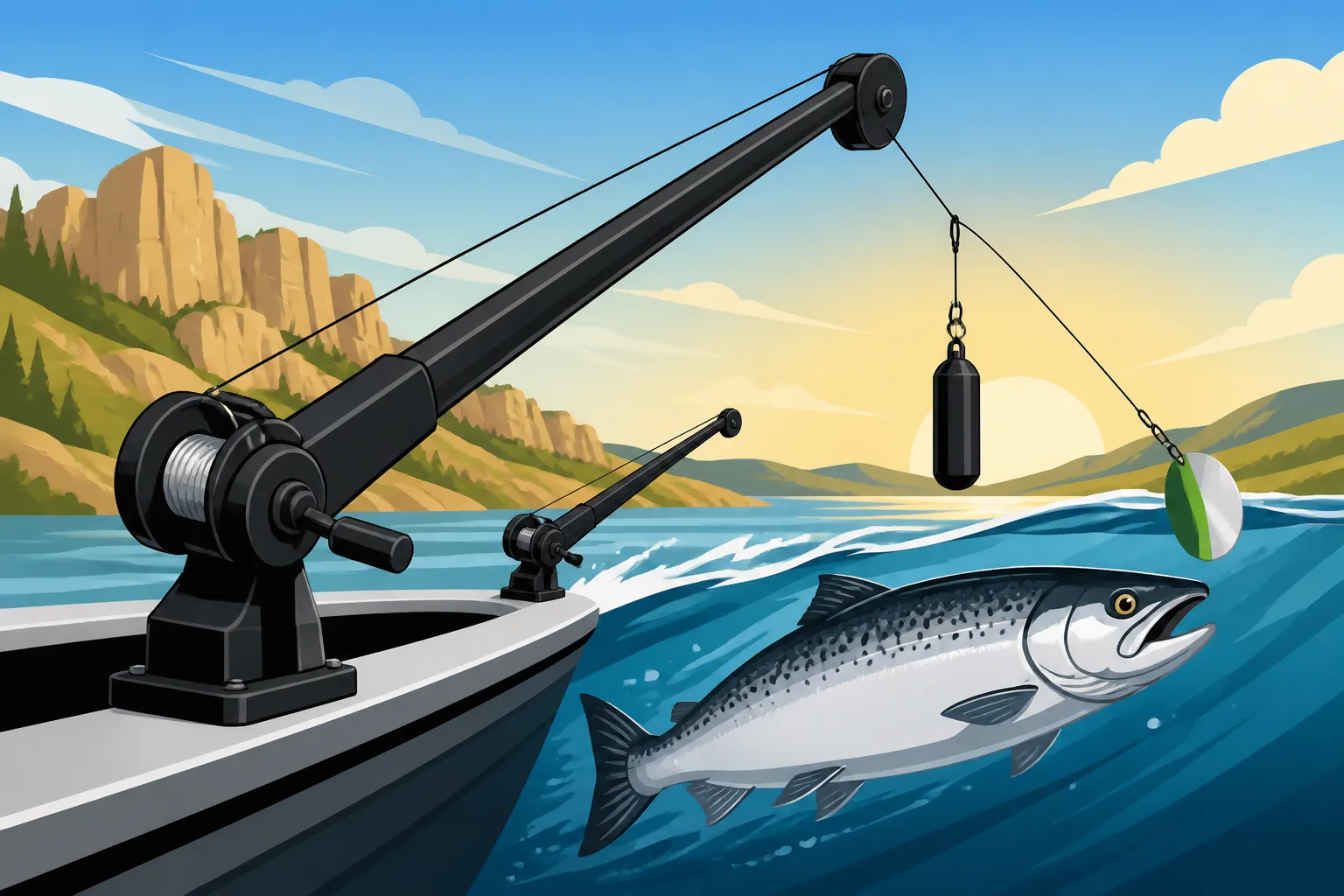
A downrigger is essentially a controlled weighting system for your fishing line. It uses a heavy cannonball weight, attached to a strong cable, to carry your fishing line (which is held by a release clip) down to a predetermined depth. Your actual fishing rod line is separate from the downrigger cable. When a fish strikes your lure, the tension pulls your line free from the release clip, and you fight the fish directly on your rod, without the heavy downrigger weight in the way.
This mechanism allows you to precisely target the depth where fish are holding. You can drop a downrigger ball to 65 feet, troll your boat, and know with confidence that your lure is presenting at precisely 65 feet. If you see fish stacking up at 58 feet, you can adjust your downrigger to 58 feet. This level of accuracy is simply unattainable with conventional weighting methods alone. It transforms a guessing game into a strategic hunt, drastically improving your efficiency and success rate when How to Set Up a Downrigger for Salmon.
Benefits Beyond Depth Control
While pinpoint depth control is the primary advantage, downriggers offer several other significant benefits for salmon trolling.
First, they allow for a much cleaner lure presentation. With traditional methods, heavy weights directly on your line can sometimes dampen the lure's action, making it less appealing. Downriggers keep your main fishing line free, letting your spoon or flasher swim naturally, creating the enticing action that salmon can't resist.
Second, downriggers help to spread out your lines. By deploying multiple downriggers at different depths and even using planer boards in conjunction, you can cover a much wider swath of the water column and horizontal area, increasing your chances of encountering fish. This is crucial on expansive waters like Lake Oahe where Chinook can be anywhere.
Finally, they can help reduce line twist and tangles, especially when running multiple lines. The heavy downrigger weight cuts through the water cleanly, minimizing interference between lines. This means less time untangling knots and more time fishing. This kind of thoughtful gear management is a big part of successful South Dakota Chinook Salmon Trolling Techniques.
Types of Downriggers: Manual vs. Electric
Once you've decided to embrace the downrigger revolution for your South Dakota salmon adventures, the next big question is whether to go manual or electric. Both have their place, depending on your budget, fishing style, and how much heavy lifting you're willing to do.
Manual Downriggers: Simplicity and Cost-Effectiveness
Manual downriggers are the traditional workhorses of the trolling world. They operate with a hand crank that you turn to lower or raise the downrigger weight. They're straightforward, reliable, and generally more affordable to purchase and maintain.
If you're just starting out with salmon trolling, or if you only fish for Chinook a few times a year, a manual downrigger can be an excellent entry point. You'll find solid, dependable manual downriggers from brands that you can often check out at local fishing departments or online retailers. They might require a bit more physical effort, especially when cranking up a heavy 10 or 12-pound cannonball from 80 feet, but they get the job done. Many anglers appreciate the tactile connection to their gear and the simplicity of operation. It's a great way to learn the ropes without a huge upfront investment, allowing you to focus on the basics of South Dakota Fishing Gear Checklist and lure presentation before adding more complex technology.
| Feature | Manual Downrigger | Electric Downrigger |
|---|---|---|
| Operation | Hand crank | Electric motor, push-button control |
| Cost | Generally lower | Significantly higher |
| Effort | Requires physical cranking | Minimal physical effort, push-button |
| Retrieval Speed | Slower, depends on angler | Faster, consistent speed |
| Auto-Stop/Depth | No auto-stop, manual depth tracking | Often includes auto-stop, depth memory |
| Cable Counter | Standard mechanical counter | Digital counter, sometimes integrated with sonar |
| Ideal For | Budget-conscious, occasional use, smaller boats | Frequent use, multiple lines, larger boats, convenience |
| Power Source | Angler | 12V DC battery |
Electric Downriggers: Power, Precision, and Convenience
For the serious salmon angler who spends many hours on the water, or for those running multiple downriggers, electric models are often the preferred choice. These units are powered by your boat's 12V electrical system, allowing you to raise and lower weights with the push of a button or the flip of a switch.
The convenience of electric downriggers cannot be overstated. Imagine needing to check your bait or move depths quickly when a school of fish appears on the sonar. With an electric unit, you can make those adjustments with minimal effort, keeping your focus on the fish finder and your trolling spread. Many electric downriggers also come packed with advanced features like digital depth counters, adjustable retrieval speeds, auto-stop at the surface, and even "bottom tracking" which automatically adjusts your weight to follow the contours of the lakebed – incredibly useful for finding fish that might be hugging structure on Lake Oahe. Brands like Cannon and Scotty are well-known for their robust electric models, offering a range of options from mid-range to high-end systems. You can browse a wide selection of these powerful tools on platforms like Amazon or Bass Pro Shops, comparing their different features and capabilities. The precision they offer in maintaining specific depths is paramount for targeting schools of South Dakota Chinook Salmon Average Size.
Hybrid Options and Considerations
Between the purely manual and fully electric, you'll sometimes find what could be considered "hybrid" options or models that offer features of both. For example, some manual downriggers might have smoother gearing or ergonomic handles to reduce fatigue, making them feel a bit more advanced than basic models. On the other hand, some entry-level electric downriggers might forego complex features like bottom tracking to keep the price more accessible while still offering the core benefit of powered retrieval.
When choosing, consider your boat's electrical system capacity. Electric downriggers draw power, and if you plan to run several, you'll need to ensure your battery bank and charging system can handle the load without draining your power too quickly, especially on long days out on Lake Oahe Fishing Guide. Think about the number of rods you typically run. If you're single-handing two lines, electrics make life much easier. If you have a dedicated fishing partner, manual units might be more manageable. Ultimately, the choice boils down to balancing budget, desired convenience, and the intensity of your salmon fishing pursuits.
Key Features to Look for in a Salmon Trolling Downrigger
Selecting the best downrigger for your South Dakota salmon trolling means looking beyond just manual or electric. Several key features contribute to a downrigger's effectiveness, durability, and ease of use, especially when battling the elements on a large reservoir like Lake Oahe.
Boom Length and Strength
The boom is the arm that extends out from the downrigger base, over the side or stern of your boat, and carries the downrigger line and weight. Its length and strength are critical.
- Length: Longer booms help get your downrigger weights further away from your boat's prop wash and engine noise, which can spook wary salmon. For larger boats or when trying to spread out multiple lines, a boom of 36 to 48 inches (or even longer) is often preferred. This creates a wider "spread" in your trolling pattern, reducing the chance of lines tangling and allowing you to cover more water. However, longer booms require more clearance and can be cumbersome on smaller boats. Consider your boat's width and how many downriggers you plan to run.
- Strength: The boom needs to be incredibly robust to handle the stress of pulling heavy cannonball weights (often 8 to 15 pounds) through the water at trolling speeds, especially in choppy conditions. Look for booms made from strong, corrosion-resistant materials like stainless steel or heavy-gauge aluminum. Flexing or weak booms can lead to imprecise depth control and premature failure. Many models offer telescoping booms, which provide the best of both worlds: extended length for fishing and compact storage when not in use.
Line Counter and Auto-Stop Features
Precision and convenience are enhanced greatly by a good line counter and, for electric models, auto-stop capabilities.
- Line Counter: A reliable line counter is non-negotiable. It tells you exactly how much downrigger cable you have deployed, ensuring you're hitting your target depth. Manual downriggers typically use mechanical, analog counters, which are durable but require careful reading. Electric downriggers usually feature digital counters, offering precise, easy-to-read depth information. Some advanced digital counters can even integrate with your fish finder or GPS, displaying the depth on those units. Without an accurate counter, you're back to guessing, which defeats the purpose of a downrigger for How to Fish for Chinook Salmon in South Dakota.
- Auto-Stop: This feature, exclusive to electric downriggers, is a game-changer for convenience. When enabled, the downrigger will automatically stop retrieving the cannonball weight when it reaches the surface or a predetermined position. This prevents the weight from crashing into your boat, damaging the downrigger, or causing tangles. It allows you to focus on other tasks, like netting a fish or adjusting other lines, knowing your downrigger will safely stop itself. Some units even have a "jog" feature, letting you make small, precise depth adjustments without a full retrieval.
Retrieval Speed and Weight Capacity
These two factors directly impact the efficiency and versatility of your downrigger.
- Retrieval Speed: How quickly can the downrigger bring up the weight? For manual units, this depends entirely on your cranking speed and endurance. For electric units, retrieval speed is a specified stat. Faster retrieval speeds are a huge advantage when you need to quickly check bait, re-rig after a missed strike, or adjust depths rapidly when fish patterns change. Imagine spotting a school of actively feeding salmon deeper than your current presentation; a fast retrieval means you can get your lure down to them much sooner. Look for electric downriggers with variable or high retrieval speeds to maximize your time with bait in the strike zone.
- Weight Capacity: Downriggers are designed to handle specific ranges of cannonball weights. For South Dakota salmon trolling, especially when trying to get lures deep (50-100+ feet) and troll at faster speeds (2.0-3.0 mph), you'll often need heavier weights, typically 8 to 15 pounds. Ensure your chosen downrigger is rated to handle these weights comfortably. An under-spec'd downrigger will struggle, strain its motor (if electric), and potentially fail prematurely. Always match the downrigger's capacity to the heaviest weight you anticipate needing. This is especially important for Deep Water Summer Fishing Techniques.
Rigging and Operating Your Downrigger for South Dakota Salmon
Getting your downrigger properly set up and knowing how to operate it efficiently are crucial steps to success. It's not just about mounting it; it's about understanding each component and its role in presenting your lure effectively to those Lake Oahe Chinook.
Essential Components and Setup
Before you even think about dropping a line, let's make sure you have everything you need and it's all correctly assembled.
- Mounting: Your downrigger needs to be securely mounted to your boat. Most come with either a fixed base that bolts directly to a strong part of your transom or gunwale, or a swivel base that allows the downrigger to pivot. A swivel base is incredibly useful for clearing lines and bringing the boom into the boat for rigging or storage. Ensure the mounting area is reinforced to handle the forces exerted by the downrigger. Use backing plates if possible. A shaky downrigger mount is a recipe for disaster on choppy water.
- Downrigger Cable: This is typically stainless steel wire or heavy-duty braided line. Stainless wire is very durable but can kink. Braided line is more forgiving but can be harder to cut if tangled. Make sure you have enough cable to reach your desired depths (150-200 feet is a good minimum).
- Cannonball Weights: These are the heavy weights that pull your line down. They come in various shapes (round, torpedo, pancake) and weights (typically 6-15 pounds for salmon). Torpedo and pancake shapes are often preferred for their stability and reduced blowback (how far back the weight trails behind the boat) at speed.
- Release Clips: This is where the magic happens! The release clip attaches your fishing line to the downrigger cable. When a fish strikes, the tension pulls your line free from the clip. There are many types: stacker releases, which allow you to run multiple lines off one downrigger cable; simple pinch clips; and adjustable tension clips. Experiment to find what works best for your line diameter and the size of fish you're targeting. A good release clip will hold your line securely during trolling but release cleanly on a strike.
- Snubbers: These are elastic shock absorbers placed between the downrigger cable and the cannonball. They help absorb shock from waves and fish strikes, reducing strain on the downrigger and preventing the cannonball from bouncing excessively, which can cause false releases.
Once mounted, thread your downrigger cable through the boom, attach your snubber, and then your cannonball weight to the end of the cable. Test the system by lowering and raising the weight a few times to ensure smooth operation.
Deploying and Retrieving Your Gear
Operating a downrigger is a systematic process that becomes second nature with practice.
- Prepare Your Lure: Attach your desired lure (spoon, flasher and fly, plug) to your fishing line, measuring out your desired "lead length" – the distance between your lure and the release clip. This is often 10-50 feet, depending on what the fish prefer.
- Clip Your Line: Open your release clip and pinch your fishing line into it, ensuring it's held firmly but can still release under strike tension. Make sure the lure is trailing well behind your boat.
- Lower the Weight: Slowly lower the downrigger cannonball to your target depth using the hand crank (manual) or control button (electric). Watch your line counter carefully. As the weight descends, your fishing line, held by the release clip, will follow it down.
- Engage the Reel: Once the downrigger weight is at depth, reel in any slack on your fishing rod until the rod tip has a nice, healthy bend. This "load" on the rod ensures a quick, clean release when a fish strikes and helps set the hook.
- Troll: Maintain your desired trolling speed. Monitor your sonar for fish and adjust depth as needed. You can effectively cover large areas of Lake Oahe Fishing Guide this way.
- The Strike! When a fish hits, your fishing line will pull free from the release clip, and your rod tip will spring back as the rod straightens. Grab the rod, reel down to the fish, and fight it!
- Retrieving: After a strike, or when you want to change depths or lures, retrieve your downrigger weight. If you've caught a fish, make sure your downrigger cable is clear of the fighting fish and any other lines. Once the weight is back up, unclip your fishing line, and you're ready to re-rig or change tactics.
Troubleshooting Common Downrigger Issues
Even the most seasoned angler encounters issues. Here are a few common problems and their solutions:
- False Releases: Your line pops out of the clip without a fish. This can be caused by too-light clip tension, excessive boat bouncing in waves, or the cannonball hitting bottom. Adjust clip tension, slow down in chop, or use a snubber to absorb shock. Check your depth on How to Read Contour Lines on a Lake Map to avoid bottom contact.
- Not Releasing on a Strike: The opposite problem – a fish hits, but the line stays in the clip. This means your clip tension is too high, or the fish is very small. Reduce tension slightly.
- Cable Kinks/Frayed Wire: Primarily an issue with stainless steel cable. Kinks can weaken the wire and lead to breakage. Avoid letting the cable spool off quickly without tension, which can cause loops and kinks. Inspect your cable regularly for signs of wear and replace it if frayed or heavily kinked.
- Tangling with Other Lines: Running too many lines too close, or sharp turns, can cause tangles. Utilize boom length to spread lines, stagger depths between downriggers, and make wider, shallower turns. Consider using planer boards for wider horizontal coverage, as discussed in South Dakota Trolling Techniques for Walleye (which can be adapted for salmon).
- Power Issues (Electric Downriggers): If your electric downrigger isn't operating, check your battery connections, fuses, and ensure your main boat battery is adequately charged. Corroded terminals are a common culprit.
Integrating Downriggers with Your Overall Salmon Strategy
A downrigger is a powerful tool, but it's most effective when integrated into a larger, well-thought-out fishing strategy. It's not just about getting bait to depth; it's about what bait, where, and when.
Locating Chinook Salmon on Lake Oahe with Downriggers
Finding Chinook salmon on a massive body of water like Lake Oahe requires more than just guessing. Your downriggers become vital for presenting lures in the right places once you've located the fish.
- Sonar and Thermocline: Your fish finder is your best friend. Look for baitfish schools (often smelt or ciscos) and the arches representing salmon. Pay close attention to the thermocline, which will show as a distinct band on your sonar. Salmon are often found just above, in, or just below this band. Once you identify that key depth, that's precisely where you set your downriggers. Many modern fish finders, which are discussed in Best Electronics for Finding Winter Walleye (though focused on walleye, the principles apply), offer excellent capabilities for marking these depths and even integrating with some electric downriggers for precise tracking.
- Structure and Features: While pelagic, salmon will still relate to underwater structure, especially points, humps, and submerged river channels, particularly during certain seasons. Use your mapping and sonar to identify these features and focus your trolling passes over and around them. Your downriggers allow you to precisely hug these contours, presenting lures to fish that might be holding tight to structure.
- Seasonal Movements: Understand Chinook Salmon Spawning Time on Lake Oahe and other seasonal patterns. For example, during the fall spawning run into areas like Whitlock Bay, salmon behavior changes, and their preferred depths may shift. Your downriggers will still be critical for targeting them in these specific areas.
Lure Presentation and Speed Control
Once you've got your downriggers deployed at the perfect depth, the next step is ensuring your lure is doing its job effectively.
- Lure Selection: Choose lures appropriate for salmon, such as spoons (like the well-known Mag Lips, Northport Nailers, or standard trolling spoons), flasher/fly combos, or plugs. The specific colors and patterns can vary greatly depending on water clarity, light conditions, and baitfish in the area. Having a good selection, perhaps stocked from a trip to Bass Pro Shops, is always wise. For specific recommendations, check out Best Lures for Lake Oahe Salmon in October.
- Trolling Speed: Salmon often have a preferred speed, which can vary from day to day and even hour to hour. Common trolling speeds for Chinook range from 1.8 to 3.0 mph. Experiment to find what triggers bites. Your downriggers allow you to maintain that consistent speed for your lures without the drag of heavy inline weights distorting their action. Pay attention to your lure's action at different speeds; sometimes just a slight increase or decrease is all it takes.
- Leader Length: The distance between your release clip and your lure (the lead length) is also a critical presentation factor. Sometimes salmon prefer a long lead (50 feet or more), giving the lure more natural freedom of movement, while other times a shorter lead (10-20 feet) might be more effective. Experiment with different lead lengths on your various downrigger lines to dial in the bite.
Maintenance Tips for Longevity
Downriggers are an investment, and proper care will ensure they last for many seasons of South Dakota salmon fishing.
- Rinse After Each Use: Freshwater rinse your downriggers thoroughly after every outing, especially if fishing in murky or silty water. Pay attention to the cable, spool, and all moving parts. This is the single most important maintenance step to prevent corrosion.
- Lubrication: Periodically lubricate moving parts, such as the boom pivot points, reel handle (on manual units), and any exposed gears (check your owner's manual for specific lubrication points and types). Use marine-grade grease or oil.
- Cable Inspection and Replacement: Regularly inspect your downrigger cable for kinks, frays, or corrosion. Stainless steel wire will eventually wear out, especially where it rubs over pulleys. Replace the cable at the first sign of significant wear. Many anglers opt to replace their cable annually, especially if they fish frequently.
- Battery Check (Electric Units): Ensure battery terminals are clean and free of corrosion. Keep your marine batteries charged, especially during the off-season, to prolong their life.
- Winter Storage: Before storing your boat for the winter, remove downriggers if possible. Clean them thoroughly, apply a protective spray (like a silicone-based lubricant), and store them in a dry, temperate place. This prevents cold and dampness from causing issues. Proper How to Winterize a Boat in South Dakota extends the life of all your equipment, not just the engine!
By understanding these components, mastering their operation, and performing regular maintenance, your downriggers will be reliable partners in your pursuit of South Dakota's impressive Chinook salmon.
Disclaimer
This article is for general informational purposes only and does not constitute professional advice. Laws, prices and regulations vary by location and change over time. Consult a qualified professional for guidance on your specific situation.