Best Electronics for Finding Winter Walleye
There's nothing quite like the thrill of ice fishing, but let's be honest, staring down a dark hole, wondering if any fish are even beneath you, can be incredibly frustrating. The vast, cold expanse of a South Dakota lake in winter can feel like an impossible puzzle when you're trying to locate walleye that seem to vanish once the ice forms. This guide is all about cutting through that guesswork, diving deep into the best electronic tools to help you pinpoint those elusive winter walleye, turning "maybe" into "definitely" and making your hardwater adventures far more successful.
The Frustration of Winter Walleye Hunting and Why Electronics are Key
Winter walleye fishing can be incredibly rewarding, offering the chance at some truly massive fish that are often more concentrated than in open water. However, it also presents unique challenges that can test the patience of even the most seasoned angler. You're not just casting blindly; you're trying to read a hidden world beneath a layer of ice and snow.
Why Winter Walleye Are So Elusive
Walleye in winter don't just disappear, but their behavior changes drastically. They often become less active, conserve energy, and will relate to structure differently than they do in warmer months. They might be hugging the bottom, suspended in the water column over deep basins, or tucked tightly into subtle breaklines you can't see from above. Without the ability to cover vast amounts of water quickly like you can in a boat, locating these fish through a small hole in the ice becomes an exercise in calculated guesswork.
Think about it: you drill a hole, drop a line, and wait. If nothing bites, do you move? If so, where to? Is there even a fish within 20 feet of your bait? This uncertainty is precisely what leads to cold, fruitless days on the ice. The fish might be there, just a few feet outside your visible range, or they might be half a mile away. The sheer effort of drilling holes and setting up only to find barren water can quickly drain your enthusiasm. That's why having a reliable way to see what's down there is not just a luxury, but often a necessity for consistent success.
The Game-Changing Role of Modern Electronics
This is where modern fishing electronics step in as your indispensable ally. They transform the guessing game into a strategic hunt. Instead of blindly drilling, you can scan, mark, and target. These tools provide real-time information about fish presence, depth, and even their reaction to your bait. Imagine dropping your lure and instantly seeing it on a screen, watching a fish approach, and knowing exactly when to set the hook. This isn't science fiction; it's what today's ice fishing electronics offer.
Beyond just finding fish, these devices help you understand the underwater topography, identify structural elements like humps, drop-offs, and weed lines that are walleye magnets, and even gauge water depth precisely. This information allows you to form patterns and make informed decisions, significantly reducing your unproductive time and maximizing your chances of catching fish, especially those notoriously finicky winter walleye. Without them, you're essentially fishing blind, hoping for a stroke of luck. With them, you're a strategic hunter, equipped to tackle the frozen challenge. If you're new to the game, you might want to read our guide on Ice Fishing Gear Basics for Beginners.
Essential Electronic Tools for Ice Fishing Walleye
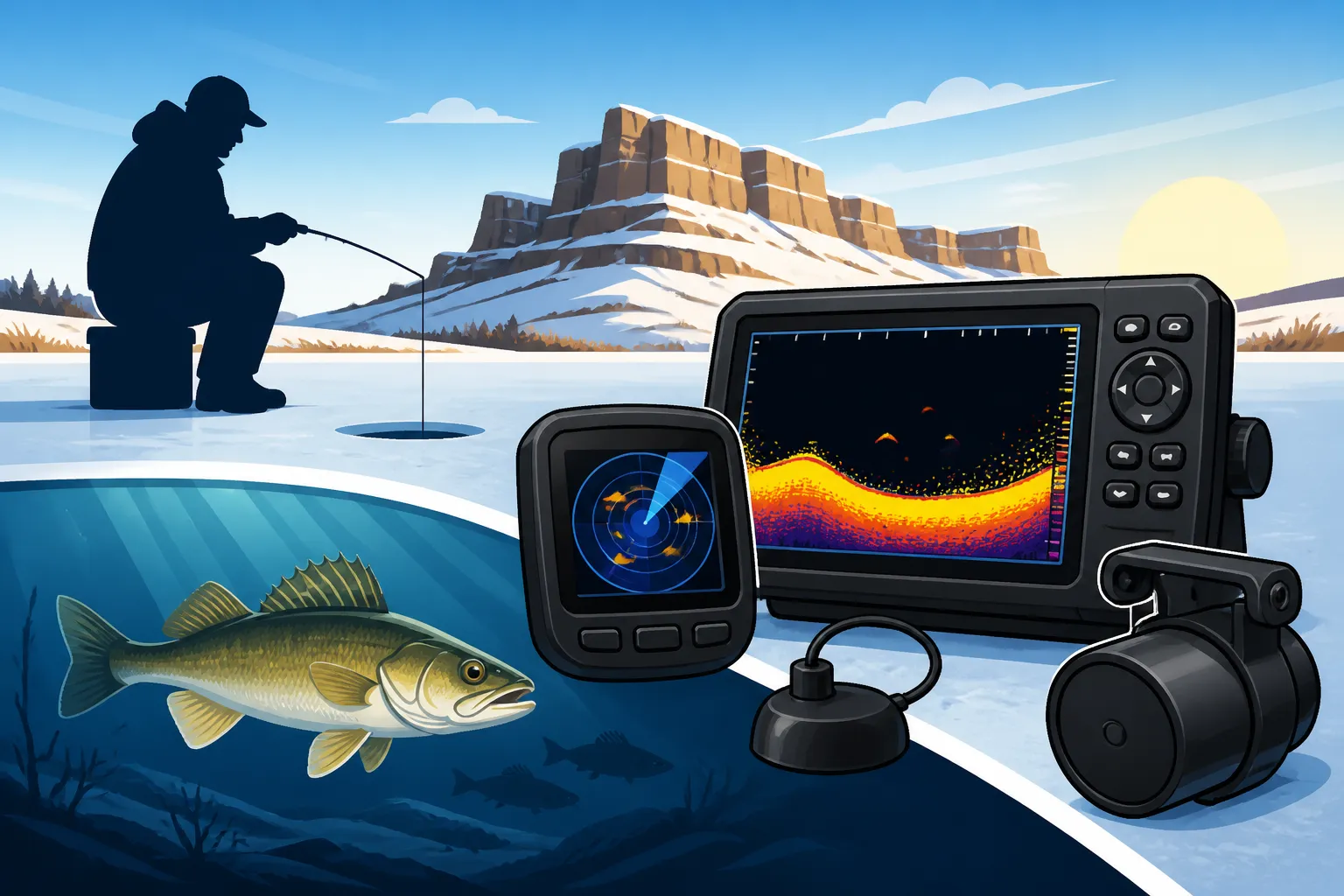
When it comes to outfitting yourself for serious winter walleye hunting in South Dakota, there are three main categories of electronics that anglers rely on. Each has its strengths and best applications, and often, combining them offers the most comprehensive picture of the underwater world.
Flashers: Your Real-Time Window Beneath the Ice
Flashers are often considered the quintessential ice fishing electronics, beloved for their real-time display and simplicity. They use a spinning colored dial to show sonar returns, where different colors or segment lengths indicate the strength of the return. This means you see your jig, the fish, and the bottom all in immediate, live action.
Imagine dropping your lure down the hole; you see a small line or dot representing your bait. As it descends, you watch it in relation to the bottom, which appears as a solid band. Then, suddenly, a brighter, thicker band appears between your bait and the bottom – that's a walleye! You can watch it approach your lure, see if it reacts, and know precisely when to twitch your rod to entice a bite. This direct feedback is invaluable, especially for aggressive walleye that might only commit for a second or two. For many anglers, the immediate feedback of a flasher is unparalleled for actively working fish. Brands like Vexilar and Marcum are very popular, and you can often find a wide selection of models and accessories on retailers like Amazon. They are generally rugged, consume less power than some other units, and are built to withstand the cold. Understanding their display takes a little practice, but once you get it, it becomes second nature. If you're targeting those big Lake Oahe walleye, this real-time feedback can be a game-changer. You can learn more about specific techniques in Winter Walleye Fishing Techniques.
Sonar Units Fish Finders: Mapping the Underwater World
While flashers excel at real-time, instantaneous feedback, modern sonar units, often called fish finders, offer a more detailed and historical view of what's below. These units typically feature LCD or LED screens, displaying a scrolling graph that shows depths, contours, and fish arches over time. Many of these units are portable and can be adapted for ice fishing with specific transducer setups and battery packs.
For finding walleye, especially when you're in an unfamiliar area or trying to understand the overall structure of a spot, a good fish finder is incredibly useful. You can see not only individual fish but also how they relate to subtle humps, sharp drop-offs, or submerged timber. The scrolling display allows you to review recent activity, identifying patterns in fish movement or depth. Many advanced units come with GPS capabilities, allowing you to mark hot spots, navigate back to productive areas, and even download detailed lake maps. This is particularly beneficial for exploring new waters or revisiting areas that produced fish last season. The ability to map the bottom and see depth contours is crucial for understanding walleye habitat, as these fish often follow specific depth breaks or structural elements.
Some modern fish finders even offer features like CHIRP sonar, which provides incredibly detailed target separation, allowing you to distinguish between your bait, a school of baitfish, and a lurking walleye, even in dense cover. When shopping, many anglers check Amazon for competitive pricing and user reviews.
Underwater Cameras: Seeing is Believing
For those who want definitive proof of what's beneath the ice, an underwater camera is an incredibly insightful tool. While they don't offer the same real-time tracking speed as a flasher or the mapping capabilities of a sonar unit, they provide an undeniable visual confirmation of fish species, size, and their reaction to your bait.
Imagine being able to literally watch a walleye swim up to your jig, sniff it, maybe even mouth it, and then decide whether or not to strike. This direct observation can teach you an immense amount about fish behavior, lure presentation, and even the subtle differences in how walleye react to various baits and jigging motions. This visual feedback can be especially helpful when walleye are sluggish or finicky, helping you adjust your presentation until you get a bite. Cameras are also fantastic for identifying structure that sonar might not fully detail, such as small rock piles, specific types of vegetation, or even submerged logs.
While cameras are invaluable for identification and behavioral observation, they do have limitations. Water clarity is a big factor; murky water will severely limit their effectiveness. They also don't provide the wide-angle, instantaneous fish-finding capabilities of sonar or flashers. However, for sheer visual confirmation and an amazing educational experience, nothing beats an underwater camera. They can also be a lot of fun, especially for kids, giving them a direct view of the underwater world.
Advanced Features and What to Look For
Beyond the basic functions, many electronic units offer advanced features that can significantly enhance your winter walleye success. Knowing what these features are and how they benefit you can help you choose the best electronics for your specific needs and fishing style.
GPS Mapping and Waypointing
For serious walleye anglers, especially on large bodies of water like Lake Oahe or Lake Sharpe, integrated GPS mapping is an absolute game-changer. Many modern fish finders and even some advanced flashers come equipped with built-in GPS capabilities, allowing you to load detailed lake maps directly onto the unit.
This means you can easily navigate to known walleye hotspots, follow contour lines, and mark precise waypoints where you catch fish or observe promising structure. Imagine finding a subtle breakline or a small rock pile that's holding walleye; with GPS, you can mark that spot and return to it exactly the next day, or even next season. This is invaluable for building a mental library of productive fishing spots. Some units even allow for custom mapping, where you can record your own sonar data to create incredibly detailed contour maps of your favorite fishing areas. For navigating vast, snow-covered lakes, knowing your exact position and where the underwater features lie can save hours of unproductive drilling and searching. It also significantly improves safety, especially in whiteout conditions or when venturing far from shore. For comprehensive information on specific areas, check out our guide on Best Ice Fishing Techniques for Lake Oahe.
Battery Life and Portability Considerations
When you're out on the ice in freezing South Dakota temperatures, the last thing you want is your electronics dying. Therefore, battery life is a critical consideration. Most ice fishing electronics are designed with portability in mind, often coming in padded carrying cases with integrated battery compartments.
Look for units that offer extended battery life, ideally capable of running for a full day (8-12 hours) on a single charge. Lithium-ion batteries are often preferred for their lighter weight and consistent power output, even in cold weather, though they might come with a higher initial cost. Consider whether the unit has an easily accessible charging port and if spare batteries are readily available. Portability also includes the overall weight and size of the unit. You'll be hauling this gear across the ice, potentially through snow, so a compact, lightweight design is a huge plus. Some setups are designed as "all-in-one" shuttle systems, making them easy to carry and protect. You'll also want to consider the transducer and its cable – a robust, cold-resistant cable is essential, and a float or arm that positions the transducer correctly in the hole without freezing is a great feature.
Durability for Harsh South Dakota Winters
South Dakota winters are no joke, and your electronics need to be built to withstand the extreme cold, snow, and occasional bumps that come with ice fishing. Durability is paramount.
Look for units with robust, impact-resistant housings that can take a fall on the ice without shattering. Screens should be bright enough to read in direct sunlight but also have adjustable backlighting for low-light conditions. More importantly, they should be designed to operate flawlessly in sub-zero temperatures. Manufacturers often specify operating temperature ranges, so pay attention to those details. Water resistance is also key; while they won't be submerged, melting snow, slush, and splashes are inevitable. Look for units with sealed buttons and waterproof connectors to prevent moisture ingress. The transducer cable, as mentioned, should be flexible and resilient in the cold to prevent cracking or breaking. Investing in a high-quality carrying case also goes a long way in protecting your valuable equipment from the elements and accidental damage during transport. A sturdy unit means fewer worries and more focus on fishing, which is what we all want out on the hard water.
Comparing Key Ice Fishing Electronics for Walleye
To help you decide which electronic marvel might be right for your South Dakota ice fishing adventures, here's a quick comparison of the main types:
| Feature/Consideration | Flasher | Sonar Unit (Fish Finder) | Underwater Camera |
|---|---|---|---|
| Primary Benefit | Real-time, instant fish & lure feedback | Detailed mapping, historical data, broader scan | Visual confirmation of fish, species ID, behavior |
| Best For | Actively working fish, quick jigging adjustments | Locating structure, finding fish over wide areas, navigation | Learning fish behavior, species ID, curious anglers |
| Display Type | Spinning LED dial (colored segments) | LCD/LED screen (scrolling graph, digital readout) | Live video feed on LCD/LED screen |
| Target Separation | Excellent | Very good (especially with CHIRP) | Excellent (you literally see it) |
| Mapping/GPS | Limited/None (unless paired with separate unit) | Often integrated, excellent for navigation | None |
| Power Consumption | Generally lower, good battery life | Moderate to high, depends on features | Moderate, depends on screen size & lighting |
| Water Clarity Impact | Minimal | Minimal | Significant (needs clear water to be effective) |
| Typical Learning Curve | Moderate (interpreting colors/segments) | Moderate (interpreting arches/structure) | Low (seeing is easy) |
This table provides a snapshot, but remember, the best setup might involve using a combination of these tools. For example, a fish finder to locate prime structure, and then a flasher or camera to fine-tune your presentation once you've drilled your hole. For more advice on specific baits, check out Best Lures for Ice Fishing Walleye.
Conclusion
Finding winter walleye in South Dakota can be one of the most challenging, yet rewarding, fishing experiences. The key to unlocking consistent success lies in leveraging the incredible technology available today. Gone are the days of blind luck; with the right electronic tools, you can transform your ice fishing approach into a strategic, informed hunt. Whether you opt for the lightning-fast feedback of a flasher, the detailed mapping and historical view of a sonar unit, or the undeniable visual proof of an underwater camera, these devices will help you locate those elusive fish, understand their behavior, and ultimately, put more walleye on the ice. Embrace the technology, and your cold-weather adventures will undoubtedly become more productive and enjoyable.
Disclaimer
This article is for general informational purposes only and does not constitute professional advice. Laws, prices and regulations vary by location and change over time. Consult a qualified professional for guidance on your specific situation.