How Deep to Fish for Walleye in August
August can be a tough month for walleye fishing in South Dakota. The scorching summer sun heats up the surface waters, making walleye disappear into the cooler, deeper parts of our vast reservoirs and glacial lakes. If you've ever found yourself casting endlessly into shallow water with no luck, wondering where all the fish went, you're not alone. This comprehensive guide is here to unravel the mysteries of August walleye behavior and equip you with the knowledge and techniques to locate these elusive fish in the depths.
Understanding Walleye Behavior in South Dakota's August Heat
When the dog days of summer hit South Dakota, everything changes for walleye. They're cold-blooded creatures, and while they can tolerate a range of temperatures, they definitely have their preferences. August pushes them to their limits, forcing them into predictable, yet often hard-to-reach, patterns.
The Impact of Water Temperature on Walleye
Imagine trying to relax in a hot tub that's just a little too warm. That's essentially what the surface water becomes for walleye in August. Walleye generally prefer water temperatures between the mid-60s and low 70s Fahrenheit. When the surface layer of a lake or reservoir heats up into the high 70s or even 80s, these fish will seek refuge.
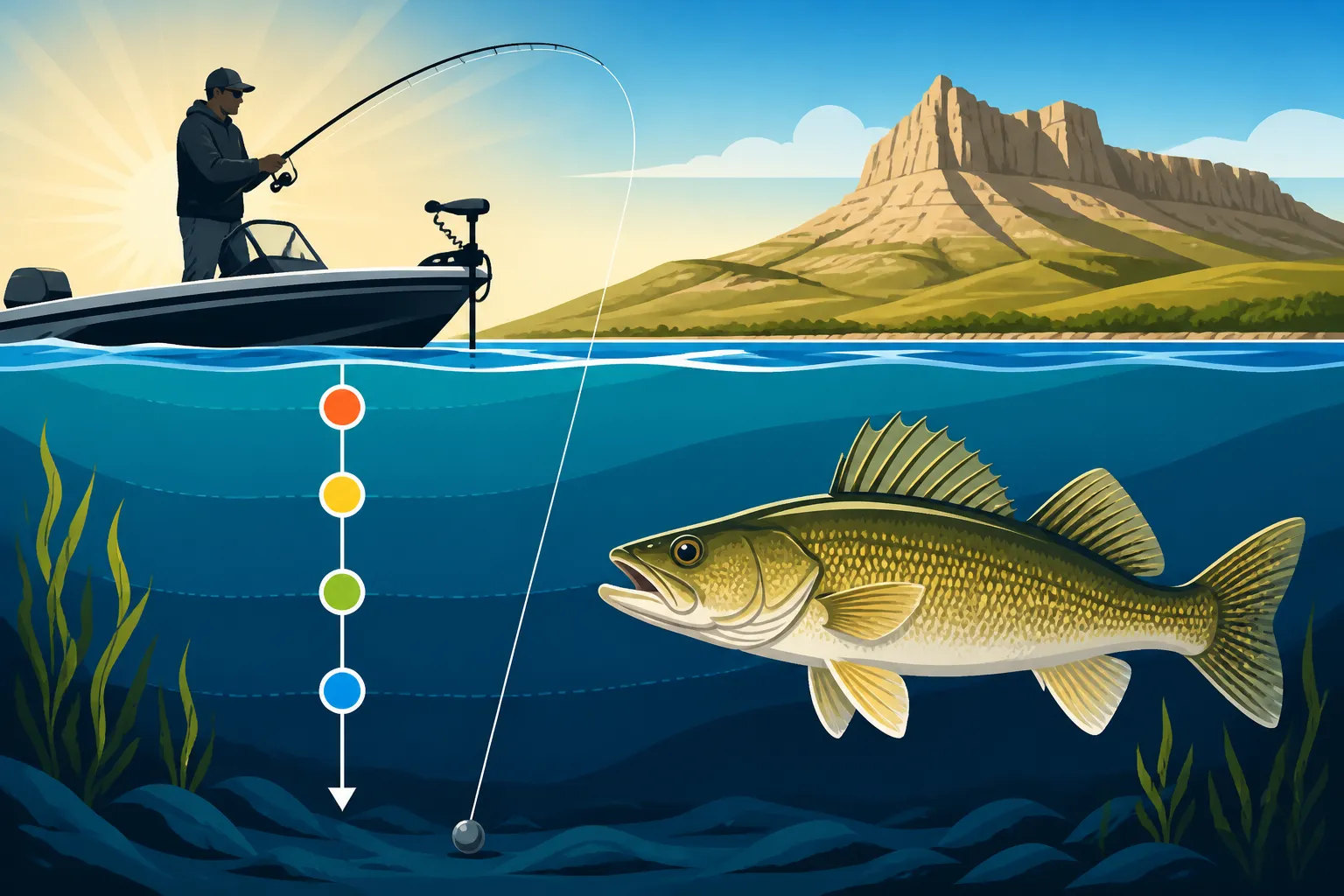
This search for comfort leads them to deeper waters, where a phenomenon called thermal stratification often occurs. This means the lake forms distinct layers of water at different temperatures. The warmest, least dense water stays on top (the epilimnion), while the coldest, densest water sinks to the bottom (the hypolimnion). In between is the thermocline – a transition zone where the temperature drops rapidly. Walleye will often hug this thermocline, finding that perfect cool-but-not-too-cold sweet spot. In South Dakota's massive impoundments like Lake Oahe or Lake Sharpe, these thermal layers can be quite pronounced, dictating where the fish will be. You can learn more about how these changes affect fish throughout the year in our guide on South Dakota Fishing Seasons Explained.
Walleye Forage and Oxygen Levels in August
It's not just about comfort; it's also about dinner. Just like walleye, their primary forage, such as baitfish like shad, smelt, and yellow perch, also respond to water temperature. These smaller fish will often move deeper to find cooler water and the plankton they feed on, which also thrives in specific thermal layers. Walleye, being opportunistic predators, will follow their food source. So, if the baitfish are deep, the walleye won't be far behind.
However, there's another crucial factor: dissolved oxygen. While deeper water is cooler, the very bottom of some highly stratified lakes can become depleted of oxygen, especially towards late summer. This creates what anglers sometimes call a "dead zone" where fish simply cannot survive, even if the temperature is ideal. Therefore, August walleye aren't just looking for the coolest water; they're looking for the coolest water that still has sufficient oxygen and, importantly, actively swimming baitfish. This often means they'll be found just above the anoxic (oxygen-depleted) zone or concentrated along the thermocline where oxygen is still abundant. Understanding What Walleye Eat in Summer can give you an edge in selecting your baits.
Preferred Structures and Cover in Summer
Even when deep, walleye still relate to structure and cover. They don't just suspend randomly in the middle of nowhere. In August, their deep-water haunts often include:
- Deep Points and Humps: Submerged points that extend far out into the main lake basin, or humps that rise up from the bottom, create current breaks and ambush points for walleye.
- Ledges and Breaks: Sharp drops or gradual breaks in the bottom contour provide excellent holding areas. Walleye can sit on the edge, looking up or down for passing bait.
- Submerged Islands: Entirely underwater islands offer extensive structure and can hold large schools of fish.
- Main Lake Basins: While they might suspend, they'll still be near transitions or subtle structures within these deep areas.
- Current Breaks: In riverine systems like the Missouri River reservoirs, any structure that provides a break from the main current can be a magnet for walleye. This might include eddies behind points, submerged rock piles, or old river channels.
Finding these features in deep water can be a challenge, but modern electronics make it more manageable. Walleye tend to be where they can ambush prey without expending too much energy.
Strategies for Locating August Walleye Depths
Successfully finding walleye in August is less about guessing and more about methodical hunting. It involves leveraging technology, patience, and a willingness to adapt.
Reading Your Electronics (Fish Finders and Sonar)
Your fish finder is your absolute best friend when trying to pinpoint August walleye. It's not just about seeing individual fish; it's about understanding the underwater environment.
First and foremost, learn to identify the thermocline. On many modern sonar units, the thermocline will appear as a distinct, hazy, or slightly thicker line across the screen. This is where the water temperature changes rapidly, and it's often where baitfish, and consequently walleye, will stack up. Pay close attention to this depth. If you're seeing lots of baitfish arches in a specific zone, the walleye are likely nearby, either in or just below that bait. You can easily find various fish finders on Amazon that offer advanced thermocline detection.
Next, focus on spotting bait balls and individual fish arches. Baitfish often ball up into dense schools when they're threatened or seeking comfort, and your sonar will show these as large, irregular blobs. Walleye, being predatory, will often be seen as distinct, crescent-shaped arches around or beneath these bait balls. Don't just scan the bottom; adjust your sensitivity and zoom to carefully examine the entire water column from the surface down to the deepest oxygenated levels. Features like side imaging and down imaging are incredibly valuable for finding subtle deep-water structures and even individual fish that might be off to the sides of your boat. For more depth-finding tips, explore How to Read a Fish Finder for Walleye.
The Importance of Scouting and Experimentation
There's no single "magic" depth that will hold all the walleye in every South Dakota lake in August. Conditions change daily, sometimes hourly, based on weather, wind, and even boat traffic. Therefore, a crucial strategy is systematic scouting and experimentation.
Start by targeting known deep-water structures. If you have a map of the lake, look for those deep points, humps, and ledges. Begin by fishing a range of depths on these structures. For example, you might start your troll at 20 feet, then gradually move to 25, 30, and even 40 feet until you start marking fish or getting bites. Don't be afraid to experiment with different speeds, lure presentations, and colors until you dial in what the fish are responding to.
Covering water effectively is key. Trolling with multiple lines at varying depths is a highly effective way to do this. If you're drift fishing, use different weight sizes to present baits at various depths simultaneously. Pay meticulous attention to your electronics, marking any areas where you see activity or get a bite. Even a single fish can provide a clue to the preferred depth, structure, or current break. Remember, you're building a puzzle piece by piece.
Consulting Local Resources and Reports
While your own on-the-water detective work is paramount, local knowledge can give you a significant head start. Before you even launch the boat, check in with bait shops in the area. These folks are on the pulse of the local bite and often get reports from successful anglers. They might tell you if walleye are hitting on deep cranks or bottom bouncers, and sometimes even give you a general depth range for a particular body of water.
Online fishing forums specific to South Dakota or social media groups can also be excellent resources. Anglers often share their successes (and sometimes frustrations) there. The South Dakota Game, Fish and Parks (GFP) website also publishes fishing reports and survey data that can provide general trends for various lakes and reservoirs. Use these resources as a starting point to narrow down your search, but always remember that conditions change, and what worked yesterday might not work today. Consider these reports as helpful hints, not gospel, and be prepared to adjust your strategy once you're on the water.
Typical Depth Ranges and Techniques for August Walleye
While every lake is different, we can generalize typical depth ranges and techniques for August walleye based on South Dakota's varied fishing environments.
Reservoir Walleye Depths (Missouri River System)
South Dakota's Missouri River reservoirs – Lake Oahe, Lake Sharpe, Lake Francis Case, and Lewis and Clark Lake – are legendary for their walleye fishing, but August presents a unique challenge. In these vast, often deep waters, walleye will generally seek out the coolest water with adequate oxygen.
-
Depths: Expect to find walleye anywhere from 20 to 45 feet, sometimes even deeper in areas with significant thermal stratification or strong current. The exact depth will often depend on the depth of the thermocline and the location of baitfish. On Lake Oahe, for instance, you might find them staging on deep main-lake points or along the old river channel at these depths. On Lake Sharpe, where current is more of a factor, they might be deeper, hugging current breaks or submerged structures that offer relief. For more insights into fishing these giants, refer to our South Dakota Missouri River Fishing Techniques guide.
-
Techniques:
- Trolling Deep-Diving Crankbaits: This is a classic August technique for covering water and reaching deep fish. Use crankbaits designed to dive to 20 feet or more, matching them to the depths where you're marking fish. Experiment with trolling speeds and colors.
- Bottom Bouncers with Spinner Rigs or Nightcrawlers: A staple for walleye. Use heavier bottom bouncers (1.5-3 ounces) to keep your bait in contact with the bottom at depth. Tip your spinner rigs with live nightcrawlers or even plastic tails.
- Vertical Jigging: If you're marking schools of fish directly beneath your boat on deep structure, vertical jigging with heavy jigs (1/2 to 1 ounce or more) tipped with minnows or plastics can be incredibly effective.
Glacial Lakes Walleye Depths (Eastern South Dakota)
Eastern South Dakota's glacial lakes, like Lake Kampeska, Lake Poinsett, and Bitter Lake, generally aren't as deep as the Missouri River reservoirs, but the principles of August walleye fishing remain the same. Walleye will still gravitate towards the deepest, coolest water available.
-
Depths: In these lakes, walleye might be concentrated in the deepest holes, main lake basins, or along pronounced deep breaks. Depths could range from 15 to 30 feet, depending on the lake's overall maximum depth and the presence of a thermocline. If the lake is shallower and well-mixed, walleye might be found simply on the deepest available structure.
-
Techniques:
- Lindy Rigging: This subtle live bait presentation is excellent for finicky walleye on glacial lakes. Use a walking sinker to present a live nightcrawler, leech, or minnow just off the bottom.
- Slip Bobber Fishing: If walleye are suspended over deep structure or concentrated on deep weed lines, a slip bobber rig can present your bait at a precise depth.
- Pitching Jigs: For walleye holding on deeper weed edges or rock piles, pitching heavy jigs (3/8 to 1/2 ounce) with plastics or live bait can work.
- Trolling: Similar to the reservoirs, trolling crankbaits or spinner rigs can cover water effectively, especially in larger glacial lakes.
Black Hills Lakes Walleye Depths (Western South Dakota)
While the Black Hills region is primarily known for its incredible trout fishing, some lakes, like Belle Fourche Reservoir and Angostura Reservoir, hold respectable walleye populations. The general rule for August depths still applies: find the coolest, oxygenated water.
-
Depths: In these lakes, walleye will also seek out deeper water, often relating to submerged timber, rock piles, or old creek channels. Depths could be in the 15-35 foot range, depending on the specific lake's characteristics and the severity of the summer heat. Belle Fourche Reservoir, with its unique bowl shape and extensive structure, can hold walleye on deep humps and points.
-
Techniques: Techniques will often mirror those used in the larger reservoirs, emphasizing deep-water presentations:
- Trolling Deep-Diving Crankbaits: Essential for covering water and probing deeper sections.
- Bottom Bouncing: Effective for systematically working deep flats and breaks.
- Vertical Jigging: When fish are marked on specific deep structure.
Here's a quick reference table for August Walleye Depths and Techniques:
| Water Body Type | Typical August Depth Range | Preferred Structures | Common Techniques |
|---|---|---|---|
| Missouri River Reservoirs | 20-45+ feet | Deep points, humps, ledges, old river channels, current breaks | Trolling deep cranks, bottom bouncing, vertical jigging |
| Glacial Lakes | 15-30 feet | Deep holes, main lake basins, deep breaks, weed edges | Lindy rigging, slip bobbers, pitching jigs, trolling |
| Black Hills Lakes | 15-35 feet | Submerged timber, rock piles, creek channels, humps | Trolling deep cranks, bottom bouncing, vertical jigging |
For even more strategies tailored to the summer months, check out South Dakota Summer Walleye Fishing Techniques.
Gear and Lure Considerations for Deep August Walleye
When walleye go deep, your gear needs to be up to the task. You're no longer casually casting light tackle. This is precision fishing, often with heavier weights and specialized presentations.
Essential Gear for Deep Water Presentation
Having the right equipment makes a world of difference when you're trying to fish 30 feet down in August.
- Rods and Reels: You'll want rods with a good backbone and a moderate-fast action to handle heavier weights and provide enough power for solid hooksets in deep water. A longer rod, perhaps 7 to 8 feet, can aid in trolling and casting heavier lures. Pair these with baitcasting reels for trolling or larger spinning reels for jigging, ensuring they have a strong drag system and ample line capacity. Look for reputable brands that offer durable gear.
- Line Choice: For deep water, braided line is often preferred for its lack of stretch and incredible sensitivity. This allows you to feel subtle bites and maintain better contact with your lure or bait, even at significant depths. Tie a fluorocarbon leader (6-10 lb test, depending on water clarity) to your braided main line. Fluorocarbon is nearly invisible underwater and offers good abrasion resistance, which is vital when fishing around deep structure.
- Weights and Rigs: You'll need heavier bottom bouncers (1.5 to 3 ounces) to keep your bait in the strike zone when drifting or trolling. Tungsten jigs are also excellent for vertical jigging because their density allows them to be smaller for their weight, offering a more compact presentation that can sink faster. If you're really pushing the limits of depth or trying to get very specific depth control, especially for suspended fish or when fishing for other deep-dwelling species like Chinook salmon, downriggers are an option, though less common solely for walleye. However, they can provide unparalleled depth precision. You can explore a wide variety of these essential items on sites like Amazon.
Lure Selection for August Depths
Your lure choice is critical, not just in type but also in how it performs at depth.
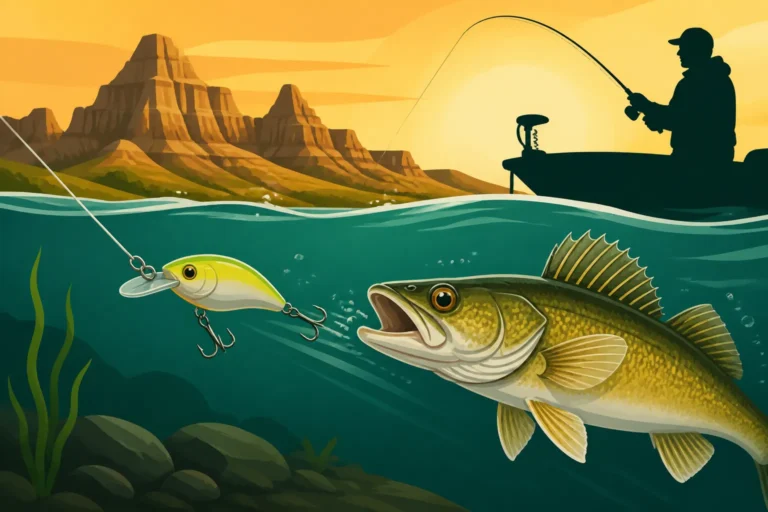
- Crankbaits: For trolling, deep-diving crankbaits are your go-to. Look for models that are specifically designed to reach depths of 20, 30, or even 40 feet on a long line. Examples include large-lipped divers or those with weight transfer systems. Color selection can be nuanced: in deeper, darker water, sometimes brighter, more reflective colors (chartreuse, orange, firetiger) can be effective due to light penetration. Other times, natural baitfish patterns (shad, perch) will mimic the forage. You'll also want to consider the bill design and body profile to ensure it dives correctly and has the right action for walleye. Don't forget to check out our broader guide on Best Lures for South Dakota Walleye for more options.
- Jigs: Heavy jigs, typically 1/2 ounce to 1 ounce, are indispensable for vertical jigging over deep structure. These are usually tipped with live bait like a large minnow (if legal and available), a nightcrawler, or even a plastic swimbait or grub. The key is to keep them directly beneath your boat and "snap" or lift-and-drop them to entice bites.
- Spinner Rigs/Live Bait Rigs: Bottom bouncers paired with spinner rigs or crawler harnesses are incredibly versatile. The flash and vibration of the spinner blade combined with a juicy nightcrawler are hard for a walleye to resist. Lindy rigs, which use a slip sinker and a long leader, are another excellent live bait presentation for slow-drifting or trolling, especially when walleye are finicky.
Mastering Deep Water Techniques
Once you have the right gear and lures, it's about refining your technique. Fishing deep is a different beast than shallow water tactics.
- Proper Boat Control: Whether trolling or drifting, maintaining precise boat control is paramount. For trolling, use your bow-mounted electric trolling motor to keep your speed consistent, even in windy conditions. For drifting, a drift sock can help slow you down and keep your drift path straight, allowing your baits to stay in the strike zone longer. When vertical jigging, keep your boat directly over the fish you're marking.
- Maintaining Bottom Contact: When using bottom bouncers or Lindy rigs, it's crucial to feel the bottom occasionally. You want your weight to be ticking or bouncing along the bottom, not dragging heavily. This ensures your bait is presented at the right depth and helps you feel subtle structure changes.
- Understanding Retrieve Speeds: For crankbaits, trolling speed dictates dive depth and lure action. Experiment until you find the speed that makes your lure run true and draws strikes. For jigs, the cadence of your lift and fall can be the difference between a productive day and a slow one.
- Sensitivity to Detect Bites: Deep-water walleye bites can be incredibly subtle – a slight tick, a spongy feeling, or just added weight. Because of the depth and the amount of line out, it takes practice to distinguish a bite from bumping the bottom. This is where braided line's sensitivity really shines. Be prepared to set the hook firmly at the slightest indication of a bite.
Fishing for walleye in August might require a shift in strategy, but by understanding their deep-water habits and employing the right gear and techniques, you can still enjoy fantastic success on South Dakota's waters. It's a rewarding challenge that makes those hard-earned walleye even sweeter.
Disclaimer
This article is for general informational purposes only and does not constitute professional advice. Laws, prices and regulations vary by location and change over time. Consult a qualified professional for guidance on your specific situation.