Best Crankbait Colors for Stained Water
It's incredibly frustrating, isn't it? You head out to your favorite South Dakota fishing spot, rods rigged and ready, only to find the water isn't the clear, inviting blue you expected. Instead, it's murky, stained a silty brown from recent rains or a greenish tint from an algae bloom. Suddenly, your go-to clear water crankbaits feel useless. This guide is all about helping you confidently choose the best crankbait colors when facing those challenging stained water conditions, ensuring your lure stands out and gets noticed by hungry fish.
Navigating South Dakota's Stained Waters: Why Color Matters
Fishing in stained water is a unique challenge that every angler in South Dakota eventually faces, whether you're on the Missouri River system after a heavy rain or exploring one of the glacial lakes with a bit of a churn. That clear, crisp visibility that makes sight fishing possible is gone, replaced by a murky veil that changes how fish perceive their environment. It's not just about what you can see; it's about what the fish can see, or rather, what they can't see.
Think about it: in clear water, fish rely heavily on their eyesight. They can spot subtle variations in color, intricate patterns, and the lifelike movement of forage from a distance. But once that water gets stained, light penetration is drastically reduced. Different wavelengths of light are absorbed or scattered at varying rates, meaning that colors change or disappear entirely at even shallow depths. A bright red lure might look vibrant on the surface, but a few feet down in muddy water, it could appear as a dull gray or black silhouette. This diminished visibility forces fish to depend more on their other senses, like the lateral line system for feeling vibrations and their olfactory senses for smell. However, color still plays a vital role in triggering strikes, provided you choose hues that can penetrate the murk or create a strong contrast.
Many anglers might be tempted to just throw the brightest thing in their tackle box, assuming "brighter is better." And while brightness can be a factor, it's more nuanced than that. The goal isn't just "bright"; it's "visible" or "contrasting." Sometimes, a darker color provides a better silhouette against the lighter sky above, making it easier for a fish to spot from below. Understanding these dynamics is the first step to unlocking success in South Dakota's stained waters. Whether the staining is from run-off, sediment, or plankton, adapting your color choice is paramount. For a broader understanding of how these conditions impact fishing, consider delving into our guide on How to Fish Muddy Water After Rain.
Types of Stained Water You'll Encounter in South Dakota
South Dakota offers a diverse range of fisheries, and with that comes various types of stained water. Each kind presents its own set of challenges and optimal color solutions.
- Turbid or Muddy Water: This is perhaps the most common type of stained water, often seen on the Missouri River lakes or after significant rain events on smaller bodies of water. It's characterized by suspended sediment, giving the water a brown or yellowish tint. Light penetration here is minimal, making it very difficult for fish to see anything clearly. This often means fish are relying heavily on vibrations and scents. In these conditions, colors that provide a strong silhouette or emit UV light are key.
- Tannin-Stained or Tea-Stained Water: Found more often in lakes and sloughs surrounded by decaying vegetation, this water has a brownish, tea-like color from dissolved organic materials. While it can be dark, it often has better clarity than muddy water, allowing certain wavelengths of light to penetrate more effectively. Greens and yellows tend to fare well in these conditions, often mimicking natural forage colors in such environments.
- Algae Bloom or Green Water: During warmer months, especially in nutrient-rich lakes, algae can proliferate, giving the water a distinct green hue. This type of stain can range from a light tint to a thick, pea-soup consistency. Algae absorb certain light wavelengths, making some colors disappear quickly. Here, contrasting colors are essential to stand out against the dominant green, or colors that still "pop" through the green veil. This type of water condition can significantly impact the effectiveness of your South Dakota Summer Walleye Fishing Techniques.
Each of these water types requires a slightly different approach, and having a diverse selection of crankbait colors, easily found on platforms like Amazon, will give you an edge. Knowing your water conditions on any given day is the first step to making an informed decision about your lure color, so always take a moment to observe the water clarity before making your first cast.
The Physics of Perception: How Fish See Color in Murky Depths
It might seem overly academic, but understanding how light behaves in water and how fish eyes are adapted to perceive it is truly helpful when choosing crankbait colors for stained water. Fish don't see the world exactly as we do, and when you add the filter of murky water, their perception becomes even more alien to our own.
Water acts as a filter, absorbing and scattering different colors of the light spectrum at varying rates. Red light, for example, is absorbed very quickly and effectively disappears first, even in relatively clear water. Orange and yellow follow, while blue and green light penetrate deepest. This is why the ocean depths appear blue—it's the only color left for us to see. In stained water, this absorption and scattering are intensified by suspended particles, significantly reducing the depth at which any color can be perceived. What appears a vibrant chartreuse on the surface might only be a dull silhouette a few feet down.
Fish, especially predatory species like walleye, bass, and pike found across South Dakota, have eyes adapted to their specific environments. Many have excellent low-light vision and a broader spectrum of color perception, some even seeing into the ultraviolet (UV) range. UV light can penetrate water deeper than visible light, and certain dyes in lures are designed to reflect UV rays, making them more "visible" to fish in conditions where visible light is scarce. This is why some lures glow under a UV light source, even if they don't appear particularly bright to the human eye. So, a color that seems subtle to us could be screaming "eat me!" to a fish in dingy water. Understanding these biological and physical factors helps us move beyond simple guesswork when selecting our next crankbait.
Light Absorption and Fish Vision in Turbid Environments
In truly turbid or muddy water, the light penetration is so minimal that traditional "color" as we know it becomes almost irrelevant. At a certain depth, all visible light is absorbed, and everything appears as shades of gray or black. In these extreme conditions, the contrast a lure creates against the ambient light—usually the lighter surface above—becomes paramount. A dark lure will create a strong, easy-to-spot silhouette, making it easier for a fish to locate. Conversely, a very bright lure might also stand out, but its color identity will be lost.
However, in less severe stained conditions, such as tannin-stained or light algal blooms, some specific colors can still be perceived. Greens and yellows, as noted, penetrate deeper. Chartreuse, a fluorescent yellow-green, is particularly effective because it often contains UV-reactive pigments that give it an extra "glow" to fish. Oranges and reds, while quickly absorbed, can still be potent in the very top layer of the water column or if they are highly fluorescent, briefly catching and re-emitting light. This is why you'll often see these "hot" colors dominate discussions about fishing in murkier waters.
The key takeaway is that fish don't just see a single color; they perceive a combination of hue, brightness, and contrast. In stained water, you're trying to give them something that stands out, either through its ability to reflect what little light is available (like bright or UV-reactive colors) or by creating a strong, unambiguous profile (like dark colors). For more on specific fish behaviors, check out our South Dakota Walleye Fishing Guide, which often touches on how these fish react to different conditions. Experimentation is crucial, but starting with colors that are scientifically proven to work better in these challenging conditions will greatly improve your odds.
Decoding the Palette: Best Crankbait Colors for South Dakota's Stained Water
Now that we've covered the "why," let's get into the "what." When you're standing on the banks of Lake Sharpe or navigating the inlets of Lake Oahe and the water looks less than pristine, these are the crankbait colors you'll want to reach for. Each has its own strengths and works best under slightly different stained water scenarios. Having a selection of these ready to go is a smart move for any South Dakota angler.
Bright and Bold: Chartreuse, Orange, and Firetiger
When visibility is low, you need something that practically screams "here I am!" to a fish. This is where the bright, fluorescent colors truly shine.
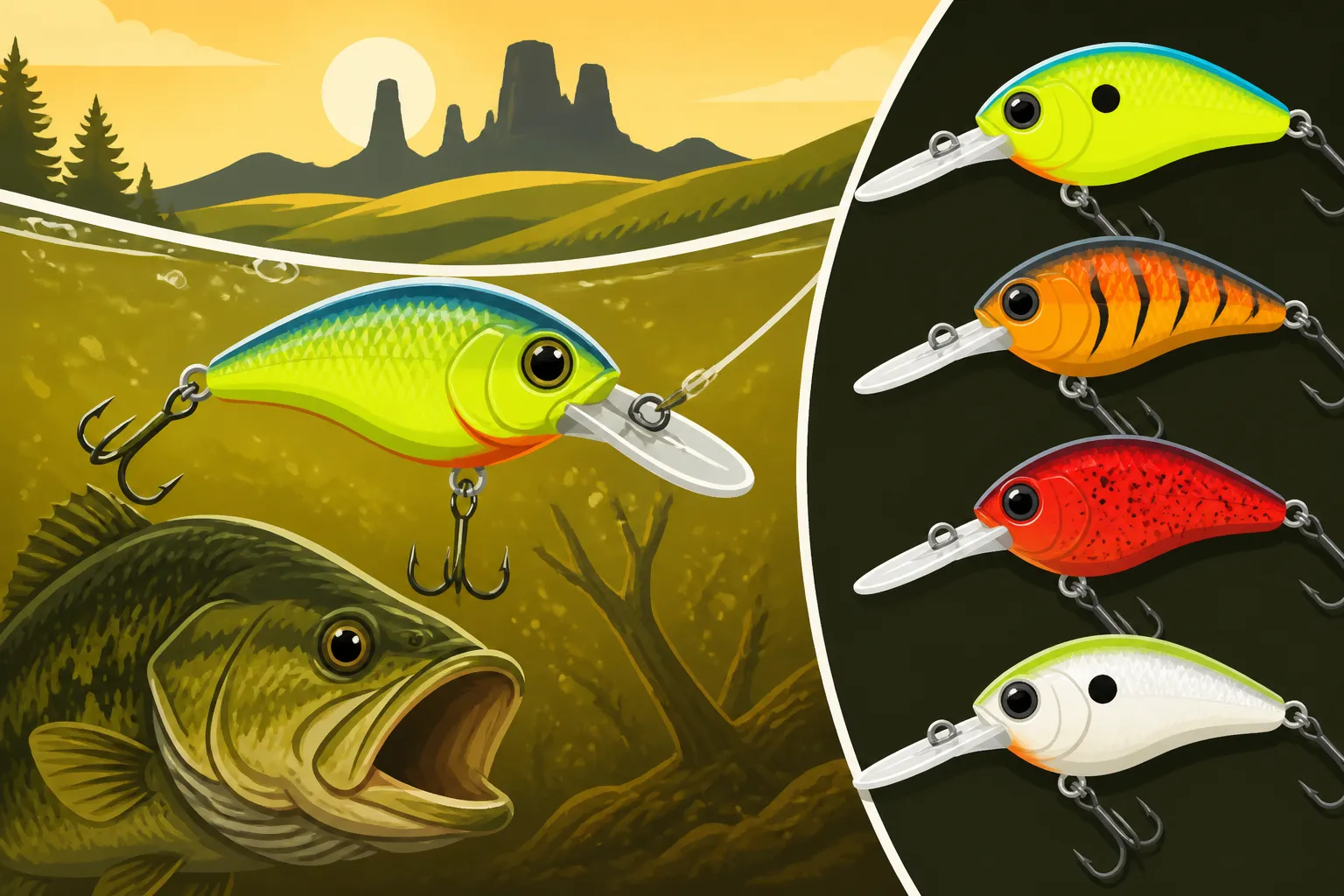
- Chartreuse: This vibrant yellow-green is arguably the king of stained water crankbait colors. Its undeniable popularity isn't just angler folklore; it's backed by science. Chartreuse often incorporates UV-reactive pigments, meaning it "glows" under ultraviolet light, which penetrates deeper into the water column than visible light. To a fish, it might appear brighter and more defined than other colors, even in dark, muddy conditions. It's an excellent choice for general turbid water conditions, whether it's a silty Missouri River backwater or a tannin-stained prairie lake. Many anglers find success with solid chartreuse or chartreuse combinations for South Dakota Spring Walleye Fishing Techniques, when runoff often causes stained conditions.
- Orange: While red light disappears quickly, highly fluorescent oranges can still make a significant impact in stained water, especially in the upper water column. It creates a bold, distinct presence that's hard to ignore. Often used in combination with black, chartreuse, or even brown, orange can mimic the bellies of some baitfish or simply act as an aggressive strike trigger. It's particularly effective in waters with a slight tint rather than full-blown mud.
- Firetiger: This classic pattern combines the best of both worlds: bright chartreuse and orange, often with dark stripes and a black back. It's a high-contrast, attention-grabbing pattern that mimics many natural forage fish while offering maximum visibility. The combination of fluorescent colors ensures it's seen, and the dark stripes create a distinct profile that can cut through the murk. It's a go-to for walleye, northern pike, and even bass in a variety of stained water conditions across South Dakota. You'll find a wide range of crankbaits in this color on online marketplaces like Amazon, making it easy to stock up.
These colors aren't just bright; they're strategically designed to perform when other, more naturalistic colors fail to get noticed. They interrupt the dull, monochromatic environment of stained water, drawing fish in from a distance.
Dark and Contrasting: Black, Purple, and Dark Patterns
While bright colors are excellent for cutting through the murk, sometimes the best approach is to create a stark silhouette. This is where dark colors come into play.
- Black: It might seem counterintuitive to use a black lure in dark water, but consider the perspective of the fish looking up. Against a slightly lighter sky or surface, a black crankbait creates the strongest possible silhouette, making it incredibly easy for a fish to spot. This is especially true in very dark, muddy water where all color is essentially filtered out, and fish are reacting to shape and vibration. Black is a fantastic choice for night fishing in stained water or during extremely overcast days.
- Purple: Often overlooked, purple can be an incredibly effective stained water color. It's a dark color that also offers a subtle hue. In water, purple can retain its identity longer than some other colors, and it provides good contrast against lighter backgrounds. When mixed with black, chartreuse, or silver, it becomes a powerful, high-contrast pattern. Some anglers swear by dark purple or black-and-purple patterns for walleye in tannin-stained waters or during periods of low light.
- Dark Patterns (Black Back/Silver Belly, Dark Brown/Orange Belly): Instead of solid colors, patterns that feature a dark back (black, dark brown, or dark green) combined with a lighter, contrasting belly (silver, orange, or white) can be deadly. The dark back creates that crucial silhouette, while the lighter belly adds a flash of perceived brightness or a different color wavelength that can be seen from the side or below. These patterns often mimic baitfish more naturally while still offering high visibility. Think of how a shad or perch might look against the cloudy sky when viewed from below.
The table below provides a quick reference for matching crankbait colors to specific stained water conditions:
| Water Clarity Type | Primary Color Recommendation | Secondary Color Recommendation | Reasoning for Choice |
|---|---|---|---|
| Muddy/Turbid | Chartreuse, Black, Firetiger | Hot Orange, Dark Purple | High contrast and UV reactivity for visibility; strong silhouettes against lighter sky. |
| Tannin-Stained | Chartreuse, Perch, Green | Orange, Dark Brown | Mimics natural forage in tea-colored water; greens and yellows penetrate better. |
| Algae Bloom | White, Black, Bluegill | Chartreuse, Chrome | Contrasts effectively against green water; white offers bright flash; black provides silhouette. |
| Lightly Stained | Firetiger, Perch, Crawfish | Orange, Gold | Good balance of visibility and natural appeal; excellent choice when clarity isn't completely gone. |
Remember, the goal in stained water is always to make your lure noticeable. Whether that's through an aggressive, fluorescent color or a bold, unmistakable silhouette, these options will cover most scenarios you'll encounter on South Dakota's waters. When browsing for options, looking at highly-rated crankbaits on Amazon can give you a good idea of what other anglers find successful in similar conditions.
Beyond the Hue: Other Crucial Factors for Stained Water Crankbait Success
While crankbait color is a massive piece of the puzzle in stained water, it's far from the only one. When fish can't rely solely on their eyes, they turn to their other highly developed senses to locate prey. Ignoring these other factors would be a disservice to your fishing strategy, especially when trying to entice a bite from a reluctant walleye or a wary bass in challenging conditions.
Getting fish to strike in stained water often means appealing to multiple senses simultaneously. Think about how you would navigate a dark room – you'd use touch and hearing, not just sight. Fish do the same. So, pairing the right color with the right action, sound, and retrieve can transform a mediocre day into a memorable one. For instance, when tackling the vastness of Lake Oahe Fishing Guide, these multi-sensory approaches become even more critical due to the sheer size and varying conditions of the water body.
Vibration and Rattle: Calling Fish from the Murk
In low visibility, sound and vibration become prime attractants. Fish have an incredibly sensitive lateral line system, which detects pressure changes and vibrations in the water, essentially "feeling" their surroundings. This is their primary tool for sensing movement and locating prey when sight is limited.
- Rattling Crankbaits: Lures with internal rattles produce distinct sounds and vibrations that travel through the water, acting as an audible beacon. Different rattles (single large beads, multiple small BBs, glass, or tungsten) produce varying frequencies and intensities, which can appeal to fish differently. When fish can't see your lure, they can definitely hear and feel it coming. Experiment with crankbaits that have loud, aggressive rattles for extremely muddy water, and perhaps more subtle, high-pitched rattles for slightly less turbid conditions.
- Wobble and Action: Beyond rattles, the physical action of the crankbait itself creates vibration. A wide, erratic wobble displaces more water, sending out stronger pressure waves that fish can detect with their lateral line. Deep-diving crankbaits often have a more aggressive wobble, which can be advantageous in stained water as they work through the water column. When choosing a crankbait, consider not just its color, but also how much water it moves and the type of vibration it emits. This is particularly relevant for South Dakota Walleye Fishing Guide, as walleye are highly attuned to subtle vibrations.
Don't underestimate the power of these non-visual cues. Sometimes, a dull-colored crankbait with a tremendous wobble and a loud rattle will outperform a brightly colored one that lacks vibration in heavily stained conditions.
Retrieve Speed and Depth: Finding the Fish in the Zone
Even with the perfect color and vibration, if your lure isn't in the right place at the right time, it won't get bit. Stained water often influences where fish hold, and adapting your retrieve speed and fishing depth is crucial.
- Slow Down: In poor visibility, fish often become less active and more reluctant to chase fast-moving prey. A slower retrieve gives them more time to locate your lure by sound and vibration, and more time to commit to a strike. It allows the fish to track the lure for a longer period, reducing the chance they'll miss it. Experiment with slow, steady retrieves, or even stop-and-go patterns that allow the lure to suspend or slowly rise, mimicking a struggling baitfish.
- Target the Right Depth: Stained water reduces the light penetration, which can push fish shallower to find warmer, brighter water, or deeper if they're light-sensitive and seeking refuge from the surface churn. Use crankbaits designed to reach specific depths where you believe the fish are holding. If you're marking fish on your electronics at 8 feet, ensure your crankbait is designed to run in that 6-10 foot range. Understanding South Dakota Fishing Depth Charts by Season can give you an edge in determining where fish might be in relation to the stained water layer. Trolling is an excellent way to cover various depths until you find the fish's preferred zone. Fine-tuning your trolling speed is also critical; learn more in our Best Trolling Speed for Walleye article.
Scent and Size: Additional Attractors
Sometimes, you need to pull out all the stops to get a bite in challenging stained water. Don't overlook the power of scent and the importance of lure size.
- Scent Applications: Fish have an excellent sense of smell, and in low visibility, this sense becomes even more important. Applying a fish attractant scent to your crankbait can significantly increase your chances. These scents, available in sprays, gels, or pastes, disperse in the water, creating a scent trail that fish can follow to your lure. They can mask human odors and add a natural, appetizing aroma that encourages a hesitant fish to bite. Choose scents formulated for the species you're targeting or general baitfish scents.
- Lure Size: While smaller baits might seem more natural, sometimes a larger profile is necessary to create enough visual and vibrational presence in stained water. A bigger crankbait displaces more water and provides a larger target silhouette. However, if the fish are keying in on very small forage, going too big can be detrimental. It's often a balance: generally, start with a moderately sized crankbait and adjust up or down based on fish activity and the size of local baitfish. For more comprehensive lure recommendations, explore our guide on Best Lures for South Dakota Walleye.
By combining the right crankbait color with attention to vibration, retrieve, depth, scent, and size, you'll be well-equipped to tackle even the most challenging stained water conditions South Dakota can throw at you. Don't be afraid to experiment; sometimes the most unexpected combination is the one that proves irresistible to fish.
Disclaimer
This article is for general informational purposes only and does not constitute professional advice. Laws, prices and regulations vary by location and change over time. Consult a qualified professional for guidance on your specific situation.