Are Saugeye Stocked in South Dakota Waters?
It’s a question that often pops up in conversations among anglers, especially those who spend a lot of time on the mighty Missouri River system here in South Dakota: what exactly is a saugeye, and are these unique fish swimming around in our waters because the state put them there? It’s easy to get confused when you pull a fish out of the water that doesn't quite look like your typical walleye or sauger, leaving you scratching your head about what you've actually caught. This guide aims to clear up that mystery, detailing what a saugeye is, South Dakota's approach to hybrid fish, and how you can tell the difference if you happen to land one.
Understanding Saugeye: Walleye and Sauger Hybrids
The term "saugeye" itself is a bit of a clue, blending the names of its two parent species: the sauger and the walleye. These are not separate species in the biological sense but rather a crossbreed, a fascinating outcome when two closely related fish decide to get a little adventurous.
What Exactly is a Saugeye?
A saugeye is, quite simply, a hybrid fish resulting from the cross between a female walleye and a male sauger. Sometimes you'll hear about the reverse cross as well, but the walleye female/sauger male is the most common and often intentionally created hybrid in other states. They share characteristics from both parents, making them a bit of a unique catch for anglers. Think of them as having the best, or at least a blend, of features from both worlds. They often grow faster than pure sauger and can tolerate slightly murkier water conditions better than pure walleye, inheriting a robustness from both sides of the family tree. You might find yourself saying, "Is that a walleye with spots, or a sauger that's a bit too big and olive-colored?" Chances are, you might be looking at a saugeye.
These hybrids aren't sterile like some other animal crossbreeds. Saugeye can, in fact, reproduce, though their offspring often exhibit genetic inconsistencies, meaning they might not be as robust or fertile as the initial hybrid generation. This is one of the complexities that fisheries managers consider when deciding whether to introduce such hybrids into a system. It’s not just about getting more fish in the water; it’s about maintaining the long-term health and genetic integrity of the fish populations.
Why Create a Hybrid?
Other states, particularly in the Midwest, have intentionally stocked saugeye for specific fisheries management goals. Why would they do this? Well, saugeye offer several compelling advantages that make them attractive in certain situations. They typically grow much faster than pure sauger, reaching a desirable table size more quickly, which is a big plus for anglers looking for a good meal. They also tend to be more tolerant of turbid (murky) water conditions and can thrive in reservoirs that might not be ideal for pure walleye. This adaptability means they can populate and create a viable fishery in waters where a pure walleye or sauger population might struggle.
Imagine a reservoir with fluctuating water levels and some natural turbidity from agricultural runoff. A pure walleye population might struggle with consistent reproduction or growth in such conditions, while sauger might stay smaller. Introducing saugeye can create a robust, fast-growing sportfish population that can handle these environmental challenges, providing excellent angling opportunities where there might otherwise be fewer. This strategic stocking helps maximize the recreational value of specific bodies of water.
Are Saugeye Stocked in South Dakota Waters?
This is the million-dollar question for many South Dakota anglers, and the answer, for the most part, is no – not intentionally. The South Dakota Game, Fish and Parks (GFP) has a specific and well-established approach to managing its fisheries, which currently does not include stocking saugeye.
South Dakota's Focus: Walleye and Sauger Management
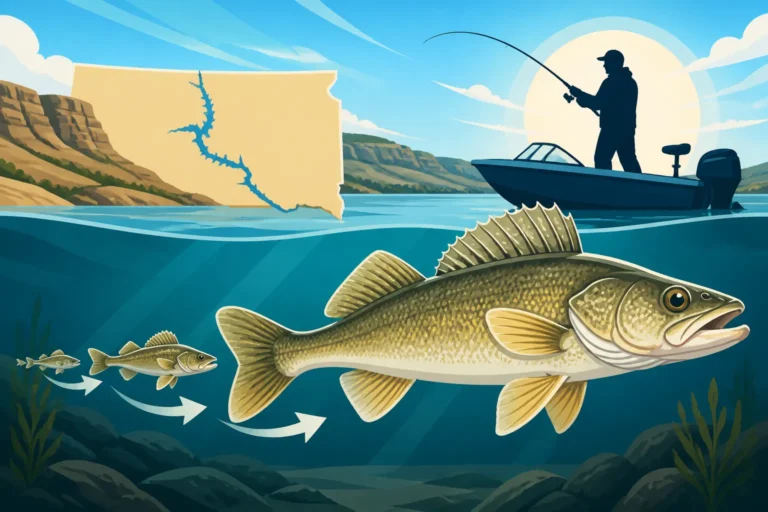
The South Dakota Game, Fish and Parks focuses its efforts on maintaining and enhancing the populations of purebred walleye and sauger, particularly within our incredible Missouri River system. This extensive river system, comprising large reservoirs like Lake Oahe, Lake Sharpe, Lake Francis Case, and Lewis and Clark Lake, is home to thriving populations of both species. The GFP's management strategies are designed to ensure these native and naturalized populations remain healthy and self-sustaining. You can find out more about these strategies in our South Dakota Walleye Fishing Guide and South Dakota Sauger Identification articles.
For walleye, a significant focus is on natural reproduction and, when necessary, supplemental stocking of pure walleye fingerlings to boost populations. Sauger also reproduce naturally in the river system, particularly in the tailwaters below dams where currents are strong and habitat is suitable. The GFP prioritizes the genetic integrity of these species, aiming to preserve their unique characteristics and adaptations to South Dakota's diverse aquatic environments. Introducing a hybrid, even one with desirable traits, could potentially dilute the genetic pool of these already well-established fish. This is a common conservation practice – protecting the "true" species.
Accidental Hybrids and Natural Occurrences
While the South Dakota GFP does not intentionally stock saugeye, that doesn't mean you'll never encounter one in South Dakota waters. Natural hybridization can occur, particularly in systems where both walleye and sauger coexist and spawn in similar areas at similar times. The Missouri River system is a prime example of such an environment. While their spawning behaviors and preferred habitats do differ slightly, there can be overlap. If a male sauger happens to fertilize a walleye egg, or vice versa, in the wild, a saugeye can result.
These naturally occurring hybrids are typically a small percentage of the overall population and are not the result of deliberate stocking efforts. They are a testament to nature's ability to surprise us and to the close genetic relationship between walleye and sauger. So, if you catch something that looks like a saugeye, it's most likely a naturally occurring hybrid rather than a stocked fish. It's a rare and exciting catch, a little biological anomaly that makes your fishing trip even more memorable! Understanding these occurrences can give you a better appreciation for the complex ecosystems we have here in South Dakota.
Distinguishing Saugeye from Walleye and Sauger
Because saugeye are not intentionally stocked, and because they can occasionally occur naturally, it’s really helpful for anglers to know how to tell them apart from their parent species. Misidentifying a fish can sometimes lead to issues with regulations, as different species can have different South Dakota Fish Limits and Size Restrictions. Plus, it’s just plain satisfying to know exactly what you’ve caught!
Key Identification Features
Distinguishing between walleye, sauger, and their saugeye hybrid requires a close look at a few key physical characteristics. While some features might seem subtle, they are usually quite distinct once you know what to look for.
Here’s a breakdown:
| Feature | Walleye | Sauger | Saugeye |
|---|---|---|---|
| Body Color | Olive, golden-brown, or yellow-gold, often fading to white on belly. | Darker, mottled brown or olive, with distinct blotches or saddles. | Intermediate; often olive/brown with some mottling, but less defined than sauger. |
| Spiny Dorsal Fin | One distinct black spot on the lower rear portion. | Rows of distinct small black spots, no large single spot. | Often has some distinct spots, but usually lacks the single prominent walleye spot. Spots might be more scattered than a sauger. |
| Pectoral Fin | Usually clear, sometimes with faint dusky markings. | Often has a dark blotch at the base. | Variable, may have a faint blotch or be mostly clear. |
| Tail Fin (Caudal) | White lower tip on the bottom lobe. | No white tip on the lower lobe. | Often has a faint or less pronounced white tip, or sometimes none at all. |
| Scales on Cheek | Largely scaleless or with very few, sparse scales. | Fully scaled. | Partially scaled, usually rough to the touch when rubbed forward. |
| Body Shape | More elongated and streamlined. | Shorter, more stout, and typically smaller overall. | Intermediate length and girth, often growing larger than sauger but perhaps not as long as a large walleye. |
Let's dive into a bit more detail on each:
- Dorsal Fin: This is often the most reliable way to tell them apart. A pure walleye will almost always have a distinct, prominent black spot on the lower rear portion of its spiny dorsal fin. Think of it as a little thumbprint. A pure sauger, on the other hand, will have distinct rows of small, dark spots running across its entire spiny dorsal fin, creating a more mottled or striped appearance, but no single large black spot. A saugeye will typically have some spots on its dorsal fin, like a sauger, but these spots might be less defined or more scattered, and it will generally lack that prominent single black spot of the walleye.
- Tail Fin (Caudal Fin): Look at the very bottom tip of the tail. A walleye will usually have a distinct white tip on the lower lobe of its caudal fin. This is another classic walleye identifier. Sauger will not have this white tip. Saugeye might have a faint or less pronounced white tip, or sometimes none at all, making it another intermediate characteristic.
- Scales on Cheek: Gently run your finger forward across the cheek of the fish. Walleyes have very few, if any, scales on their cheeks, making them feel relatively smooth. Sauger, by contrast, have fully scaled cheeks, which will feel noticeably rough to the touch. Saugeye will have partially scaled cheeks, often feeling rougher than a walleye but not quite as uniformly scaled as a sauger. This can be a tricky one, but it’s a good supporting indicator.
- Body Pattern and Coloration: Walleye tend to be more uniform in color, typically an olive, golden-brown, or yellow-gold, with a lighter, often white belly. Sauger have a much more distinct mottled pattern, with dark blotches or "saddles" across their backs and sides. Saugeye will fall somewhere in between, often having a somewhat mottled or blotchy appearance, but usually not as pronounced as a pure sauger, and sometimes with the overall golden hue of a walleye.
Why Proper Identification Matters
Beyond the sheer joy of knowing what you've caught, proper identification is crucial for a few practical reasons when fishing in South Dakota. Firstly, regulations can differ. While walleye and sauger often have similar general regulations, there can be specific nuances in daily limits, possession limits, or even length restrictions for certain waters. For instance, you might have specific South Dakota Walleye Limits or South Dakota Sauger Identification details that apply differently. If you incorrectly identify a saugeye as a walleye or sauger, you might inadvertently violate a regulation.
Secondly, it contributes to accurate creel surveys and biological data. When anglers accurately report their catches, it helps the GFP collect better data on fish populations, which in turn leads to more effective management decisions for all species. Finally, it just makes you a more knowledgeable and confident angler. Being able to correctly identify the species you catch enhances your understanding of the fishery and the diverse aquatic life in South Dakota.
The Future of Hybrid Fish in South Dakota
While saugeye stocking isn't currently a part of the South Dakota Game, Fish and Parks strategy, it's natural to wonder about the future of hybrid fish in our waters. Fisheries management is an evolving science, always balancing biological integrity with angler demand and environmental realities.
Conservation and Management Goals
South Dakota's current conservation and management goals for its major fisheries, particularly in the Missouri River system, prioritize the health and sustainability of existing native and naturalized populations. The focus remains on robust walleye and sauger populations, which are incredibly popular and provide fantastic fishing opportunities. The GFP invests heavily in habitat improvement, water quality monitoring, and carefully managed stocking programs for purebred fish when natural reproduction isn't sufficient. This approach aims to maintain healthy ecosystems that support diverse fish populations, ensuring that future generations of anglers can enjoy the same excellent fishing we do today. You can read more about overall management in our South Dakota Fishing Regulations Explained and South Dakota GFP Fishing Handbook Guide.
Introducing hybrids would represent a significant shift in this long-standing strategy. While hybrids can offer advantages in certain niche environments, they also introduce genetic complexities that could have unforeseen long-term impacts on the purebred populations. For South Dakota, where walleye and sauger are so central to the state's fishing identity and economy, a cautious and well-researched approach is paramount.
Angler Interest and Emerging Trends
It's no secret that anglers are always interested in new and exciting fishing opportunities. The idea of a fast-growing, adaptable fish like the saugeye certainly sparks curiosity. In other states where saugeye are stocked, they have proven to be a popular sportfish, offering hard fights and good eating. This success elsewhere might lead some South Dakota anglers to wish for similar opportunities here.
However, the decision to introduce any new species or hybrid into a state's waters is a complex one, involving extensive biological research, environmental impact assessments, and public input. It's not a decision made lightly. While angler interest is always a factor, it must be weighed against ecological considerations, the potential impact on existing fisheries, and the long-term vision for the state's aquatic resources. For now, South Dakota remains committed to its highly successful purebred walleye and sauger programs, providing some of the best fishing experiences in the nation. So, while you might not intentionally target a stocked saugeye in South Dakota, keeping an eye out for those rare natural hybrids makes every catch a little more intriguing! If you're looking for more general information on fish, our Fish Identification for Beginners post might be helpful.
Disclaimer
This article is for general informational purposes only and does not constitute professional advice. Laws, prices and regulations vary by location and change over time. Consult a qualified professional for guidance on your specific situation.