South Dakota Chinook Salmon Trolling Techniques
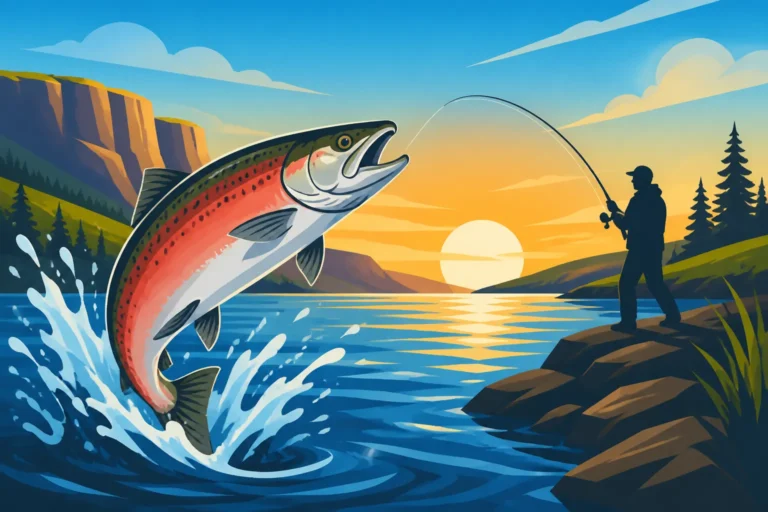
There’s nothing quite like the thrill of a Chinook salmon strike, that powerful run that makes your drag scream and your heart pound. But let's be honest, successfully targeting these magnificent fish, especially in a vast waterbody like South Dakota's Lake Oahe, through trolling, can feel like a daunting puzzle. Many anglers struggle to dial in the right depth, speed, and lure presentation, often spending hours on the water with little to show for it. This comprehensive guide is here to unravel those mysteries, helping you understand the nuances of South Dakota Chinook salmon trolling techniques so you can confidently pursue these hard-fighting beauties.
Understanding Chinook Salmon Behavior in South Dakota
Before you even think about putting lines in the water, it's crucial to understand the fish you're after. Chinook salmon, often called "Kings," have distinct behaviors, especially in a freshwater environment like Lake Oahe. Their movements, what they eat, and how they react to water conditions are key to unlocking successful trolling.
Seasonal Movements and Depths
Chinook salmon in Lake Oahe are known for their deep-water habits, but their exact location and preferred depth shift dramatically with the seasons. They are constantly on the move, chasing baitfish and seeking optimal water temperatures.
In the spring, after the ice recedes, Chinook often linger in the shallower parts of the lake, especially near the river mouths and bays where baitfish like smelt and ciscoes might be congregating. As the water warms, they'll start to spread out, often found in the upper water column in areas that are still cool and oxygenated. Don't be surprised to find them anywhere from 15 to 40 feet deep. The frustration here is that spring can be unpredictable; one day they're shallow, the next a cold front pushes them deeper. It's a constant game of hide-and-seek.
As summer truly sets in, the thermocline (that distinct layer separating warm surface water from cold deep water) forms. This is where Chinook salmon will spend most of their time. They are cold-water fish, typically preferring temperatures in the mid-40s to low-50s Fahrenheit, which means they'll hug the cooler water below the thermocline, often in depths ranging from 50 to 120 feet, sometimes even deeper. This is where having precise depth control becomes absolutely non-negotiable. Trying to find them without the right gear in summer is like searching for a needle in a haystack.
Come fall, as the water temperature starts to drop across the entire lake, salmon begin their pre-spawn migrations. This is when they become more aggressive and often move shallower, especially as they get closer to their spawning grounds, such as the Whitlock Bay Salmon Spawning Station. Depths might vary widely, from 20 to 80 feet, as they transition. This period, especially in September and October, offers some of the most exciting fishing for big Kings. Anglers often refer to this as the "glory days" for Chinook.
Preferred Forage and Water Conditions
Chinook salmon are opportunistic predators, but in Lake Oahe, their diet is heavily dominated by a few key baitfish species. Understanding their menu helps you choose the right lures and presentations.
The primary forage for Lake Oahe Chinook salmon is rainbow smelt and ciscoes (lake herring). These small, oily fish are what the Kings are constantly hunting. When you're selecting lures, think about mimicking the size, shape, and flash of these baitfish. That shimmering, silver-blue profile is often irresistible. The challenge is that baitfish schools move, and if you're not where the food is, the salmon won't be either. You need to keep an eye on your electronics not just for salmon, but for baitfish concentrations too.
Water conditions play a massive role. Chinook salmon thrive in cold, oxygen-rich water. They are extremely sensitive to temperature changes. That's why the thermocline is so critical in summer. They also prefer clear to slightly stained water. Extremely muddy conditions, often caused by heavy rains or strong winds stirring up the bottom, can push them deeper or scatter them, making them harder to locate. A common frustration is when a beautiful day turns into a fishing nightmare after a major weather event makes the water murky. Keeping an eye on water clarity reports can save you a lot of wasted time. Furthermore, understanding What Water Temperature Triggers the Salmon Spawn? can give you insights into their behavior during the crucial fall period.
Essential Gear for South Dakota Chinook Trolling
Trolling for Chinook salmon is not a minimalist endeavor. It requires specialized gear designed to handle powerful fish, deep presentations, and long hours on the water. Skimping on the right equipment often leads to lost fish and endless frustration.
Rods, Reels, and Line Selection
The foundation of your trolling setup starts with the right rod and reel, tailored to withstand the brute force of a King salmon.
For rods, you're generally looking for medium-heavy to heavy power rods, typically 8 to 10.5 feet in length. The longer length helps spread your lines, absorb shock from violent strikes, and handle the heavy weights associated with downriggers or divers. A rod with a moderate-fast to fast action is ideal, providing enough backbone to fight a large fish while having enough flex in the tip to telegraph subtle bites and absorb headshakes. Many anglers prefer fiberglass or composite rods for their durability and parabolic bend, which acts like a shock absorber. Brands like Okuma, Daiwa, or Shimano offer excellent dedicated trolling rods that can be found on platforms like Amazon.
When it comes to reels, a strong baitcasting or line-counter trolling reel is essential. You need a reel with a robust drag system, high line capacity (at least 300 yards of 20-30 lb test), and durable gearing. Line-counter reels are incredibly valuable for precise depth control, allowing you to replicate successful presentations time and again. Knowing exactly how much line you have out, especially when running multiple lines at different depths, is a game-changer. Without it, you're just guessing.
Line selection is another critical factor. Many anglers use 20-30 lb monofilament or fluorocarbon as their main line for its stretch, which helps absorb the initial shock of a strike. However, the trend is increasingly towards braided line (often 30-50 lb test) for its incredible strength, zero stretch, and thin diameter, which allows for deeper diving lures. If you use braid, a 20-30 lb fluorocarbon leader (6-10 feet) is almost always tied to the end. The leader provides invisibility to wary fish and offers some abrasion resistance. For your internal links, consider researching Best Rod and Reel Setup for Walleye Trolling as the principles can be adapted for salmon, focusing on heavier gear.
Downriggers and Planer Boards: Your Depth Control Arsenal
This is where the serious salmon angler separates themselves. Downriggers and planer boards are not just accessories; they are non-negotiable tools for precision trolling. Trying to catch deep-water salmon without them is a recipe for frustration.
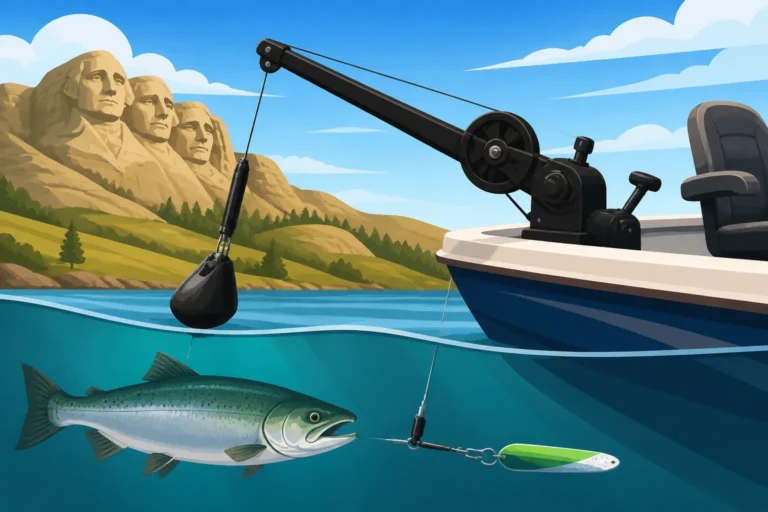
Downriggers are crucial for getting lures down to specific depths, often 50 to 120 feet, and keeping them there. They consist of a heavy cannonball weight (typically 8-15 lbs) attached to a cable, which is lowered by an electric or manual crank. Your fishing line is then clipped to a release clip on the downrigger cable. When a fish strikes, the line pops free from the clip, and you fight the fish directly without the weight. Understanding How to Set Up a Downrigger for Salmon is fundamental. Without them, your lures won't reach the salmon's feeding zone in deeper water. The ability to precisely adjust depth by a few feet can be the difference between an empty livewell and a limit.
Planer boards, on the other hand, are designed to spread your lines horizontally away from the boat. This allows you to cover a wider swath of water, present more lures, and avoid spooking fish directly under your boat. They're particularly useful for shallower presentations or when fish are scattered. There are various types, from small inline boards to large mast systems, each with its advantages. They are less about depth and more about maximizing your search pattern. While not as critical for deep-water Chinook as downriggers, they are excellent for covering more water when fish are spread out or in the upper parts of the water column.
Key Lures, Baits, and Color Strategies
The world of salmon lures is vast, but a few categories consistently produce in South Dakota. Your success hinges on selecting lures that mimic the local forage and present them effectively.
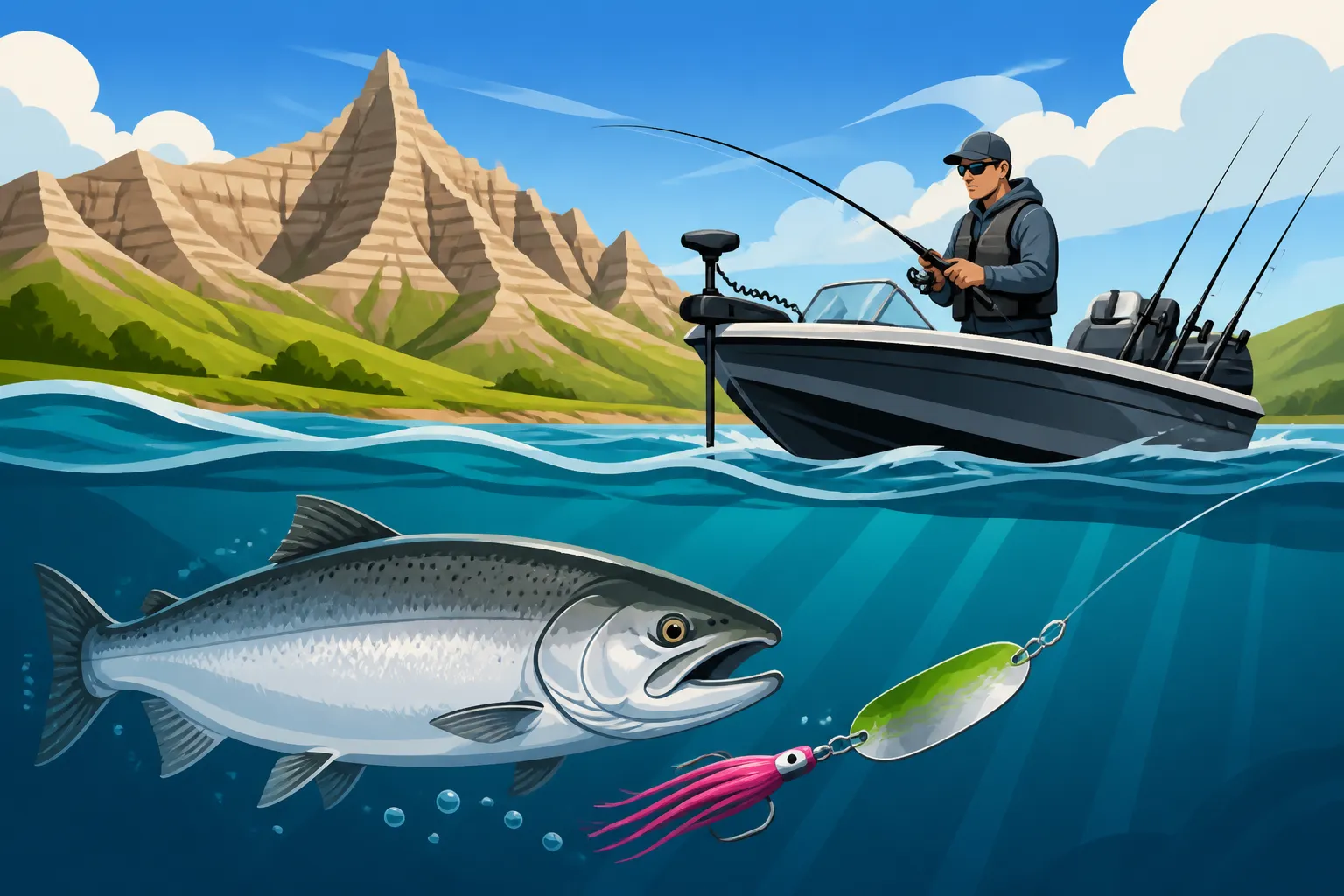
Flasher/Dodger and Fly Combinations: This is perhaps the most iconic and effective setup for Chinook salmon. A flasher or dodger is an attractor that rotates or dodges in the water, creating flash and vibration to draw salmon in. Behind this attractor, a short leader (typically 18-36 inches) is tied to a salmon fly (often called a Hoochie or Squid). The flasher attracts, and the fly imitates a small baitfish. Popular brands like Pro-Troll, Gibbs, and Rhys Davis make excellent flashers. Common fly colors include greens, blues, chartreuse, purples, and sometimes bright oranges, often with silver or glow accents. The combination of flash, vibration, and a subtle baitfish imitation is often irresistible.
Spoons: Trolling spoons are another staple. They mimic injured baitfish with their wobbling action and flash. Sizes vary, but generally, you're looking at spoons between 3.5 to 5 inches for Chinook. Popular patterns include silver/blue, silver/green, various glow patterns, and natural baitfish imitations. Brands like Northern King, Dreamweaver, and Michigan Stinger are highly regarded. Spoons can be fished directly off downriggers, or behind divers and lead core setups. Consider a trip to a local tackle shop or an extensive search on Amazon for "Chinook salmon trolling spoons" to see the variety.
Plugs/Crankbaits: While not as prevalent for deep-water Kings as flashers and spoons, certain large, deep-diving crankbaits can be effective, especially during low-light conditions or when salmon are shallower. These lures often have a more aggressive swimming action.
Live Bait / Cut Bait: While artificial lures dominate, sometimes a strip of herring or a whole baitfish trolled behind a flasher can be the ticket, especially on tough days. However, be sure to check South Dakota Fishing Regulations Explained for any bait restrictions on specific bodies of water.
Color Strategies: This is often hotly debated, but a good rule of thumb is to start with natural colors (silvers, greens, blues) in clear water and brighter, glow-in-the-dark, or UV-enhanced colors in darker conditions, deeper water, or on overcast days. Don't be afraid to experiment! Sometimes, an oddball color can trigger a strike when nothing else will.
| Lure Type | Primary Action/Purpose | Ideal Depth | Key Feature |
|---|---|---|---|
| Flasher/Fly Combo | Attracts with flash/vibration, imitates baitfish | Deep (with downrigger) | High visibility, subtle fly action |
| Trolling Spoons | Wobbling, injured baitfish imitation | All depths | Versatile, good flash |
| Deep-Diving Plugs | Aggressive swimming, direct dive | Mid-deep | Strong vibration, erratic motion |
| Cut Bait/Herring | Natural scent and appearance | All depths | Irresistible scent, realistic profile |
Mastering Trolling Techniques for Chinook Success
Having the right gear is only half the battle. Knowing how to use it effectively, understanding boat control, and interpreting your electronics are what truly bring success.
Speed, Direction, and Boat Control
Trolling speed is paramount for Chinook salmon. Too fast, and your lures might not have the right action or appear natural. Too slow, and they might lack the enticing movement needed to trigger a strike.
Generally, a trolling speed between 1.8 to 2.8 miles per hour (MPH) is a good starting point for Chinook salmon. However, this is highly variable. Pay close attention to how your lures are performing in the water – check them periodically at the side of the boat if possible, or use your fish finder's down-view to observe their action. The ideal speed often depends on the specific lure you're using (some spoons need more speed to wobble correctly, while flies behind flashers have a broader speed tolerance). Small adjustments of 0.1 to 0.2 MPH can make a huge difference.
Direction also matters. Trolling in a straight line for too long can be less effective. Incorporate gentle S-turns or wide arcs. As your boat turns, your inside lines will slow down and drop, while your outside lines will speed up and rise. This change in speed and depth can often trigger strikes from following fish. Many experienced anglers find that Chinook often hit on the outside turn.
Boat control is all about maintaining that precise speed and direction, especially in windy or choppy conditions. A good kicker motor or a bow-mounted trolling motor with GPS capabilities (like a Minn Kota Terrova or Ulterra, or a Lowrance Ghost) can make your life infinitely easier. These systems allow for precise speed adjustments and can even hold your boat on a specific course regardless of wind or current. Trying to troll with just your main outboard can be a constant battle against the elements, leading to inconsistent lure action and missed opportunities.
Reading Your Electronics for Salmon Hotspots
Your fish finder is your eyes under the water. Learning to interpret what it's telling you is crucial for consistently finding and catching Chinook salmon. It's not just about seeing fish; it's about understanding the entire aquatic environment.
First and foremost, you need to find the thermocline in summer. This is often visible as a distinct layer on your sonar screen. Salmon will be concentrated in the cooler water below it. Many modern fish finders, especially those from Humminbird or Garmin, have excellent resolution for this. Next, look for baitfish schools. These will appear as clouds or dense clusters of small arches. If you find bait, especially smelt or ciscoes, you're in the right neighborhood. Chinook won't be far behind.
Then, you're looking for the salmon themselves. They'll appear as large, distinct arches, often elongated due to their swimming speed. Pay attention to their depth relative to the thermocline and the baitfish. Are they just below the bait, or are they suspended above it? Are they holding tight to structure or free-swimming in open water? The more you observe, the more patterns you'll identify.
Side imaging or Mega Imaging (Humminbird) and SideVü (Garmin) technologies are incredibly powerful for trolling. They allow you to scan wide areas to the left and right of your boat, revealing baitfish schools, structure, and even individual salmon that might be outside your traditional sonar cone. This is invaluable for finding those subtle edges or humps that hold fish on a vast lake like Oahe. For a deeper dive, check out How to Read a Fish Finder for Walleye, as many of the principles for identifying fish and structure apply to salmon as well.
Setting Up Your Spread: Multiple Lines and Depths
To maximize your chances, especially on large bodies of water, you'll want to run a "spread" – multiple lines at various depths and distances from the boat. This allows you to experiment, cover more water, and determine the fish's preference on any given day. Remember to check South Dakota's regulations on the maximum number of lines per angler.
A common Chinook salmon trolling spread might include:
- Two Downrigger Lines: These are your workhorses for deep-water fish. You might run one slightly shallower and one slightly deeper, or both at the same depth if you've found a productive zone. For example, one at 80 feet and one at 90 feet.
- Diver Rods (e.g., Dipsy Divers or Jet Divers): These devices clip to your main line and use water pressure to dive to specific depths, often shallower than downriggers but deeper than lead core. They also run out to the side of the boat, helping to spread lines. You might run two diver rods, one on each side, set to run at 30-60 feet.
- Lead Core or Copper Line Rods: These specialized lines are inherently heavy and sink, allowing you to achieve depth without additional weights like downriggers. Each color of lead core (usually 10 yards per color) sinks to a predictable depth at a given speed. You might run a 5-color lead core out the back, targeting a mid-depth range.
- Planer Board Lines: If you're using planer boards, these lines will run furthest out to the sides, often targeting shallower depths (10-30 feet) or simply covering untouched water.
The goal is to stagger your lures both vertically and horizontally. This way, if a fish strikes, you can quickly identify which depth and lure combination was successful and replicate it on your other rods. It's a bit like having a scientific experiment running constantly. Don't be afraid to change out lures or depths until you find what the fish are keying in on.
Where and When to Troll for Chinook Salmon
Knowing the techniques is great, but knowing where to apply them and when you'll have the best chance makes all the difference. Lake Oahe is a vast fishery, and understanding its hotspots and seasonal windows is critical. For a general overview of seasonal patterns, refer to the South Dakota Fishing Seasons Explained.
Prime Locations on Lake Oahe
Lake Oahe, a massive reservoir on the Missouri River, is the undisputed king of South Dakota's Chinook salmon fishing. Its sheer size and deep, cold waters provide the ideal habitat.
- Whitlock Bay (Near Gettysburg): This is perhaps the most famous and productive area for Chinook salmon, especially during the fall spawning run. Salmon congregate here heavily as they prepare to ascend the spawning ladder. Trolling outside and within the main bay, especially around the mouth, can be incredible. Even during summer, the deeper waters around Whitlock Bay can hold Kings. The Lake Oahe Chinook Salmon Fishing at Whitlock Bay article offers more specific details for this area.
- The Cheyenne River Arm: This large arm of Lake Oahe, particularly where it meets the main lake, offers extensive deep water and structure. Salmon will often migrate through or hold in these areas, especially where there are significant depth changes, submerged creek channels, or points. Look for baitfish here.
- The Main Lake Channel (from Pierre North): The old Missouri River channel, now submerged, acts as a highway for salmon and baitfish. Troll along the edges of this channel, especially where it meets flats or submerged points. Areas near the Oahe Dam can also be productive, as the tailrace provides a constant flow of cold water, though special regulations may apply directly below the dam. For more general information about this area, check out the Lake Oahe Fishing Guide.
- Deep Points and Humps: Anywhere there's a significant change in bottom contour, especially deep points extending into the main lake or submerged humps rising from the depths, can be a salmon magnet. These features often concentrate baitfish and provide ambush points for predatory salmon.
It's a huge lake, so having good charts (digital or paper) on board is essential. Focus your efforts on areas with sharp depth transitions, proximity to the main river channel, and, most importantly, where you're seeing baitfish on your electronics.
Best Times of Day and Seasonal Windows
Chinook salmon are often most active during specific times of the day and year, though there are always exceptions.
Time of Day:
- Low Light Periods: The hours around dawn and dusk are typically the most productive for Chinook. During these periods, salmon often move shallower or become more aggressive as baitfish are more active.
- Overcast Days: Overcast or rainy days can extend the productive "low light" bite throughout the day, as the reduced light penetration makes salmon feel more comfortable feeding in shallower water.
- Night Fishing: While not as common as daytime trolling, night fishing for Chinook can be incredibly effective, especially in summer. Salmon often come up shallower under the cover of darkness. This requires specialized gear like glow lures and proper navigation lighting.
Seasonal Windows:
- Late Spring (May-June): As the water warms, but before the thermocline is fully established, salmon can be found in a wider range of depths. This is a great time to start your trolling efforts.
- Summer (July-August): This is deep-water fishing season. Success relies heavily on downriggers and finding that thermocline. While challenging, the rewards can be great. The average size of salmon caught is often smaller, but they are plentiful.
- Fall (September-October): This is prime time for trophy Chinook. As salmon approach their spawning period, they become incredibly aggressive and often move shallower. This is when anglers target the biggest fish, often leading to impressive South Dakota Chinook Salmon Average Size catches. The famous salmon run at Whitlock Bay happens during this window.
Common Challenges and Troubleshooting for Trolling
Even with the best gear and knowledge, trolling for Chinook salmon isn't always easy. Anglers face various challenges, from finicky fish to tangled lines. Knowing how to troubleshoot these common issues can save your day.
Dealing with Finicky Bites and Changing Conditions
One of the most frustrating aspects of salmon fishing is when the fish are "finicky." You know they're there, you see them on the sonar, but they just won't bite. This often means you need to adjust your presentation.
- Speed Adjustments: Your first go-to should be subtle changes in trolling speed. Even 0.1 MPH can make a difference. Experiment with slowing down or speeding up. Remember to incorporate those S-turns to vary your lure speed and depth.
- Lure Changes: If speed isn't working, it's time to cycle through your tackle box. Change lure colors, sizes, or even types. Sometimes a subtle fly is preferred over an aggressive spoon, or vice-versa. Pay attention to the local baitfish and try to match the hatch. This is where having a good selection of Best Lures for South Dakota Walleye (and adapting them for salmon) can be beneficial.
- Depth Tweaks: Even if you're on the thermocline, try moving your lures a few feet up or down. Salmon might be feeding just above or below the main bait ball, or they might be hugging a specific depth contour.
- Lead Length: For flasher/fly combos, try adjusting the leader length between the flasher and the fly. Sometimes a longer lead (e.g., 36 inches) gives the fly a more natural action, while a shorter lead (e.g., 18 inches) makes it more erratic.
- Time of Day/Conditions: If the sun is high and conditions are calm, fish often go deeper or become less active. Consider focusing on deeper water, switching to more subtle presentations, or waiting for lower light conditions. Conversely, if a storm front is moving in, fish might become more aggressive.
Changing conditions like wind, current, or sunlight can dramatically impact fish behavior. If the bite suddenly dies, don't just keep doing the same thing. Be proactive and make adjustments!
Avoiding Gear Tangels and Snags
Few things are more frustrating than pulling up a tangled mess of lines or losing expensive gear to a snag. With multiple lines in the water, prevention is key.
- Maintain Your Spread: Ensure your lines are properly staggered horizontally and vertically. This is where planer boards, diver settings, and downrigger depths become crucial. If you notice lines getting too close, adjust.
- Regular Lure Checks: Periodically check your lures to ensure they're running cleanly. Sometimes weeds, debris, or even a small fish can foul a lure, causing it to spin incorrectly or tangle with other lines.
- Sharp Hooks: Ensure your hooks are razor-sharp. Dull hooks lead to missed strikes, and a thrashing fish on a dull hook is more likely to create a tangle.
- Clean Releases: When a fish strikes and your downrigger clip releases, reel in the slack quickly and fight the fish. A loose line can easily drift into other lines. When resetting a downrigger, ensure the weight is clear of all lines before dropping it.
- Watch Your Electronics for Structure: When trolling in areas with submerged trees, rock piles, or steep drops, keep a close eye on your fish finder. If you see potential snags approaching, reel up your lines to avoid them. This is where understanding your sonar, as discussed in "Reading Your Electronics," pays dividends.
- Use Heavy Main Line and Leaders: While you don't want lines so heavy they spook fish, using adequately strong main lines and leaders for your downriggers and divers can help prevent break-offs if you do snag, allowing you to often retrieve your expensive gear. The initial shock of a snag is often less damaging than the continuous pull on a weak line.
By being mindful of your gear, your boat's movement, and the underwater environment, you can significantly reduce the chances of tangles and snags, making your fishing experience much more enjoyable.
Safety and Conservation Practices
Being out on Lake Oahe chasing Chinook salmon is an incredible experience, but it comes with responsibilities. Safety on the water and conserving the fishery for future generations are paramount.
Essential Boat Safety on Big Water
Lake Oahe is an enormous body of water, and conditions can change rapidly. Prioritizing safety is not just good practice; it's essential for your well-being and that of your crew.
- Life Jackets (PFDs): Ensure everyone on board has a properly fitting, readily accessible life jacket. For children, it's often best that they wear them at all times. On big water, accidents can happen fast. Refer to South Dakota Boat Safety Requirements for a full list of regulations.
- Navigation and Communication: Carry up-to-date nautical charts (digital on your fish finder/GPS, and a paper backup). Have multiple means of communication: a charged cell phone in a waterproof bag, and ideally, a VHF marine radio, especially if you're venturing far from shore.
- Weather Awareness: Check the weather forecast before you leave and monitor it throughout the day. High winds can turn Lake Oahe into a very dangerous place with significant waves. Know when to head back to shore.
- Emergency Kit: Pack a well-stocked first-aid kit, a fire extinguisher, distress signals (flares or an air horn), a paddle or oars (even on a powerboat), and extra water and snacks.
- Tell Someone Your Plan: Always inform a trusted person on shore of your float plan – where you're going, when you expect to return, and who is with you.
- Boat Maintenance: Ensure your boat and engine are well-maintained before each trip. Check fuel levels, battery charge, and navigation lights. Running out of fuel or having engine trouble on a vast lake can quickly become a serious situation.
Responsible Catch and Release or Harvest
As anglers, we are stewards of our fisheries. Practicing responsible catch and release, or ethical harvesting, ensures that South Dakota's Chinook salmon population remains healthy.
- Know the Regulations: Before you go, thoroughly understand the current South Dakota Fishing Regulations Explained for Chinook salmon, including daily limits, possession limits, and any size restrictions. These can change, so always check the latest South Dakota Game, Fish and Parks (GFP) guide.
- Handle Fish Carefully: If you plan to release a salmon, minimize its time out of the water. Handle it gently with wet hands, supporting its body. Use a rubberized net to protect its slime coat.
- Revive If Necessary: If a fish is lethargic after a fight, hold it gently in the water, facing into the current, until it regains strength and swims away on its own.
- Ethical Harvest: If you're harvesting fish, dispatch them quickly and humanely. Bleed them immediately and get them on ice to ensure the best possible table fare. A large cooler filled with ice is indispensable for preserving your catch on a long day on the water.
- Avoid High-Grading: High-grading, or culling through your catch to keep only the largest fish while releasing smaller, stressed fish that are likely to die, is unethical and often illegal. Once a fish is in your livewell or on your stringer and meets legal requirements, it typically counts towards your limit.
By adhering to these safety and conservation practices, you not only protect yourself and others but also contribute to the long-term health and enjoyment of South Dakota's incredible Chinook salmon fishery.
Disclaimer
Please note: Fishing regulations, conditions, and fish behavior can change rapidly. Always consult the latest South Dakota Game, Fish and Parks (GFP) regulations and local advisories before heading out on the water. This guide is for informational purposes only and does not supersede official regulations.