Is a Jon Boat Good for South Dakota Reservoirs?
Many anglers dream of hitting the vast waters of South Dakota's reservoirs, but a common question that pops up, especially for those new to bigger water or on a budget, is whether their trusty Jon boat is truly up to the task. It’s a valid concern, as these aren't small, sheltered ponds we're talking about, and the wrong boat can quickly turn a fun day into a perilous one. This guide will dive deep into the practicalities, advantages, and very real limitations of using a Jon boat on South Dakota's expansive reservoirs, helping you make an informed decision to stay safe and catch more fish.
Understanding Jon Boats and South Dakota's Reservoir Landscape
Before we can really tackle the question of whether a Jon boat is suitable, it's crucial to understand what a Jon boat is and what exactly we mean by "South Dakota reservoirs." The mismatch often lies in the fundamental design of the boat versus the dynamic environment it's asked to perform in.
Characteristics of a Typical Jon Boat
A Jon boat is generally known for its flat-bottomed hull, which makes it incredibly stable in calm, shallow water. Think small rivers, quiet lakes, or marshy backwaters. They typically have a wide beam relative to their length, providing a stable platform for casting or standing, and they're often made from aluminum, making them relatively lightweight and easy to transport. The open, no-frills layout is fantastic for hauling gear, and their simple design often means a lower price point and easier maintenance compared to more complex vessels. For many, a Jon boat is the quintessential utilitarian fishing craft, perfect for putting around a local farm pond or the calm stretches of a smaller river. You can find a wide array of accessories and even entire boat packages designed around this simplicity at retailers like Bass Pro Shops.
However, that flat bottom, while great for stability in calm water and navigating skinny depths, is also its biggest weakness in choppy conditions. It tends to "slap" waves rather than cut through them, creating a jarring, wet, and potentially unsafe ride when the water gets rough. The low freeboard (the height of the boat's side above the waterline) also means that even moderately sized waves can easily splash into the boat, or worse, swamp it entirely if the conditions are severe.
The Nature of South Dakota's Larger Reservoirs
When we talk about "South Dakota reservoirs," we're often referring to the huge impoundments on the Missouri River system: Lake Oahe, Lake Sharpe, Lake Francis Case, and Lewis and Clark Lake. These aren't just big lakes; they are vast, open bodies of water, some stretching for hundreds of miles, often surrounded by wide-open plains. This geographic reality means a few things for boaters:
Firstly, wind is a constant factor. South Dakota is known for its strong, persistent winds, which can whip up waves surprisingly quickly, even on what started as a calm morning. These waves can become significant, with whitecaps and swells that would be challenging for even larger boats, let alone a flat-bottomed Jon boat. The sheer fetch – the distance over which the wind blows unobstructed – allows waves to build substantial size and power.
Secondly, these reservoirs can have deep, open water, especially in the main channels. While you might be fishing shallower bays or structure, traveling between spots can expose you to vast expanses of open water where wind-driven waves have ample room to develop. Fishing on Lake Oahe, for instance, often involves covering significant distances, and a sudden squall can turn a pleasant cruise into a dangerous ordeal if you're not in a boat designed to handle it. The conditions can change rapidly, and being caught far from a safe harbor in an unsuitable boat is a serious safety concern. The South Dakota Boat Safety Requirements are in place for a reason, stressing the importance of having the right equipment for the waters you're on.
Advantages and Disadvantages of Using a Jon Boat on South Dakota Reservoirs
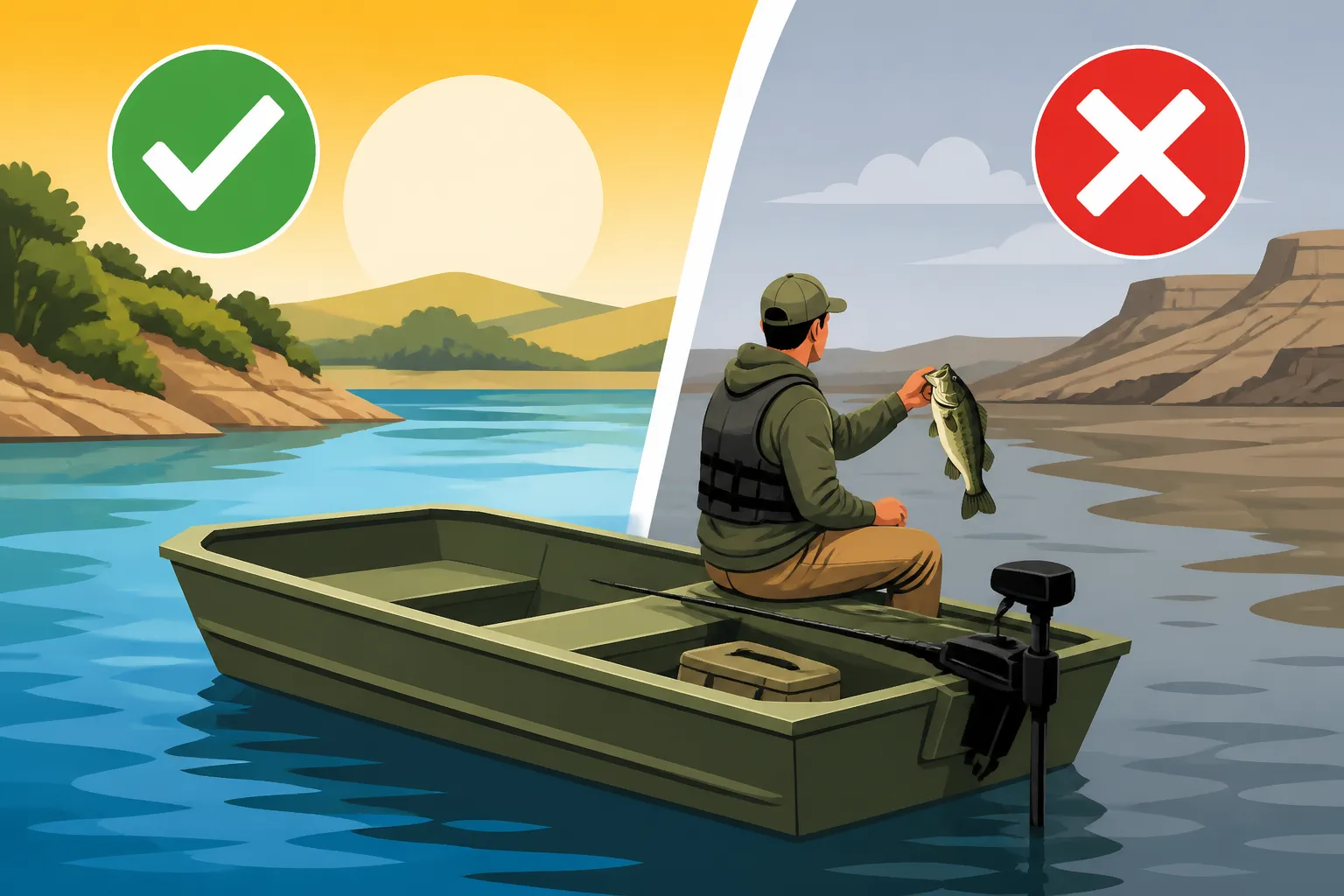
So, can you actually use a Jon boat on these big South Dakota waters? The short answer is: sometimes, with extreme caution, and under very specific, limited conditions. But the long answer really highlights why it's usually not the best or safest choice.
Where Jon Boats Shine on Reservoirs
There are indeed niche scenarios where a Jon boat might seem like a viable option, particularly for anglers who understand its limitations and prioritize safety above all else.
- Calm, Bluebird Days: On those rare, perfectly calm days with little to no wind, a Jon boat can indeed offer a stable platform for fishing. If the forecast is absolutely clear and you plan to stick to the most protected coves or backwaters, you might be able to enjoy a peaceful outing. This is especially true if you’re fishing very early in the morning before any breezes pick up or late in the evening as the winds die down.
- Sheltered Coves and Backwaters: The large reservoirs do have numerous bays, creek arms, and protected coves that are somewhat shielded from the main lake's chop. If your fishing plan involves exclusively targeting these areas, and never venturing into the main body of water, a Jon boat can theoretically get you to those spots. These might be areas where shallow water access is key, like flooded timber or weed beds that are hard for deeper-V boats to reach.
- Smaller Glacial Lakes: South Dakota also has a multitude of smaller glacial lakes in the eastern part of the state, such as Lake Kampeska or Lake Poinsett. While still sizable, many of these tend to be shallower and might not generate the same kind of massive waves as the Missouri River reservoirs. On these lakes, especially on calm days, a Jon boat can be a much more practical choice for chasing panfish or even smaller walleye. However, even these lakes can get nasty in a strong wind, so vigilance is still paramount. South Dakota Glacial Lakes Fishing Guide offers more insight into these waters.
- Specific Fishing Styles: If you're primarily focused on very slow-trolling or vertical jigging in relatively shallow, protected waters, and can pick your days perfectly, a Jon boat's stable platform can be advantageous. It's easy to move around in, and you can outfit it with a simple trolling motor for precise boat control.
However, even in these "shining" moments, the underlying vulnerability of the Jon boat remains. A sudden change in weather, which is not uncommon in the plains, can quickly negate any perceived advantage.
The Significant Limitations and Risks
This is where the reality check comes in. The limitations of a Jon boat on South Dakota's major reservoirs are significant and, frankly, often dangerous.
- Wind and Waves: This is the number one issue. As mentioned, South Dakota is windy. A mild breeze can quickly turn into a gusty wind, and within minutes, the once-calm water can transform into a minefield of whitecaps. A flat-bottomed Jon boat pounds mercilessly against waves, sending spray flying over the bow, soaking occupants, and making any kind of comfortable or safe ride impossible. The constant pounding can also be incredibly hard on the boat itself, potentially stressing seams and equipment.
- Safety Concerns: The low freeboard of a Jon boat means it's highly susceptible to taking on water in choppy conditions. If waves break over the bow or sides, the boat can quickly fill with water, leading to instability, swamping, or even capsizing. Imagine being miles from shore on Lake Oahe with waves breaking into your boat – it’s a terrifying scenario. Even if you're wearing appropriate South Dakota Life Jacket Requirements safety gear, being in the water in large, cold reservoirs can quickly lead to hypothermia, even in summer. The vastness of these lakes means help can be a long time coming.
- Lack of Comfort: Beyond safety, the ride in a Jon boat on anything but glass-smooth water is incredibly uncomfortable. You'll be constantly bracing, getting soaked, and likely dealing with gear bouncing around. What's supposed to be a relaxing day of fishing turns into an exhausting battle against the elements. This lack of comfort often means cutting trips short, especially if you have family or less experienced anglers with you.
- Limited Range and Versatility: Because of the safety and comfort issues, Jon boats are severely limited in their range on big reservoirs. You can't safely make long runs to find fish or quickly get back to shore if the weather turns. This significantly restricts your access to prime fishing spots that might be further out or require crossing open water. For anglers looking to chase walleye across Lake Sharpe or Chinook salmon on Lake Oahe, a Jon boat simply isn't a practical vessel. South Dakota Chinook Salmon Fishing Guide elaborates on the challenges of fishing for this species on big waters.
| Feature | Jon Boat (Typical) | Deep-V Hull Boat (Typical) | Multi-Species Boat (Typical) |
|---|---|---|---|
| Hull Shape | Flat Bottom | Deep-V or Modified V | Modified V, often with flatter stern |
| Primary Use | Calm, shallow waters; small rivers/ponds | Open, choppy waters; large lakes/reservoirs | Versatile, handles varied conditions for multiple species |
| Ride in Waves | Rough, pounding, wet; prone to swamping | Cuts through waves, smoother, drier ride | Good, absorbs chop well, decent ride in moderate waves |
| Stability (Still) | Excellent | Good, but can rock more than a Jon boat | Very good, often wider beam for stability |
| Shallow Water | Excellent access, shallow draft | Moderate, deeper draft can limit access | Moderate, deeper draft but often with jack plates |
| Speed/Power | Moderate, often smaller outboards | High, designed for larger engines | High, designed for larger engines |
| Safety on SD Reservoirs | LOW (High Risk in Wind/Waves) | HIGH (Designed for these conditions) | HIGH (Designed for these conditions) |
| Cost | Lower | Moderate to High | Moderate to High |
| Portability | High (lighter weight) | Moderate | Moderate |
When a Jon Boat Might Work and Alternative Boat Types
Given the significant risks, it's generally advisable to approach the idea of using a Jon boat on South Dakota's large reservoirs with extreme caution. If you already own one, understanding strict limits is key.
Best Practices for Jon Boat Anglers on Reservoirs
If you absolutely must use a Jon boat on a larger South Dakota reservoir, perhaps because it's your only option, here are critical best practices that shift from "recommended" to "mandatory" for your safety:
- Strict Weather Monitoring: This is non-negotiable. Check the forecast religiously, not just for the day, but for the hour-by-hour changes. Look for wind speeds, gust predictions, and any approaching storm fronts. If wind speeds are predicted to exceed 10-15 mph, especially from an exposed direction, stay home or stick to truly sheltered areas. Remember, conditions on the water can worsen much faster than on land. Many anglers consult apps that provide detailed wind and wave forecasts for specific bodies of water before even leaving the driveway.
- Stay Close to Shore and Accessible Exits: Never venture far from shore or from easily accessible boat ramps or protected areas. Your escape plan should be crystal clear. If the weather starts to turn, you should be able to get back to safety in minutes, not hours. This means limiting your fishing to very specific, protected coves or bays, and treating the main lake like an off-limits zone.
- Prioritize Safety Gear: Every single person on board must wear a properly fitted life jacket at all times, not just have it stowed away. Ensure your boat meets all South Dakota Boat Safety Equipment Requirements, including a functional bilge pump (test it!), sounding device, navigation lights, and a throw cushion. Carry a marine radio or fully charged cell phone in a waterproof bag, though keep in mind cell service can be spotty on some parts of the reservoirs. An anchor with ample rope is also crucial to hold your position if you lose power or need to wait out a squall.
- Know Your Limits and Your Boat's Limits: Be realistic about what your Jon boat can handle. It's not a deep-V fishing machine. If you start to feel uncomfortable, or if the waves begin to make you nervous, it's time to head in, no matter how good the fishing is. Fish are simply not worth risking your life. This often means foregoing popular spots or certain times of day that might be excellent for fishing but too risky for your particular craft.
- Consider a Smaller, More Protected Body of Water Instead: Honestly, the safest and most enjoyable option for a Jon boat is often to simply avoid the major Missouri River reservoirs altogether on anything but the calmest days. South Dakota has countless smaller lakes and calm river stretches where a Jon boat excels. South Dakota State Park Fishing Ponds are often perfect for this type of boat.
Considering Other Boat Options for South Dakota Waters
If you plan to frequently fish the larger South Dakota reservoirs and truly want to explore their potential safely and comfortably, investing in a more suitable boat is highly recommended. These boats are designed to handle the challenging conditions these waters can present.
- Deep-V Hull Boats: These are perhaps the most common choice for serious anglers on the Missouri River system. Their V-shaped bow cuts through waves, providing a much smoother, drier ride than a flat-bottomed boat. They offer higher freeboard, making them less susceptible to taking on water in rough conditions. While they might draw a little more water, their performance in wind and waves makes them far safer and more versatile for reservoir fishing. Brands like Lund, Alumacraft, and Ranger offer excellent deep-V options, often found at dealers or on online marketplaces like Amazon.
- Multi-Species Boats: Often a variation of the deep-V, these boats are designed with versatility in mind, offering features suitable for walleye, bass, pike, and other species. They typically have wider beams for stability, ample storage, and robust construction to handle big water. They strike a great balance between ride quality and fishability.
- Bay Boats (Smaller Versions): While more common in saltwater, some smaller bay boat designs, with their modified-V hulls and casting platforms, can be surprisingly effective and stable on larger freshwater reservoirs, offering a good compromise between shallow-water access and wave-handling capability.
Ultimately, while a Jon boat can get you out on the water, the question isn't just can it, but should it? For the vast, often windy, and rapidly changing conditions of South Dakota's major reservoirs, a boat specifically designed to handle those challenges will offer a much safer, more comfortable, and ultimately more enjoyable fishing experience. When considering the South Dakota Fishing License Guide and planning your next trip, remember that the right gear, especially your boat, is just as important as your tackle.
Disclaimer
This article is for general informational purposes only and does not constitute professional advice. Laws, prices and regulations vary by location and change over time. Consult a qualified professional for guidance on your specific situation.