Best Fish Finders for Ice Fishing
There's nothing quite like the crisp, quiet solitude of a South Dakota winter day out on the ice, but let's be honest, staring down a dark hole, hoping for a bite, can feel a lot like playing a frustrating guessing game. You know the fish are down there somewhere, but finding them and understanding their movements under the ice can be an absolute mystery without the right tools. This guide is dedicated to helping you unlock the secrets beneath your feet, offering a deep dive into the best fish finders specifically designed to make your ice fishing trips more productive and enjoyable, turning that guessing game into a strategic hunt.
Understanding the Different Types of Ice Fishing Fish Finders
When you first start looking into fish finders for ice fishing, it can feel a bit overwhelming with all the jargon and different styles out there. But really, there are a few core types that dominate the ice, each with its own strengths and a particular way of showing you what's happening below. Knowing these differences is key to choosing the right tool for your specific needs, whether you're chasing walleye on Lake Oahe or targeting perch on one of the smaller glacial lakes.
Flasher Units: The Traditional Ice Angler's Friend
Flasher units are, for many seasoned ice anglers, the quintessential tool. They've been around for a long time and for good reason: they offer a real-time, instantaneous display of what's directly beneath your transducer. Instead of a scrolling historical graph, you get a circular display with colored lights or segments indicating depth, bottom, and fish. It's like watching a live video feed of your jig and any fish that come near it.
These units shine in their simplicity and speed. When a fish moves in, the flasher reacts immediately, showing you exactly where it is in the water column relative to your bait. This responsiveness is invaluable for vertical jigging, allowing you to react instantly to fish behavior, whether they're rising to your lure or backing off. The vibrant, often multi-colored display is easy to see even in bright sunlight, which is a huge plus when you're out on the open ice without a shelter. Many anglers swear by the flasher's intuitive nature, claiming it helps them develop a better "feel" for the fish and the presentation.
Portable Sonar/CHIRP Units: Modern Technology on Ice
Stepping into the more modern realm, portable sonar or CHIRP (Compressed High-Intensity Radiating Pulse) units bring the advanced capabilities of open-water fish finders to the ice. These units typically feature a detailed, scrolling LCD screen that displays a historical view of the water column, much like a traditional boat-mounted fish finder. They often come in robust, portable cases, perfect for carrying across the ice or fitting into an ice shelter.
The biggest advantage of these units is their detailed graphical display. You can see not just fish arches and bottom contours, but also distinguish between different types of bottom structure, vegetation, and even baitfish schools. CHIRP technology, in particular, offers superior target separation and clarity, meaning you can often differentiate between multiple fish tight to the bottom or even tell a large fish from a smaller one. Many of these units also incorporate GPS and mapping capabilities, which can be a game-changer for finding those exact humps or drop-offs you marked during open water season, or even for navigating back to your favorite South Dakota Ice Fishing Lakes.
Dedicated Ice Fishing Bundles: All-in-One Convenience
For those who want the best of both worlds or simply prefer a complete, ready-to-go solution, many manufacturers offer dedicated ice fishing bundles. These packages often combine a high-quality sonar or flasher unit with all the necessary ice-specific accessories: a durable carrying case, an ice fishing transducer with a float, and a powerful, long-lasting battery. Think of it as a complete kit designed to withstand the harsh South Dakota winter elements.
These bundles take the guesswork out of assembling your ice fishing electronics. Everything is designed to work seamlessly together, from the transducer's weighted cable that keeps it straight in the hole to the insulated carrying case that protects your unit and extends battery life in freezing temperatures. They're an excellent option for beginners looking to jump straight into advanced ice fishing or for experienced anglers who want to upgrade to a system optimized for the unique challenges of fishing through the ice. Brands like Humminbird, Garmin, and Vexilar offer a wide range of these convenient packages, often available through retailers like Bass Pro Shops or online platforms such as Amazon.
Key Features to Look for in an Ice Fishing Fish Finder
Choosing the right fish finder isn't just about picking a type; it's about understanding the individual features that will truly enhance your time on the ice. The conditions can be brutal, and fish can be finicky, so having a unit tailored to these challenges can make all the difference between a slow day and a successful outing. Let's break down some of the most critical aspects to consider.
Transducer Technology and Beam Angle
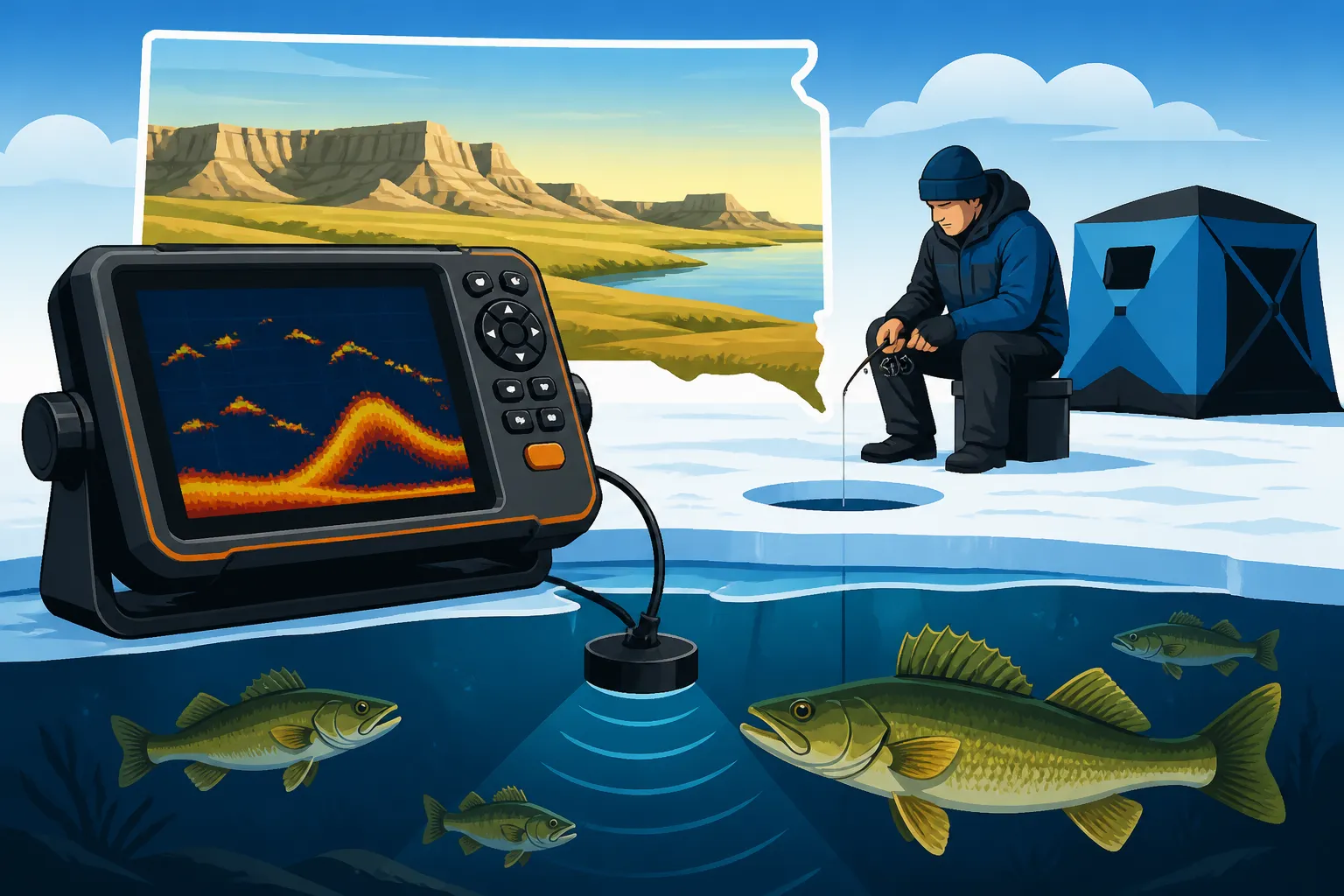
The transducer is the "eye" of your fish finder, sending and receiving sonar waves. For ice fishing, you typically drop it directly into your ice hole. The technology within that transducer is paramount. Many modern units feature CHIRP sonar, which provides a much clearer, more detailed picture of fish and structure by sending a range of frequencies rather than a single one. This enhanced target separation means you can often see your jig clearly, even if it's very close to a fish or the bottom.
Beyond CHIRP, consider the beam angle. A wider beam angle (e.g., 20 degrees or more) covers a larger area under the ice, which is great for finding fish quickly when you're moving between holes or searching for schools. However, a wider beam can also show more interference from outside the hole. A narrower beam (e.g., 9-12 degrees) offers greater detail and precision directly below your hole, which is excellent for targeting specific fish or when fishing deeper water. Some advanced units offer dual-beam or even triple-beam transducers, allowing you to switch between wider and narrower angles or even see a broader area around your hole, giving you a comprehensive view of the action below.
Display Quality and Readability
When you're out on the frozen expanses of a South Dakota lake, battling glare from the sun or huddling in a dark pop-up shelter, the readability of your fish finder's display is crucial. For flashers, look for bright, high-contrast LED or LCD displays with multiple color options. The different colors typically represent signal strength, making it easier to distinguish between your lure, fish, and the bottom.
For graphical sonar units, screen size and resolution are key. A larger screen with higher pixel density will provide a clearer, more detailed image, reducing eye strain during long hours on the ice. Consider units with transflective displays that perform well in direct sunlight, and always look for backlighting options for those early morning or late evening bites. Remember, you'll be reading this screen constantly, so ease of viewing, especially in varying light conditions, is a non-negotiable feature.
Battery Life and Portability
Ice fishing often means venturing far from power outlets, and dealing with freezing temperatures that can rapidly drain batteries. Therefore, exceptional battery life is a cornerstone feature for any good ice fishing fish finder. Most units use 12-volt sealed lead-acid (SLA) batteries, but increasingly, lithium-ion options are becoming popular for their lighter weight and longer run times. Look for units that promise at least 8-10 hours of continuous use, with many higher-end models offering 15-20 hours or more on a single charge. It’s always a good idea to carry a fully charged backup battery, especially if you plan on extended trips or multi-day excursions where recharging might be difficult.
Portability is equally important. An ideal ice fishing fish finder should be lightweight, compact, and housed in a durable, easy-to-carry case. This case should protect the unit from bumps, drops, and the elements, while also providing convenient storage for the transducer and cables. Many cases are designed to fit into a bucket or sled, making transport across slick ice or through deep snow much easier. Think about how you’ll be moving around – whether you’re a run-and-gun angler drilling many holes or someone who sets up a permanent shelter – and choose a unit that matches your mobility needs.
GPS and Mapping Capabilities
While not strictly necessary for every angler, integrated GPS and mapping can significantly elevate your ice fishing game, especially on large, unfamiliar bodies of water like Lake Sharpe or Lake Francis Case. A GPS-enabled unit allows you to mark waypoints for productive holes, submerged structure, or even hazards like thin ice areas. This means you can return to your exact hot spots season after season, or even within the same day after moving to a new area.
Advanced mapping features, often pre-loaded with high-definition bathymetric charts, allow you to visualize underwater contours, channels, and drop-offs. This information is invaluable for understanding fish habitat and migration routes. Imagine identifying a subtle point or a deep weed line from a map, then drilling your holes with pinpoint accuracy. Some units also offer the ability to create your own custom maps, recording sonar data as you move, giving you an even more personalized view of your favorite fishing grounds. This capability can be incredibly useful for maximizing your time on the ice, reducing the "dead time" spent searching for fish.
Top Fish Finder Brands for Ice Fishing
The ice fishing world is lucky to have several fantastic brands consistently delivering high-quality, reliable fish finders that stand up to the rigorous demands of winter angling. Each brand has its loyal followers, often due to specific strengths or signature features. Let's take a look at some of the leaders you'll commonly see out on South Dakota's frozen waters.
Humminbird ICE Series
Humminbird is a powerhouse in the marine electronics world, and their ICE series units are specifically engineered for ice fishing. They offer both traditional flasher units and more advanced digital sonar/GPS combos. The Humminbird ICE Flasher series, like the ICE-35, ICE-45, and ICE-55, are renowned for their crisp, bright flasher displays and extreme target separation, making it easy to distinguish a walleye from your jig even when they're stacked on top of each other. These units often feature selectable beam angles and zoom functions, giving you a detailed view of the fish's activity.
For anglers wanting more, Humminbird also offers portable versions of their Helix and Solix units, packaged in ice fishing bundles. These units provide stunning CHIRP sonar imagery, detailed mapping with LakeMaster charts (which are excellent for many South Dakota lakes), and GPS functionality. The graphical display gives you a comprehensive history of what has passed under your transducer, making it easier to identify patterns. Whether you prefer the real-time response of a flasher or the detailed data of a sonar graph, Humminbird has a robust solution that many anglers trust. You can often find a great selection of these units at sporting goods stores or online.
Garmin Striker and ECHOMAP Series
Garmin has made significant strides in the ice fishing market, leveraging their extensive GPS and mapping expertise. Their Striker Vivid series and ECHOMAP UHD series are popular choices, offering excellent CHIRP sonar performance in highly portable packages. The Striker Vivid models are celebrated for their vibrant, high-contrast color palettes that make fish and structure pop on the screen, even in challenging light conditions. They are user-friendly, feature built-in GPS for marking waypoints, and many come with Quickdraw Contours, allowing you to create your own custom maps of fishing areas like Belle Fourche Reservoir.
The ECHOMAP UHD series steps it up with even higher-resolution screens, more powerful CHIRP sonar, and support for Garmin's specialized transducers that can include ClearVü and SideVü scanning (though SideVü is less applicable for traditional vertical ice fishing, it's a fantastic feature for open water). These units are often bundled with ice fishing kits, including a bag, battery, and ice transducer. Garmin's detailed maps, often featuring South Dakota-specific contours, provide a huge advantage for navigating the ice and finding hidden structure. Their intuitive interface and reliable performance have earned them a strong following among both casual and serious ice anglers. For example, a quick search on Amazon will reveal many Garmin options.
Vexilar Flasher Units
Vexilar is practically synonymous with ice fishing flashers. They've been making them for decades and have refined the technology to an art form. When you think of a classic ice fishing flasher, you're likely thinking of a Vexilar unit. Their FL series (FL-8, FL-12, FL-18, FL-20, FL-22, FL-28) are legendary for their bulletproof durability and incredibly accurate, real-time displays. These units are built like tanks, designed to withstand the harsh realities of ice fishing, from frigid temperatures to accidental drops.
The Vexilar FL series flashers offer super-fast signal processing, giving you instant feedback on fish movement and your jig's presentation. Anglers often appreciate the different zoom zones available on many models, allowing them to focus on a specific section of the water column to fine-tune their bait presentation to actively moving fish. While they don't offer the graphical history or GPS mapping of sonar units, their unparalleled real-time performance in vertical ice fishing scenarios makes them a favorite for many, particularly those chasing aggressive fish like South Dakota Northern Pike Limits. If you're looking for a dedicated, no-nonsense flasher that just works, Vexilar is a top contender.
| Feature / Brand | Humminbird ICE Series | Garmin Striker/ECHOMAP | Vexilar FL Series |
|---|---|---|---|
| Type | Flashers & Digital Sonar/GPS | Digital Sonar/GPS | Flashers |
| Display | Bright LED/LCD, graphical | High-res LCD, color palettes | Multi-color LED flasher |
| Real-Time Responsiveness | Excellent (Flashers), Good (Sonar) | Good | Excellent (Instant) |
| Target Separation | Excellent (CHIRP & Flashers) | Excellent (CHIRP) | Excellent |
| Mapping/GPS | Optional (LakeMaster) | Standard (Quickdraw, pre-loaded) | Not Available |
| Portability | Good (dedicated bundles) | Excellent (compact, bundles) | Excellent (durable case) |
| Battery Life | 8-20+ hours (model dependent) | 8-15+ hours (model dependent) | 8-20+ hours (model dependent) |
| Typical Use | Vertical jigging, searching | Searching, mapping, vertical jigging | Vertical jigging, active fish |
| Price Point | Mid to High | Mid to High | Mid |
Mastering Your Ice Fishing Fish Finder
Having the best gear is only half the battle; knowing how to use it effectively is what truly makes a difference on the ice. A fish finder can be a powerful ally, but only if you understand what it's telling you and how to interpret its signals. It's not just about seeing fish; it's about seeing the story beneath the ice.
Interpreting the Display: Flashers vs. Sonar
Interpreting a flasher display is a bit like learning a new language, but once it clicks, it's incredibly intuitive. The center of the circle is the surface, and the outer edge is the bottom. Colored segments light up around the circle, with the thickness and intensity indicating the strength of the return. A thin, faint line might be your small jig, while a thick, bright band could be a hefty walleye. Fish will appear as distinct lines or segments between your jig and the bottom. You'll quickly learn to identify your bait and then watch for fish to appear as they approach it. The beauty is its immediacy; the moment a fish moves, you see it.
Sonar units, on the other hand, provide a scrolling graphical display. The right side of the screen is "now," and the left is "past." You'll see fish arches (or sometimes just blobs, depending on settings and fish movement) as they pass through the sonar cone. Your jig will appear as a distinct line or dot dropping down from the top. The bottom will be a solid line across the screen, often with textures indicating hardness or softness. With sonar, you can observe historical patterns, like how fish were reacting a minute ago or if they were holding at a specific depth. Both types require a bit of practice, but with time, you'll be able to read them like a book.
Optimizing Settings for South Dakota Conditions
Just like you wouldn't use the same lure for all species or conditions, you shouldn't use the same fish finder settings all the time. Adjusting your gain (sensitivity) is paramount. Too low, and you'll miss faint signals; too high, and you'll get excessive clutter and interference. Start with a moderate gain and slowly increase it until you see your jig clearly and pick up any faint returns, then back it off slightly if you get too much noise. On flashers, you might adjust the "range" to zoom in on a specific depth, which is fantastic when targeting fish holding tight to the bottom in deeper waters, like those on Lake Oahe.
Interference rejection is another crucial setting, especially when fishing in crowded areas like during a tournament or popular weekend outing. Other fish finders nearby can cause crosstalk on your screen. Most units have interference rejection or noise filter settings that can help clean up the display. Also, consider your beam angle – a narrower beam might be better in very deep water or when precision is key, while a wider beam is great for scouting new holes or shallower water. Don't be afraid to experiment with these settings throughout the day, as conditions (like fish activity or even ice thickness) can change.
Effective Hole Hopping and Fish Location Strategies
Your fish finder is an invaluable tool for finding fish, but it works best when paired with effective strategies. "Hole hopping" is a classic ice fishing technique where you drill numerous holes and quickly check each one with your fish finder. Instead of sitting idly over a barren spot, you can quickly identify whether fish are present and at what depth. If you don't see any activity after a few minutes, move to the next hole. This is where portability and quick setup are so important.
Once you find fish, use your fish finder to observe their behavior. Are they suspended midway up the water column? Are they hugging the bottom? Are they aggressive and rising quickly to your bait, or are they hesitant? This information allows you to adjust your jigging presentation – perhaps a faster retrieve for aggressive fish, or a subtle quiver for finicky ones. On larger bodies of water, like the Missouri River reservoirs, using the GPS to find known structure (like humps, points, or old river channels) is a fantastic starting point. South Dakota Fishing Depth Charts by Season can also give you a strong initial guess for where to start drilling and scanning.
Maintenance and Care for Your Ice Fishing Fish Finder
Your ice fishing fish finder is an investment, and like any valuable piece of gear, it needs proper care to ensure it performs reliably season after season. The extreme cold, moisture, and rough handling of ice fishing can take a toll, so a little preventative maintenance goes a long way in protecting your device and extending its lifespan.
Battery Care in Cold Weather
The battery is the lifeblood of your fish finder, and cold weather is its worst enemy. Always store your batteries in a warm place when not in use, preferably indoors at room temperature. Charge your batteries fully before each trip, and avoid letting them completely discharge, as this can reduce their overall lifespan. During a long day of fishing, consider keeping a spare battery in an insulated bag or even inside your jacket to keep it warm, ensuring you have power when you need it most.
When using your fish finder, ensure the battery is housed in its insulated carrying case. This not only protects it from physical damage but also helps to maintain its temperature, which significantly impacts its performance and longevity in freezing conditions. After the season, perform a full charge on your battery and store it in a cool, dry place. Check and top it off periodically (every few months) to prevent deep discharge, which can permanently damage the battery. If you invest in a lithium-ion battery, these tips still apply, though they tend to handle cold better and have a longer inherent lifespan.
Transducer and Cable Protection
The transducer and its cable are surprisingly vulnerable components. The transducer is constantly being submerged and pulled out of freezing water, and the cable can become brittle in the cold. Always ensure your transducer cable is not crimped or pinched by the ice hole, your auger, or heavy gear. When deploying or retrieving, do so gently, avoiding sharp bends in the cable.
After each use, especially if fishing in areas with murky water or slush, wipe down the transducer and cable to remove any ice, dirt, or debris. Allow them to air dry thoroughly before packing away to prevent moisture from freezing and potentially damaging connections or the transducer face itself. Store the cable neatly coiled, without kinks, in its designated spot in your carrying case. A damaged transducer cable is a common point of failure, so treating it with care is paramount.
Screen and Unit Housing Maintenance
The display screen is your window to the underwater world, and keeping it clear and protected is essential. Avoid touching the screen directly with greasy or dirty fingers, especially after handling bait or fish. Use a soft, non-abrasive cloth to gently wipe the screen clean. Never use harsh chemical cleaners, which can damage the display coating. Many anglers also use screen protectors, similar to those for cell phones, to guard against scratches and impacts.
The unit's housing, typically made of durable plastic or composite, is designed to be tough, but it's not indestructible. After your trip, wipe down the entire unit to remove any moisture, ice, or salt from melted snow. Inspect the housing for any cracks or damage, and ensure all ports and covers are clean and properly sealed to prevent water intrusion. Always transport your fish finder in its protective carrying case to prevent accidental bumps or drops, especially when navigating uneven terrain or loading it into a vehicle. Proper care will ensure your fish finder remains a reliable companion for countless South Dakota Fishing Season Dates and Limits to come.
Disclaimer
This article is for general informational purposes only and does not constitute professional advice. Laws, prices and regulations vary by location and change over time. Consult a qualified professional for guidance on your specific situation.