Best Kayak Anchor for River Fishing
River fishing from a kayak in South Dakota is an incredible experience, but anyone who has tried to hold their position in a strong current knows the frustration of constantly paddling or drifting past that perfect seam or eddy. This guide is dedicated to helping you choose the best kayak anchor specifically designed to keep you steady in river currents, ensuring you can focus on the fish, not the drift.
Why River Kayak Fishing Demands a Different Anchor Approach
Fishing rivers from a kayak is a unique beast compared to lake fishing, and it’s something many anglers learn the hard way. On a lake, you might only contend with wind, which can be annoying but usually predictable. Rivers, however, bring a whole new dynamic with their relentless current, varying bottom compositions, and often faster-changing conditions. What works perfectly on Lake Oahe might leave you helplessly drifting down the Big Sioux River.
The Challenge of Current and Varying Depths
Imagine you've paddled hard upstream on the James River, spotted a promising logjam where catfish might be lurking, and you want to drop anchor. If you're using a lightweight, small grapnel anchor meant for calm lake bottoms, the current will likely drag it along the bottom, or it simply won't dig in deep enough. This isn't just frustrating; it can be dangerous if you drift into snags or rapidly moving water unexpectedly. Rivers rarely have a consistent depth, either. One moment you might be in a shallow riffle, the next a deep hole, meaning your anchor system needs to be versatile.
The constant push of the water means your anchor isn't just holding you against gravity; it's holding you against a persistent horizontal force. This requires more grip, more weight, and a more robust anchoring system than you might initially assume. Plus, river currents can carry debris, making anchor retrieval a potential nightmare if your gear isn't designed to shed snags. It’s all about finding that sweet spot of enough holding power without being so heavy it becomes a nuisance to deploy and retrieve from a small craft like a kayak.
The Problem of Snags and Obstructions
Rivers are notorious for their underwater real estate – fallen trees, rock piles, discarded tires, old fishing line, you name it. Dropping an anchor that can easily get permanently snagged is a quick way to lose valuable gear and waste precious fishing time. It’s a common scenario: you’re trying to hold your spot near a promising submerged brush pile, your anchor digs in, you hook a nice smallmouth, and then as you try to move, your anchor refuses to budge. Now you're faced with cutting your line, losing your anchor, and potentially leaving a hazard for other anglers.
Traditional boat anchors, especially those with fixed flukes, are prime candidates for snagging in river environments. Kayak anglers need to prioritize anchors designed with retrieval in mind, even in the most challenging underwater landscapes. The solution often involves designs that can be released from a snag with a strategic pull or systems that allow for reverse-pull retrieval. Considering how much of your focus needs to be on your line and the fish, having an anchor that you don't have to constantly worry about getting stuck is a game-changer for river kayaking. This is particularly true when you're exploring South Dakota Missouri River Fishing Techniques, where bottom structures can be complex and unforgiving.
Understanding Anchor Types for River Kayaks
When it comes to picking the right anchor for your river kayak adventures, it's not a one-size-fits-all situation. Different anchor types excel in different river conditions, and understanding their strengths and weaknesses is key to staying put when you need to.
Grapnel Anchors: Versatility with Caveats
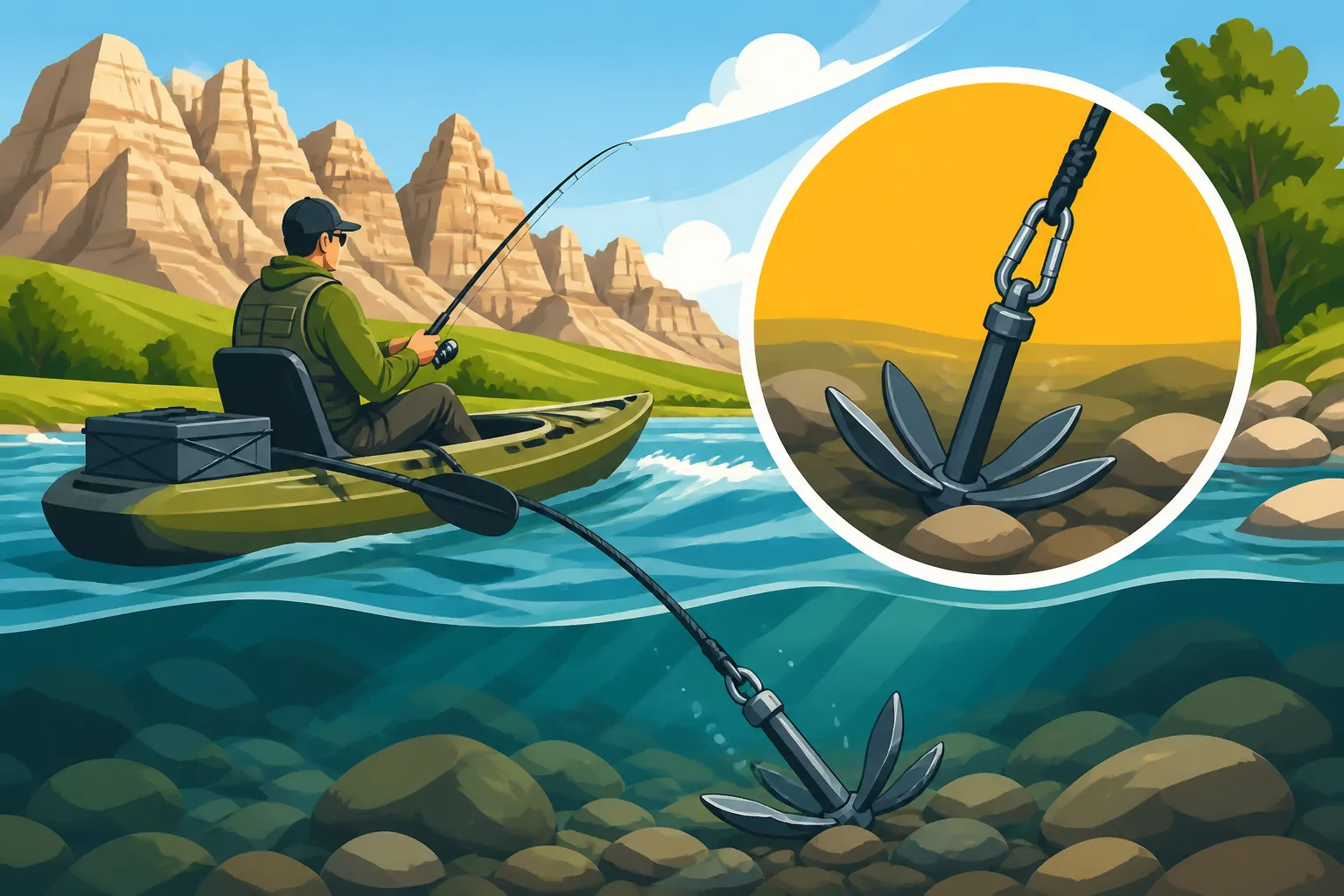
Grapnel anchors are often the first choice for kayak anglers due to their compact size and foldability. They typically have four or more flukes that are designed to grab onto rocks, roots, or other underwater structure. For slow-moving rivers with a rocky or root-filled bottom, a grapnel can work quite well. Their relatively light weight makes them easy to deploy and retrieve, and when folded, they take up minimal space in your kayak. You can often find a good selection of these at outdoor retailers like Bass Pro Shops.
However, their versatility comes with a caveat. In soft, muddy, or sandy bottoms common in many South Dakota rivers, a grapnel anchor might not dig in sufficiently to hold against a strong current. The flukes might just drag through the sediment, leaving you to drift. Furthermore, those same grabbing flukes that make them effective on rocky bottoms can also make them incredibly prone to snagging. If a fluke gets wedged deep into a rock crevice or wrapped around a submerged branch, you could be saying goodbye to your anchor. Many experienced river kayakers modify their grapnel anchors with a "breakaway" system using zip ties or thin rope to attach the chain to the anchor eye, allowing the main rope to pull from the bottom of the anchor, hopefully freeing it from a snag.
River Anchors: Designed for Flow
River anchors, sometimes called pyramid, box, or mushroom anchors, are specifically designed to perform in currents. These anchors typically feature a dense, compact shape, often pyramidal or box-like, that digs into softer bottoms and resists dragging. Their weight-to-surface-area ratio is optimized to provide significant holding power without being overly bulky. A pyramid anchor, for instance, has a flat, broad base that can dig into sand or mud and a narrow top that's less likely to collect debris.
These types of anchors are much less prone to snagging than grapnels, especially on softer bottoms. The lack of projecting flukes means there's less for them to grab onto when encountering underwater obstructions, making retrieval much smoother. However, they might not hold as effectively on purely hard, flat rock bottoms where a grapnel could wedge into a crevice. River anchors tend to be heavier than grapnels for the same holding power, which is something to consider if you're trying to keep your kayak as light as possible. They are an excellent choice for anglers fishing areas like the calmer stretches of the Missouri River or the James River, where the bottom is often a mix of sand and mud.
Drag Chains or Spud Poles: Alternative Holding Methods
Beyond traditional anchors, river kayak anglers often utilize drag chains or spud poles for holding position. A drag chain is exactly what it sounds like: a heavy chain (or multiple chains linked together) deployed over the side of the kayak to drag along the river bottom. The weight and friction of the chain create drag, slowing or holding the kayak in place. Chains are fantastic in areas with soft, muddy bottoms and are almost impossible to snag permanently since they don't have flukes to wedge. They are also highly adaptable – you can add or remove sections of chain to adjust your holding power based on the current.
Spud poles, on the other hand, are long, sturdy poles (often fiberglass or aluminum) that are manually pushed into the riverbed to pin the kayak in place. They work incredibly well in shallow to moderately deep water with soft bottoms. Many fishing kayaks come with "stake-out pole" holes or mounts, making deployment effortless. The advantage of a spud pole is silent deployment and minimal disturbance to the fishing area. You can quickly pull it up and move a few feet with ease. The downside is their limited range (only good in depths where the pole can reach the bottom and still clear your head) and their ineffectiveness on hard, rocky bottoms where they can't penetrate. For shallow sections of rivers or backwaters, though, a spud pole is an incredibly efficient and snag-free option.
Here’s a quick comparison of common kayak anchor types for river fishing:
| Anchor Type | Best For | Pros | Cons | Snag Risk |
|---|---|---|---|---|
| Grapnel Anchor | Rocky/Rooty bottoms, slow current | Compact, foldable, good grip on structure | Prone to snagging, poor on soft bottoms | High |
| Pyramid Anchor | Muddy/Sandy bottoms, moderate current | Digs well in soft bottoms, low snag risk | Heavier, less grip on purely hard rock | Low |
| Drag Chain | Soft/Muddy bottoms, varying current | Nearly snag-proof, adjustable drag | Can be bulky, less precise holding | Very Low |
| Spud Pole | Shallow soft bottoms | Silent, instant deployment, no drag | Limited depth, ineffective on hard bottoms | Very Low |
Choosing the Right Anchor Weight and Rope for River Conditions
Selecting the right anchor type is only half the battle; getting the weight and rope length dialed in for South Dakota's diverse river conditions is equally crucial. Too light, and you'll drift; too heavy, and you'll wear yourself out. Too short a rope, and you won't hold; too long, and you'll have a tangled mess.
Determining Anchor Weight for Current
The ideal anchor weight for river kayak fishing depends heavily on a few factors: the strength of the current, the size and weight of your kayak, and the type of bottom you're anchoring in. Generally, river currents demand more weight than lake conditions. A common starting point for river kayaks might be a 1.5 to 3-pound anchor for lighter kayaks in slower currents, scaling up to 5-10 pounds for heavier kayaks or stronger flows. For example, if you're navigating the relatively gentle flows of the Vermillion River, a 3-pound pyramid anchor might be sufficient. But if you're trying to hold your spot in a faster current on a main channel of the Missouri River, especially with a fully loaded kayak, you might need a 5-7 pound pyramid or a robust drag chain setup.
It's always better to err on the side of slightly heavier rather than too light. A heavier anchor will hold more reliably, saving you from constant re-anchoring or drifting past your prime fishing zone. You can always compensate for a slightly heavier anchor by using a "breakaway" system or ensuring your retrieval method is efficient. Many anglers will carry a primary anchor and a lighter backup, or a combination of an anchor and a drag chain to adapt to changing conditions. You can often find a good range of weights and types to choose from when shopping online through Amazon or at local sporting goods stores.
The Importance of Proper Anchor Rode (Rope/Chain)
Your anchor rode – the line connecting your kayak to your anchor – is just as important as the anchor itself. The length, material, and setup of your rode directly impact your anchor's effectiveness and your safety. A general rule of thumb for anchoring is to use a scope (ratio of rope length to water depth) of at least 5:1, and preferably 7:1, in currents. This means if you're in 10 feet of water, you'll want at least 50-70 feet of rope deployed. This generous scope allows the anchor to pull horizontally along the bottom, giving its flukes or edges a chance to dig in and hold properly. Too short a scope, and the anchor will pull upward, making it easier to drag.
Nylon rope is a popular choice for anchor rode due to its stretchiness, which helps absorb shocks from waves or current fluctuations. A small section of chain (3-6 feet) between the anchor and the rope is highly recommended. This chain helps the anchor lie horizontally on the bottom, increasing its holding power, and it also protects the rope from chafing on sharp rocks or debris near the riverbed. When considering How Much Anchor Rope You Need for Deep Water, always overestimate for river applications due to the current. Ensure your rope is robust enough for your anchor weight and that any knots are secure. A bright-colored rope can also be a good safety feature, making it easier to see and avoid by other boaters.
Essential Rigging and Safety for River Kayak Anchors
Anchoring in a river isn't just about dropping a weight; it's about smart rigging and prioritizing safety. A poorly rigged anchor can be a hazard, leading to capsizing, lost gear, or even dangerous situations in fast currents.
Anchor Trolley Systems: Control and Safety
Perhaps the most critical piece of rigging for any river kayak angler is an anchor trolley system. This simple yet ingenious setup allows you to deploy your anchor from either the bow (front) or stern (back) of your kayak and then move the anchor line attachment point along the side of your kayak using a pulley system. Why is this so crucial for river fishing? In a current, you typically want to anchor from the bow to face upstream, presenting a stable profile and allowing you to cast downstream into productive water. However, if you get snagged, or if conditions rapidly change, you might need to quickly switch your anchor pull point to the stern to pivot your kayak and free the anchor.
Without a trolley, if you anchor directly from the side of your kayak, the current can quickly catch the broadside of your boat, making you unstable or even flipping you. The trolley allows you to adjust your position relative to the current and your anchor, maintaining stability and control. It’s also invaluable for quick releases – if you need to quickly un-anchor and move, you can simply release the line from the trolley cleat, letting the anchor rope run out with a buoy attached (a "breakaway" system). This is a core component of safe Kayak Fishing Techniques for Beginners in moving water. Ensure your trolley system is installed correctly and all cleats and pulleys are securely fastened.
Quick Release and Breakaway Systems
When fishing in a river, losing an anchor to a snag is almost inevitable at some point. A proper quick-release and breakaway system can save your anchor, your sanity, and potentially prevent a dangerous situation. A quick-release cleat on your anchor trolley allows you to instantly free the anchor line from your kayak if you get into trouble. This is vital if you're drifting towards rapids, a dam, or if your kayak starts to take on water due to being broadsided by the current while anchored.
A breakaway system, particularly useful with grapnel anchors, involves rigging the anchor in such a way that the main pull point of the anchor line is at the bottom of the anchor, with a weak link (like a zip tie or light monofilament) securing the chain to the top eye. If the anchor gets snagged, pulling hard breaks the weak link, allowing you to pull the anchor out backward, usually freeing it. You'd attach a float to the end of your anchor line when using a quick-release, allowing you to re-retrieve your anchor after addressing the immediate situation. It’s a smart investment in safety and gear preservation. Just remember that even with the best systems, vigilance is key, and wearing a Best PFD for Kayak Fishing is non-negotiable on any river outing. This also ties into the broader topic of South Dakota Boat Safety Requirements, which emphasizes being prepared for unexpected situations on the water.
Essential Safety Gear and Practices
Beyond the anchor system itself, remember the fundamental safety rules for river kayaking. Always wear your personal flotation device (PFD). Rivers can be unpredictable, and even strong swimmers can be overwhelmed by currents or cold water. Carry a sharp knife for cutting your anchor line in an emergency if all else fails. A whistle or other sound-signaling device is also important. Keep a Best Dry Bag for Kayak Fishing with essential items like your phone, car keys, and a first-aid kit securely stowed.
Before heading out, check river conditions, including current speed, water levels, and any known hazards. Let someone know your float plan – where you're putting in, where you're taking out, and when you expect to be back. And finally, inspect your anchor, rope, and trolley system before each trip for any signs of wear or damage. River fishing is incredibly rewarding, but it demands respect for the water and a commitment to safety.
Disclaimer
This article is for general informational purposes only and does not constitute professional advice. Laws, prices and regulations vary by location and change over time. Consult a qualified professional for guidance on your specific situation.