Best Anchor Type for a Reservoir With a Rocky Bottom
Nothing throws a wrench into a perfect fishing day quite like a stuck anchor, especially when you're out on one of South Dakota's massive reservoirs with their notoriously rocky bottoms. That moment of dread when you pull and pull, only for your anchor to refuse to budge from a submerged rock pile, can be incredibly frustrating and even dangerous. This comprehensive guide is here to help you navigate those tricky waters, exploring the best anchor types and techniques to ensure your boat stays put without losing valuable gear or precious fishing time.
Why Anchoring on Rocky Bottoms is a Unique Challenge in South Dakota
South Dakota's major reservoirs, particularly those along the Missouri River such as Lake Oahe, Lake Sharpe, Lake Francis Case, and Lewis and Clark Lake, are renowned for their incredible fishing. However, beneath those productive waters lie a landscape of old river channels, submerged timber, and, most importantly for our discussion, vast stretches of rocky bottom. These aren't just smooth pebbles; we're talking about jagged rocks, boulders, and rubble fields left behind by glaciers or the river itself. This environment presents specific challenges that anglers need to understand to anchor effectively and safely.
The Battle Against Snags and Lost Gear
Picture this: you've found the perfect walleye spot, maybe a subtle hump or a rocky point near a drop-off on Lake Oahe. You drop anchor, settle in, and start catching fish. The day progresses, and it's time to move. You pull up your anchor line, and thunk. Nothing. You try again, from a different angle, with more force. Still nothing. Your anchor is undoubtedly wedged between two unyielding rocks, or maybe wrapped around some submerged rebar from an old homestead. This isn't just a minor inconvenience; it can lead to losing an expensive anchor, chain, and rope. It’s also incredibly frustrating and takes away from your precious time on the water. Many anglers have given up and cut their lines, leaving a piece of their fishing budget at the bottom of the lake.
The sheer unpredictability of these rocky environments means that even a seemingly good drop can result in a snag. It's not always visible structure; sometimes it's an unseen crevice or a cluster of rocks just waiting to grab onto your anchor flukes. This constant threat of losing gear demands a different approach than anchoring in soft mud or sand. It's a key reason why many seasoned South Dakota anglers invest in specific anchor types and retrieval methods that minimize the risk of permanent entanglement.
Holding Power in Current and Wind
Beyond the snagging nightmare, anchoring on South Dakota's large reservoirs also means contending with significant current, especially on the Missouri River system, and often unpredictable winds. These bodies of water are vast, and a strong breeze can whip up quickly, creating chop and putting immense strain on your anchor. Couple that with the steady flow of the river below the surface, and your anchor needs to have exceptional holding power to keep your boat stable over your chosen fishing spot. A light anchor that might work perfectly on a calm, muddy lake will simply drag across a rocky bottom in current or heavy wind, pulling you off your mark and scattering the fish.
Many anchor designs are optimized for digging into soft bottoms, where their flukes can really bury deep. On a hard, rocky surface, these designs struggle to get a purchase. Instead, they bounce and scrape, offering minimal resistance. This is where the specific design of an anchor becomes critical – you need something that can grab onto irregularities in the rock without getting permanently stuck, or a system that allows for easy release when a snag occurs. It's a delicate balance between sufficient holding power and preventing irreversible entanglement, a challenge every angler who has spent time on these waters understands well. South Dakota Missouri River Fishing Guide can give you an idea of the forces at play in some of these waters.
Popular Anchor Types and Their Suitability for Rocky Reservoirs
When you walk into a Bass Pro Shops or browse online through Amazon, you'll see a dizzying array of anchors. Each one is designed with a specific type of bottom and water condition in mind. For South Dakota's rocky reservoirs, some are far better choices than others, while some are almost guaranteed to cause you headaches. Let's break down the common types and see how they stack up.
The Grapnel Anchor: A Double-Edged Sword
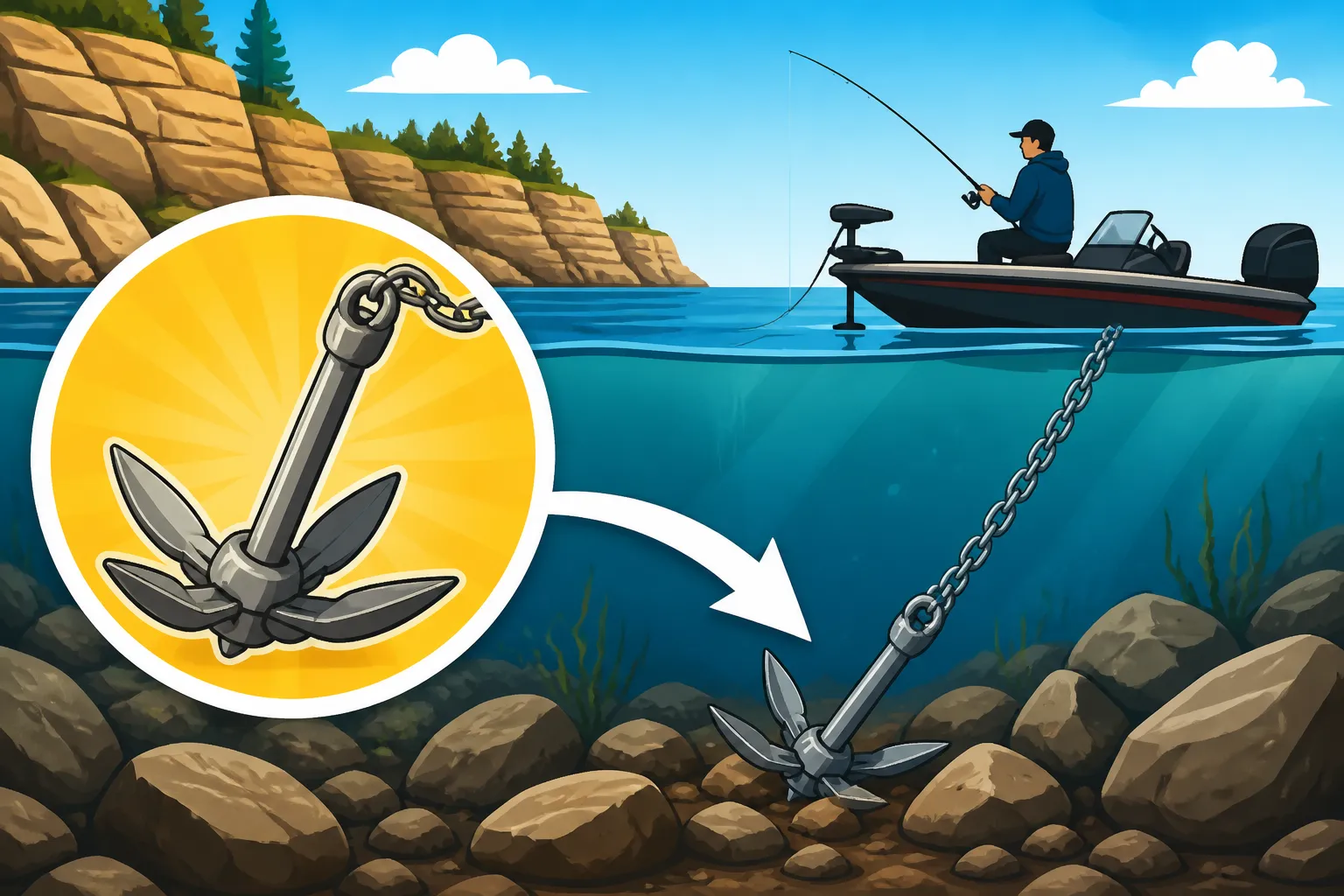
The grapnel anchor is often visually distinctive, with four or more "claws" or tines designed to hook onto bottom structure. It looks like it would be perfect for rocky bottoms, right? It's certainly what many anglers might initially consider. In theory, those tines should grab onto crevices, ledges, or individual rocks, providing a strong hold where a fluke anchor might simply slide. They are often foldable, making them compact for storage, which is a nice bonus for smaller boats or kayaks.
However, the grapnel anchor is truly a double-edged sword on South Dakota's rocky reservoirs. While its tines can grab onto structure, they are equally adept at getting hopelessly wedged. Imagine those four tines digging deep into a rock fissure. It can provide an incredibly strong hold, sometimes too strong. Retrieving a grapnel anchor that has found a good "bite" in a rock pile can be next to impossible without specialized techniques or a lot of brute force, often resulting in a lost anchor. For this reason, while it might seem like a natural fit, many experienced anglers steer clear of traditional grapnel anchors for general use on these types of bottoms, unless they are specifically rigged with a breakaway system.
The River Anchor (Fluke/Danforth Style): When It Works and When It Fails
The river anchor, often referred to as a fluke or Danforth style, is characterized by its large, flat flukes that pivot and are designed to dig deep into soft bottoms like mud, sand, or clay. These are excellent anchors for holding power in soft sediments, as the flukes create significant resistance once buried. Many anglers in less rocky areas of South Dakota or on smaller, calmer lakes might use these effectively.
On a rocky reservoir, however, the river anchor often falls short. Its design relies on the flukes penetrating and holding in soft material. When dropped onto a hard, rocky bottom, these anchors tend to skip, slide, or simply lie flat without gaining any purchase. They might briefly snag on a rock, but they rarely get the deep, secure hold necessary to combat strong currents or wind. If they do get a fluke wedged, it can be difficult to retrieve, similar to a grapnel, but they are less likely to get a solid, reliable hold in the first place. You'll find yourself constantly dragging and re-anchoring, which is far from ideal when trying to stay on a precise fishing spot. Therefore, while great for some applications, river anchors are generally not the best choice for rocky conditions.
The Mushroom Anchor: Best Left for Calm Waters
The mushroom anchor, with its distinctive bell or dome shape, is designed to create suction in soft, muddy bottoms. They are relatively inexpensive and are often seen on smaller boats, canoes, or paddle boats used in very calm, protected waters with soft substrate. The weight of the mushroom anchor, combined with the suction it can create, provides its holding power.
For South Dakota's rocky reservoirs, the mushroom anchor is almost entirely unsuitable. It has virtually no mechanism to grab or dig into a hard, rocky bottom. It will simply roll, scrape, and slide across the rocks, offering minimal to no holding power against even light current or wind. It's a recipe for constant dragging and frustration. While it might be a budget-friendly option for very specific, calm conditions, it’s not an anchor you want to rely on when fishing the main channels of Lake Sharpe or any other substantial reservoir with a rocky floor. It’s best to save this anchor for fishing farm ponds or very quiet, shallow coves with soft bottoms.
The Box Anchor: A Strong Contender
The box anchor is a relatively newer design that has gained popularity for its effectiveness in various bottom types, including rocky ones. It's characterized by its boxy, four-sided construction with large, flat surfaces or "flukes" at the bottom. The unique aspect of the box anchor is how it functions: when deployed, it essentially "trips" on its side, and the flukes immediately begin to dig in, often providing a very quick and strong set.
What makes the box anchor a strong contender for rocky bottoms is its ability to hold without deep penetration. Instead of needing to bury itself, its large surface area and design allow it to "sit" on top of the rocks and use its weight and angles to grab onto irregularities. More importantly, many box anchors are designed with an easy retrieval mechanism, often allowing the anchor to fold or collapse in a way that helps free it from snags. While they might be a bit bulkier to store than some other types, their reliability on diverse bottoms, including rocky ones, makes them a favorite among many serious anglers on South Dakota's larger waters like Lake Francis Case. Their quick-set nature is also a huge advantage when you need to drop anchor fast in changing conditions.
The Best Anchor Type for South Dakota's Rocky Reservoirs
When it comes down to choosing the best anchor for those challenging rocky bottoms in South Dakota, it's less about a single anchor type and more about a combination of design, proper rigging, and smart deployment. The goal is maximum holding power with minimum risk of permanent snagging. For many anglers, the best solution involves a specific type of anchor often rigged with a breakaway system.
A modified grapple or pyramid anchor, when paired with a thoughtful breakaway system, often emerges as the top choice. A pyramid anchor, with its single point and four flat sides, is designed to dig in quickly and hold well in various bottoms, including some rocky ones where its shape helps it to wedge. However, the true game-changer for rocky South Dakota reservoirs is rigging it properly to avoid permanent loss. This typically involves attaching the anchor line to the crown (the top) of the anchor rather than the eye at the bottom, and then securing the line to the bottom eye with a strong zip tie or a piece of lighter cord that can be broken.
The Role of a Breakaway Anchor System
This breakaway system is your secret weapon against lost anchors. Here's how it works:
- Attach the anchor line to the crown: Instead of tying your main anchor rope directly to the primary attachment point (the 'eye' where the chain normally goes), you run your anchor line to the very top (the 'crown') of the anchor.
- Secure with a weak link: You then take a short piece of lighter rope, cable tie, or a strong zip tie and connect the main anchor line (or a short length of chain from the main line) down to the primary attachment point at the bottom of the anchor.
- Deploy as usual: When you deploy the anchor, it functions normally, digging in or wedging itself as intended.
- Retrieve from the opposite direction: If the anchor gets truly stuck, you simply motor forward over the anchor, pulling from the opposite direction. The idea is that the main line, pulling from the crown, will cause the weak link to break, essentially flipping the anchor over and pulling it free from the direction it originally snagged.
This ingenious method means you rarely lose your primary anchor. You might break a zip tie, which is easily replaced, but you save your anchor and avoid the frustration. This system is particularly effective with pyramid anchors, but can also be adapted for specific grapnel or even some box anchor designs. It’s a must-have for anyone serious about anchoring on Lake Oahe or any other rocky body of water.
Considering Anchor Weight and Chain Length
Choosing the right weight and proper chain length is just as crucial as the anchor type. Many anglers make the mistake of using an anchor that's too light for their boat size and the conditions they face. On South Dakota's large, windswept reservoirs with their strong currents, you generally want to go a little heavier than the minimum recommended weight for your boat length. A good rule of thumb is to err on the side of caution.
- Anchor Weight: For a typical 18-22 foot fishing boat on these reservoirs, an anchor in the 15-25 pound range is often appropriate, especially when rigged with a chain. A heavier anchor provides more initial setting power and resistance against dragging. You can find a good selection of these weights at outdoor retailers or online platforms like Amazon.
- Anchor Chain: A length of heavy chain between your anchor and your rope is absolutely vital, especially on rocky bottoms. The chain serves multiple purposes:
- Lays Flat: The weight of the chain helps the anchor lay flat and maintain the correct angle for setting.
- Adds Weight: It adds significant weight near the bottom, helping the anchor to dig in or hold better.
- Abrasion Resistance: It protects your rope from being frayed or cut by sharp rocks on the bottom.
Most experts recommend a minimum of 4-6 feet of chain for smaller boats and up to 15-20 feet for larger boats or those fishing in areas with significant current.
Retrieval Techniques for a Stubborn Anchor
Even with the best breakaway system, sometimes an anchor just doesn't want to come up. Here are a few retrieval techniques that can help:
- Circle the Anchor: If your anchor is stuck, don't just pull harder from the same direction. Slowly motor in a wide circle around the spot where the anchor is stuck. This changes the angle of pull and can often dislodge a wedged anchor. With a breakaway system, this is the action most likely to break the weak link.
- Use Momentum (Carefully): With the anchor line cleated, slowly motor forward, creating tension on the line. When you're directly over the anchor, shift into neutral or reverse quickly. The sudden slack, followed by the boat's momentum, can sometimes pop the anchor free. Do this carefully to avoid putting excessive strain on your boat's cleats or transom.
- Anchor Ball/Buoy System: For truly stubborn snags (or just easier retrieval in general), an anchor buoy or anchor retrieval ring system can be a lifesaver. This system involves a buoy and a ring that slides down your anchor line. You motor forward, and the buoy floats your anchor up from the reverse direction. This method is particularly efficient for heavy anchors and can save your back! South Dakota Fishing Gear Checklist will likely include this.
Practical Tips for Anchoring Success on Rocky Bottoms
Beyond the type of anchor and its rigging, there are several practical habits and pieces of gear that can dramatically improve your anchoring success and reduce frustration on South Dakota's rocky reservoirs. Being prepared and methodical in your approach will save you headaches and keep you fishing.
Always Use a Buoy and Anchor Rope Bag
This might seem basic, but it's surprising how many anglers overlook these simple tools. An anchor buoy is crucial for two main reasons:
- Marking Your Spot: If you have to cut your line or briefly release your anchor to pursue a fish, a buoy attached to the anchor line lets you easily find it again. This is especially useful if you're trying a breakaway system for the first time or fishing in low visibility conditions.
- Safety and Courtesy: It visibly marks your anchor line for other boaters, preventing accidental prop fouling and promoting safe navigation, particularly in popular fishing areas on lakes like Lewis and Clark Lake.
An anchor rope bag is another highly recommended item. Tangled anchor lines are not only annoying but can also be dangerous if they snag a foot or an arm during deployment or retrieval. A good rope bag keeps your line neatly coiled and ready to deploy, preventing knots and snags. When you pull in your anchor, the rope goes directly into the bag, staying organized and free of debris. This also protects your boat from muddy or dirty rope.
The Importance of Proper Anchor Deployment
It's not enough to just throw your anchor over the side and hope for the best. Proper deployment technique is key to getting a good set and minimizing snags on rocky bottoms.
- Position Upwind/Upcurrent: Approach your desired fishing spot from upwind or upcurrent. This allows you to drift back into position as you deploy the anchor.
- Lower, Don't Throw: Gently lower your anchor to the bottom rather than heaving it. This prevents the chain and rope from tangling around the anchor itself, which can prevent it from setting properly. It also allows you to feel for the bottom type and potential snags as you go.
- Pay Out Sufficient Scope: "Scope" is the ratio of your anchor line length to the depth of the water. For good holding power, you need sufficient scope. A general rule of thumb for safe anchoring is a 7:1 ratio (7 feet of rope for every 1 foot of water depth), though 5:1 is often acceptable in calmer conditions. On rocky bottoms with current or wind, more scope helps the anchor dig in at a shallower angle, increasing its effectiveness.
- Allow Time to Set: Once you've paid out enough line, slowly back down or let the current/wind pull your boat away from the anchor to allow it to fully set. You'll feel the anchor dig in as your boat settles. A quick tug can verify it's holding firmly.
Maintenance and Storage of Your Anchor Gear
Your anchor gear works hard, especially when battling South Dakota's elements and rocky terrain. Taking a few moments for maintenance can extend its life and ensure it's ready for your next trip.
- Rinse After Use: Always rinse your anchor, chain, and rope thoroughly with fresh water after each outing, especially if you've been in muddy or silty water. This removes grit, salt (if applicable), and any aquatic invasive species.
- Inspect Regularly: Check your anchor and chain for bent flukes, worn shackles, or corrosion. Inspect your rope for fraying, cuts, or weak spots. Pay particular attention to the first few feet of rope where it connects to the chain, as this area experiences a lot of stress and abrasion. If you notice significant wear, it's time to replace that section or the entire rope.
- Proper Storage: Store your anchor and chain in a dedicated anchor locker or a sturdy bucket to prevent it from banging around and damaging your boat. Keep your rope in an anchor bag, out of direct sunlight, to prevent UV degradation. Proper How to Winterize a Boat in South Dakota procedures should also include your anchor gear.
By combining the right anchor type, a smart breakaway system, and diligent anchoring practices, you'll be well-equipped to tackle the challenging but rewarding waters of South Dakota's rocky reservoirs, spending more time fishing and less time wrestling with a stubborn anchor.
Disclaimer
This article is for general informational purposes only and does not constitute professional advice. Laws, prices and regulations vary by location and change over time. Consult a qualified professional for guidance on your specific situation.